Figure Technology Solutions completed its acquisition of Kiavi on September 1, 2026, moving the transaction from a signed deal into an actual Day-1 accounting event. Figure’s closing Form 8-K says it paid approximately $590 million of cash consideration, net of cash acquired, for Kiavi’s technology platform and debt service coverage ratio (DSCR) loans on Kiavi’s balance sheet.
For a controller, that $590 million is a closing fact, not a complete purchase-price allocation. Figure has not publicly disclosed the dollar amount of cash acquired, closing indebtedness, transaction expenses, the working-capital adjustments or acquisition-date fair values. The Day-1 file therefore has to keep verified closing mechanics separate from the contractual true-up and later purchase accounting.
What changed and what it means
The close creates a real Day-1 evidence file, but the approximately $590m net-of-cash figure is not a published purchase-price allocation or a full public reconciliation of closing consideration.
- Decision affected
- Approve the Day-1 closing file only for verified consideration, acquired-asset and debt-payoff facts, while leaving undisclosed adjustment amounts and purchase accounting provisional.
- Evidence in brief
- Figure's September 1 SEC filing verifies the close, approximately $590m net-of-cash consideration, acquired technology and DSCR loans, target debt payoff, financing termination and lien release.
- What remains unresolved
- Figure has not disclosed the dollar amounts of cash acquired, closing indebtedness, transaction expenses, working-capital adjustments or an acquisition-date purchase-price allocation.
- Next verification
- Track Figure's next acquisition-accounting disclosure and keep the merger-agreement true-up separate from the later purchase-price allocation.
Key takeaways
- Figure closed Kiavi on September 1 and reported approximately $590 million of cash consideration net of cash acquired.
- The merger agreement starts from a $532.426 million Purchase Price and adds or subtracts defined cash, working-capital, indebtedness, expense and other components.
- Figure identified Kiavi’s technology platform and balance-sheet DSCR loans as acquired assets, but did not publish an acquisition-date value for the DSCR portfolio.
- Kiavi debt was repaid, a Deutsche Bank repurchase facility was terminated and related liens were released at closing; the payoff amounts were not disclosed.
- The contract’s post-closing consideration true-up is not the same thing as Figure’s later GAAP purchase-price allocation.
What the September 1 closing actually proves
The legal state is no longer ambiguous. Figure’s 8-K says the merger completed on September 1, all closing conditions were satisfied or waived, and Kiavi survived as a wholly owned Figure subsidiary. That is the acquisition-date evidence the earlier signed-deal file did not have.
The filing also establishes a specific acquired perimeter for Figure: Kiavi’s technology platform and the DSCR loans that were on Kiavi’s balance sheet. Figure’s June transaction presentation had described a broader structure in which residential transition loan assets would move to a Sixth Street-controlled joint venture while the operating platform and DSCR loans would be integrated into Figure.
Three price numbers have three different scopes
| Number | What the source says | Day-1 treatment |
|---|---|---|
| $717m | June presentation’s total purchase price for the broader Figure/Sixth Street transaction; Figure contribution $538m and Sixth Street contribution $179m. | Transaction-structure context, not a closing-consideration reconciliation. |
| $532.426m | The executed merger agreement’s defined “Purchase Price.” | Starting component of the contractual Closing Consideration formula. |
| ~$590m | September 1 8-K’s cash consideration, net of cash acquired, labeled “Merger Consideration.” | Verified closing disclosure, but still subject to stated customary adjustments. |
Those figures cannot be reconciled by subtraction from the public record. In particular, the difference between $590 million and either $532.426 million or $717 million is not a disclosed amount of cash acquired. The sources describe different scopes and calculation frameworks.
What belongs in the contractual closing consideration
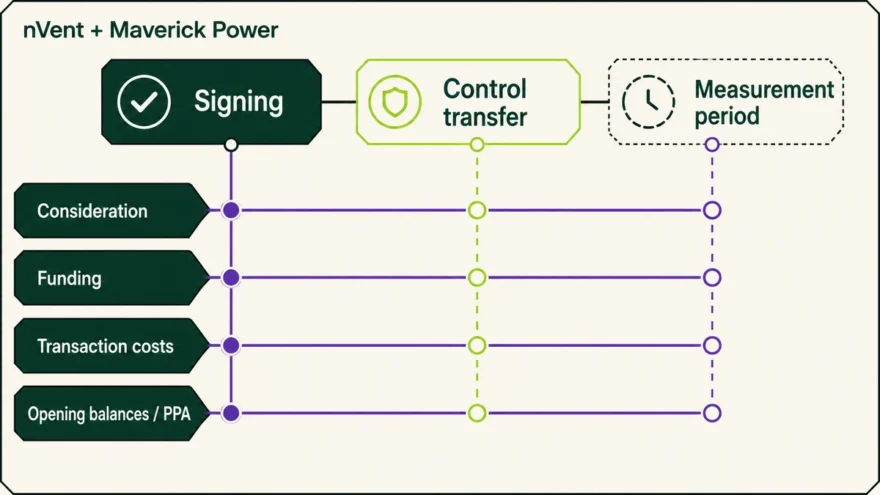
The executed merger agreement defines Closing Consideration as the $532.426 million Purchase Price, plus Closing Cash, plus the operating net-working-capital adjustment, plus the warehouse-working-capital adjustment, minus Closing Indebtedness and Third Party Expenses, plus specified option and warrant exercise prices, securityholder loan balances and EPA consideration.
The agreement is also more precise about the buckets. Closing Cash is cash and cash equivalents plus specified customer and uncleared receipts, less uncleared outgoing disbursements and restricted cash, plus unreimbursed buyer expenses; EPA consideration is excluded from Closing Cash. Closing Indebtedness is all defined indebtedness outstanding immediately before the effective time, but warehouse-facility obligations are excluded. Third Party Expenses cover unpaid pre-close deal-adviser fees, specified transfer-tax and representations-and-warranties-policy costs, certain transaction compensation and payroll costs, and allocated restructuring costs; Buyer Expenses and Closing Indebtedness are excluded.
Operating net working capital is measured against a $12,766,099 target and its adjustment is capped at plus or minus $10 million. Its definition excludes Closing Cash, Closing Indebtedness, Third Party Expenses, Buyer Expenses, operating-lease right-of-use amounts, specified tax items and restricted cash. Warehouse working capital has a separate $20,154,452 target.
The September 1 8-K names cash, indebtedness, transaction expenses and operating net working capital when describing the customary adjustments to the approximately $590 million figure. It does not disclose the actual dollar amount of any of those adjustments. It also does not state an actual warehouse-working-capital adjustment, so the public file cannot assume that component was zero.
Debt payoff and lien release belong in the Day-1 file
Figure’s closing filing provides unusually clear evidence on target financing. On the closing date, Figure repaid in full all outstanding obligations under Kiavi’s Third Amended and Restated Credit Agreement dated December 19, 2024. Kiavi Funding, Inc. and Kiavi Funding Trust 2 also terminated their September 19, 2025 Master Repurchase Agreement with Deutsche Bank AG, New York Branch. The filing says the related financing documents were terminated and the liens securing those obligations were released.
The dollar amount repaid under the Kiavi credit agreement is not disclosed. The merger agreement also excludes obligations under a warehouse facility from its defined “Indebtedness,” so the Deutsche Bank repurchase-facility termination should not be converted into a Closing Indebtedness amount without the closing schedules.
That target-debt cleanup is separate from Figure’s own acquisition financing. Figure’s second-quarter Form 10-Q says it issued $600 million principal amount of 8.5% senior notes on July 14, producing $586.5 million of net proceeds, and terminated its undrawn $600 million acquisition bridge facility at the same time.
The DSCR loan assets are identified, not measured
The closing 8-K is sufficient to establish that balance-sheet DSCR loans were acquired by Figure. It is not sufficient to establish their acquisition-date fair value, carrying amount after purchase accounting, credit mark or allowance treatment. None of those measurements appears in the closing filing.
That distinction also prevents a common scale error. Kiavi’s origination or marketplace volume is not the same as the balance-sheet DSCR loan assets acquired on September 1. The public sources checked do not provide a dollar value for that acquired DSCR portfolio.
The 90-day true-up is not the purchase-price allocation
The merger agreement required Kiavi to prepare a pre-closing statement with estimated Closing Consideration and an unaudited consolidated balance sheet for the contractual calculation. Figure, as buyer, then has no more than 90 calendar days after closing to deliver a Post-Closing Statement calculating all Closing Consideration components and reconciling them to the pre-closing estimate.
That process can finalize contractual cash, working-capital, indebtedness and expense amounts. It does not by itself establish Figure’s GAAP acquisition-date allocation. As of the September 1 closing filing, Figure had not publicly disclosed a purchase-price allocation, goodwill, identifiable intangible values, fair values for acquired loans and other assets or a public acquisition-date opening balance sheet.
What the controller can approve now
The Day-1 file can approve the legal close, the approximately $590 million net-of-cash closing disclosure, the acquired technology-and-DSCR perimeter, the target debt payoff, the repurchase-facility termination and the lien release as verified facts. It can also document the merger agreement’s consideration formula and adjustment definitions.
It should keep the actual cash acquired, closing indebtedness, transaction expenses, operating and warehouse working-capital adjustments, final contractual Closing Consideration and acquisition-date purchase accounting open until evidence exists. That separation is the accounting consequence of the September 1 close: the transaction is complete, but the public accounting file is not.