Fujitsu announced on July 28, 2026 that it would begin developing the Uvance for Finance AI Transformation Platform on August 1 for financial institutions, including regional banks in Japan. The July 28 announcement describes a dedicated environment built around Fujitsu Kozuchi Enterprise AI Factory, the Takane large language model, generative AI trust technology and finance-specialized AI agents. Fujitsu is targeting a March 2027 launch, so this is a development-stage platform rather than a generally available finance system.
For finance systems and data-governance leaders, the immediate issue is control design. Fujitsu says institutions will be able to control their own data and operational rules and to visualize and manage AI usage and risk. It also lists reporting as a future application. The announcement does not specify audit-log granularity, role and approval models, data-lineage treatment, retention rules, core-system connectors or whether an agent will be able to execute or approve accounting transactions. Those gaps turn the announcement into a requirements-setting event, not evidence that reporting controls are already solved.
What changed and what it means
The planned private AI layer could move AI from isolated assistance into governed finance workflows, shifting where access, approval and audit evidence must be enforced
- Decision affected
- Define data, approval, logging and reporting controls before finance AI agents enter governed workflows
- Evidence in brief
- Fujitsu says the platform will use a dedicated environment with institution-controlled data and operating rules, AI-risk visibility, Takane and finance-specific agents, targeting a March 2027 launch.
- What remains unresolved
- Fujitsu has not disclosed platform-level audit logs, role and approval design, data lineage, retention, core-system connectors or the exact scope of reporting functions.
- Next verification
- Verify launch documentation for identity, action authority, audit trails, reporting lineage, change controls and the exact production scope before March 2027.
Key takeaways
- Fujitsu announced the platform on July 28, said development would start August 1, and is targeting a March 2027 launch.
- The announced architecture combines a dedicated environment, institution-controlled data and operating rules, Takane, trust technology and finance-specific AI agents.
- Reporting is on the future roadmap, but Fujitsu has not disclosed the control detail finance teams would need for production reporting or agent-led workflow execution.
What changed from Fujitsu’s earlier AI stack
The July announcement is not Fujitsu’s first move into private enterprise AI. In a January dedicated-platform release, Fujitsu announced a phased rollout of an enterprise platform for closed or dedicated environments, with preliminary trials beginning in February and an official launch planned for July. The announced platform included model and agent lifecycle management, guardrails, a vulnerability scanner, MCP support and inter-agent communication for enterprise use across industries.
Fujitsu had also already signaled a finance-industry agent direction. Its February Uvance for Finance expansion reorganized the broader finance offering and said Fujitsu planned to develop agentic AI and other financial-industry services using Kozuchi and Takane.
The July change is therefore narrower and more operationally specific. Fujitsu has now named a dedicated finance-industry platform, tied it to a March 2027 launch target, and described finance-oriented agents for tasks including loan screening, inquiries and document creation. Takane is described as handling financial-industry business practices, legal frameworks and terminology. That moves the story from a general AI infrastructure roadmap toward a defined financial-services control and workflow architecture.
Data governance becomes part of the finance control design
Fujitsu says the dedicated environment will let financial institutions control their own data and operational rules. It also says the platform will visualize and manage AI usage and risks. Those are relevant design claims for institutions that cannot treat model access as a separate innovation sandbox once AI begins touching customer, credit, compliance or reporting data.
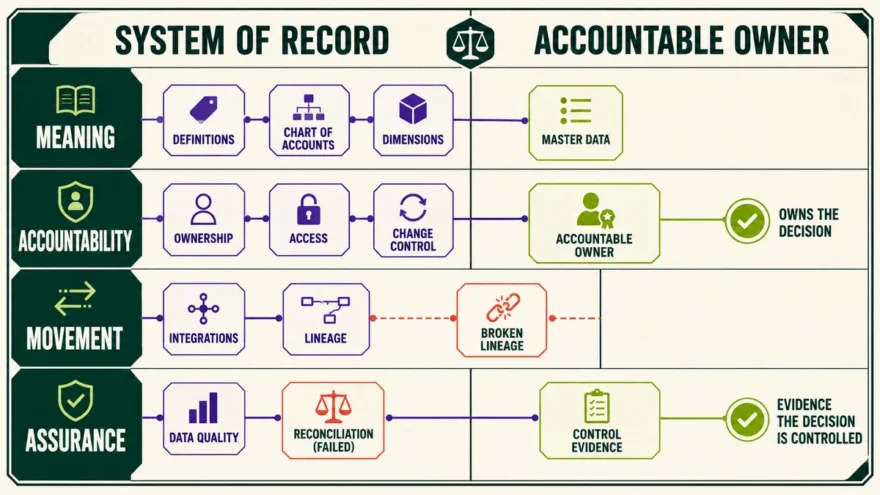
For finance teams, however, data sovereignty is only the outer boundary. A production control design still needs to define which source systems and datasets each agent can read, which records it can create or change, how entitlements inherit from human users, how restricted data is segmented, and how every input and output can be traced to the model, agent and rule set in force at the time.
This matters especially because Fujitsu says it wants multiple institutions to accumulate and reuse AI agents and business know-how through a co-creation ecosystem. The announcement does not explain the technical or contractual separation model for that ecosystem. Finance and data-governance teams should therefore require evidence on tenant isolation, data movement, agent portability and the boundary between reusable know-how and institution-specific information before treating ecosystem reuse as compatible with internal data policy.
Reporting is on the roadmap, not a current control capability
Fujitsu lists reporting among the areas it plans to address alongside branch operations, compliance and customer service. The wording is important. The source does not establish that the March 2027 release will include every reporting function, nor does it say that the platform will prepare statutory reports, generate accounting entries, reconcile balances or approve disclosures.
That means a controller or finance-systems owner should translate “reporting” into testable requirements before any deployment decision. At minimum, the institution needs to know whether an AI-generated figure or narrative can be traced to governed source data, whether the same result can be reproduced after a model or agent update, how close-period data is frozen, who approves exceptions, and how generated content is distinguished from system-of-record data.
Those controls are not stated platform features. They are Finance Circuit’s analysis of the evidence a finance organization would need before an AI agent could participate in a governed reporting process. The distinction matters because a private deployment boundary can reduce exposure without, by itself, proving completeness, accuracy, authorization or auditability.
Finance-specific agents create new approval and evidence points
Fujitsu says multiple specialized agents will collaborate on workflows such as loan screening, inquiry handling and document creation. When several agents can pass context or tasks to one another, the control question becomes more granular than whether a single model is approved.
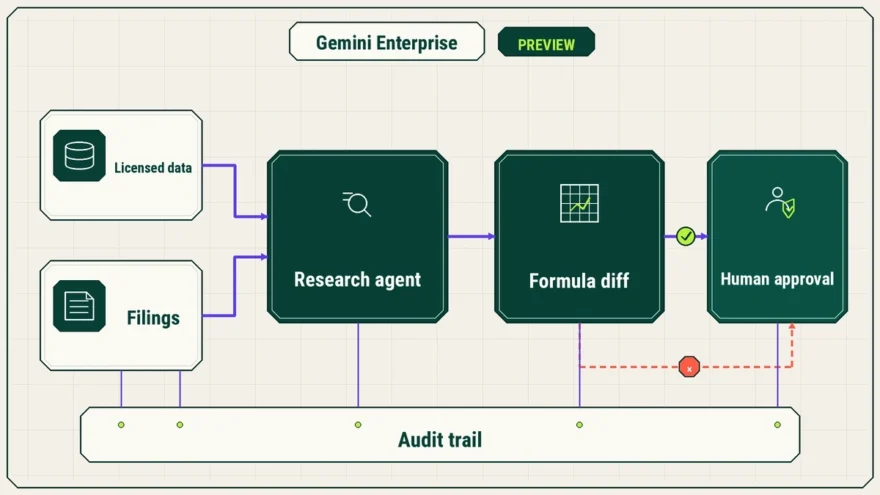
A financial institution should distinguish at least three levels of agent authority: recommendation, preparation and execution. A recommendation can remain advisory. Preparation may create documents, calculations or workflow items that still require human approval. Execution can change a record, send a communication, trigger a payment, alter a limit or complete another controlled action. The July announcement does not state which authority levels its finance agents will have. Google’s August preview supplies a current acceptance case: Gemini Financial Research agent acceptance tests separate cited research from spreadsheet-write authority and final human approval.
Fujitsu’s separate AI Ethics and Governance framework says its enterprise AI project governance includes controls on purpose and scope, data protection, incident procedures, human-in-the-loop processes, roles and responsibilities, and visibility into system capabilities, limitations and risks. That provides useful context on Fujitsu’s governance approach, but the finance-platform announcement does not say which of those practices will be enforced as product-level controls for customers.
What finance teams should put into the requirements now
| Control area | Evidence to request before production use | Finance consequence |
|---|---|---|
| Data boundary | Source-system permissions, data residency, tenant isolation, retention and deletion rules | Defines which financial and customer data an agent may see or retain |
| Action authority | Agent identity, role mapping, segregation of duties and human approval points | Prevents an advisory agent from becoming an unapproved transaction actor |
| Audit trail | Prompt, context, tool-call, output and action logs linked to model and agent versions | Supports investigation, replay and evidence for control testing |
| Reporting | Source lineage, reproducibility, period controls, exception workflow and approval records | Determines whether AI-assisted reporting can enter a governed close or disclosure process |
| Change management | Approval and testing for model, prompt, tool, policy and agent updates | Stops a control-approved workflow from changing silently after release |
| Shared ecosystem | Rules for agent reuse, data separation, intellectual-property boundaries and rollback | Sets the limit on what can move between institutions without weakening governance |
The most useful procurement question is therefore not whether the platform is private. It is whether the private boundary is paired with evidence that maps each agent action to an authorized identity, governed data, an approved model and rule version, a human decision where required, and a recoverable audit trail. The Moody’s AI provider concentration warning adds a separate approval test: whether the model and cloud layers can be substituted or exited without losing the governed workflow.
What to watch before the March 2027 target
Fujitsu’s next useful evidence will be product documentation or launch material that turns the current architecture into enforceable controls: named deployment options, identity and access design, logging and retention detail, system integrations, approval mechanisms, change-management controls and the actual scope of reporting support. Customer deployments would add a second layer of evidence by showing which functions operate in production rather than in planned architecture.
Until then, finance teams can use the announcement to set a control baseline and shape requests for information. They should not treat the planned platform, its finance agents or its reporting roadmap as proof of an operating control environment. The March 2027 target is the next major status point, but the more important milestone for finance governance will be the first documentation that shows exactly what an agent may access, decide, create and execute.