Many treasury teams start with a spreadsheet bottleneck and end by buying a forecast engine. The operating problem usually sits earlier: balances arrive on different clocks, enterprise resource planning (ERP) transactions carry accounting dates rather than expected cash dates, and manual overrides can remain in the model after the event that justified them has changed. A faster calculation is not yet a controlled forecast.
This guide treats cash flow automation as a chain rather than a product label. It follows bank and ERP feeds through cash positioning, accounts receivable (AR) and accounts payable (AP) inputs, categorisation, forecast refreshes, reconciliations, alerts, scenarios, reporting and exception ownership. It deliberately stops before payment execution, debt and investment workflows, foreign-exchange activity, facility strategy, cash pooling and full treasury management system selection. Broader function-wide scope belongs to treasury automation.
Quick answer
Poorly governed automation can refresh a cash forecast faster while spreading stale, misclassified or unreconciled data into liquidity decisions.
Decision: Approve and design cash flow automation only after assigning each data feed, rule, review, exception and forecast decision to a named finance owner.
Key takeaways
- Automate data movement, validation, mapping and calculation only after source ownership, cut-off rules and failure handling are explicit.
- Build the forecast from a controlled cash position, not from an unreconciled balance snapshot or a mixture of actual and expected flows.
- AR and AP records need expected cash dates, confidence states and review queues; invoice due dates alone are not a cash forecast.
- Systems can calculate scenarios, variances and alerts, but treasury or finance owners must select the case, approve overrides and decide the response.
- Choose an ERP module, treasury suite, specialist platform or data-led layer by the system-of-record design and acceptance evidence, not by the longest feature list.
What cash flow automation means in corporate treasury
Cash flow automation is the controlled use of integrations, schedules, rules, models and workflow to turn source transactions into a current cash position and a governed forward forecast. Its narrow job is to move and test data, assign cash-flow meaning, roll the forecast, compare it with actuals and route exceptions to accountable people.
The forecast method still matters. The Association for Financial Professionals explains that short-term forecasts commonly use receipts and disbursements, bank data, statistical methods or a combination, and that the useful method depends on the available data and the forecast horizon. A receipts-and-disbursements forecast is cash-based rather than accrual-based, while a bank-data approach begins from current bank information. AFP’s methodology note also warns that the result is only as reliable as its underlying sources.
| Topic | Primary object | Included here | Outside this article |
|---|---|---|---|
| Cash flow automation | Source data through cash position, forecast, variance and exception workflow | Feeds, mappings, AR/AP inputs, refreshes, reconciliations, alerts, scenarios and reporting | Execution of the resulting funding, payment or investment action |
| Treasury automation | The broader treasury operating model | Only the cash-data and forecasting segment | Payments, debt, investments, FX, hedging and treasury accounting |
| Liquidity management software | Usable liquidity and the actions available to manage it | Forecast data supplied to the liquidity decision | Facilities, restrictions, pooling, intercompany funding, borrowing and investment actions |
| Treasury management system | A platform category spanning several treasury processes | A forecasting module may host this chain | Full platform comparison, implementation scope and module selection across treasury |
Map the cash-data and forecasting chain before buying software
Automation should follow the operating chain. If the design begins with a vendor screen, the team can miss the handoffs where cash meaning changes. Define each stage, its input, its output and the evidence that proves completion.
| Stage | Controlled output | Typical automation | Evidence to retain |
|---|---|---|---|
| 1. Source receipt | Dated bank, ERP and supplementary data batches | API, host-to-host, file or scheduled extract | Source, timestamp, account or entity scope, row count and completion state |
| 2. Validation and normalisation | Accepted records in a common structure | Schema checks, control totals, duplicate tests and field standardisation | Accepted, rejected and quarantined counts with reason codes |
| 3. Cash positioning | Opening and current cash by account, entity and currency | Balance selection, transaction aggregation and status rules | Balance type, statement date, pending items and reconciliation state |
| 4. AR and AP enrichment | Expected receipt and payment dates | Terms, payment-run, collection-behaviour and recurring-flow rules | Source date, calculated date, confidence or exception state and owner |
| 5. Categorisation | Mapped cash-flow categories | Deterministic rules and model suggestions | Rule or model version, mapping result and unmapped queue |
| 6. Forecast refresh | A dated baseline forecast version | Full or incremental calculation on an approved schedule | Cut-off, source versions, job state and output version |
| 7. Reconciliation and variance | Explained differences between sources, forecasts and actuals | Matching, tolerance tests and variance classification | Matched population, open breaks, ageing, explanation and resolution |
| 8. Alerts | Prioritised conditions requiring attention | Threshold, missing-feed, stale-data and exception rules | Trigger, recipient, acknowledgement, action and closure |
| 9. Scenarios | Comparable forecast cases with explicit assumptions | Recalculation of approved assumption sets | Scenario owner, changes from baseline and version lineage |
| 10. Reporting | Position, forecast, variance and exception views | Assembly, refresh, drill-down and distribution | Report timestamp, data version, access and sign-off state |
Bank and ERP feeds: automate transfer, not source accountability
Bank data needs a defined balance and freshness state
A bank feed can contain prior-day statements, intraday transactions, current balances or a mixture. Those states are not interchangeable. The receiving process should record the account, balance type, statement or transaction timestamp, currency, source channel and whether the batch is complete. Oracle cash-positioning documentation, for example, combines bank statements with AP, AR, payroll and external cash transactions, while Oracle’s prior-day balance note says its cash position requires an official prior-day closing balance.
Connectivity choice affects timing, acknowledgements, resilience and maintenance. A team deciding among APIs, SWIFT and host-to-host should settle that architecture separately through a documented bank connectivity architecture. The forecast process should consume the approved data state rather than infer that every received balance is final.
ERP data needs object-level authority
ERP feeds can supply open AR, open AP, sales orders, purchase orders, payroll, budget entries, recurring transactions and other expected flows. Microsoft Dynamics 365 forecast documentation describes integrations with general ledger, AP, AR, budgeting, inventory and external data. Oracle source-extraction documentation covers AP, AR, payroll, external cash transactions and bank statements. These sources carry different meanings and should not be merged without rules for status, date, amount, currency, entity and document identity.
Use a finance systems integration map to state which application owns each field, how the interface proves completeness, and how retries avoid duplicate forecast events. A successful transport job proves delivery, not business acceptance. The forecast should not refresh from a batch that is technically complete but missing an entity, an account or a required transaction class.
Design failure states before the normal run
For every feed, specify what happens when it is late, partial, duplicated, out of sequence or structurally valid but commercially implausible. Safe responses include holding the prior accepted data set, quarantining only the failed population, marking the output stale, notifying a named owner and blocking downstream publication. Silently substituting zeros or carrying forward a balance without a visible stale-data state can make a dashboard look current when it is not.
Cash positioning: establish the actual state first
The forecast needs an opening cash state that can be traced to approved bank data. At minimum, distinguish reported balance, available balance, ledger balance, intraday movement, pending transaction and reconciled closing balance. The chosen state should be consistent by account and visible in the report definition.
Position calculation can be rules-based when the data contract is stable: select the approved balance code, convert currency using the defined rate source, aggregate by legal entity and account, and include or exclude pending items under documented rules. Review is still needed for missing statements, dormant or newly opened accounts, trapped or restricted cash flags, unexplained differences and stale timestamps.
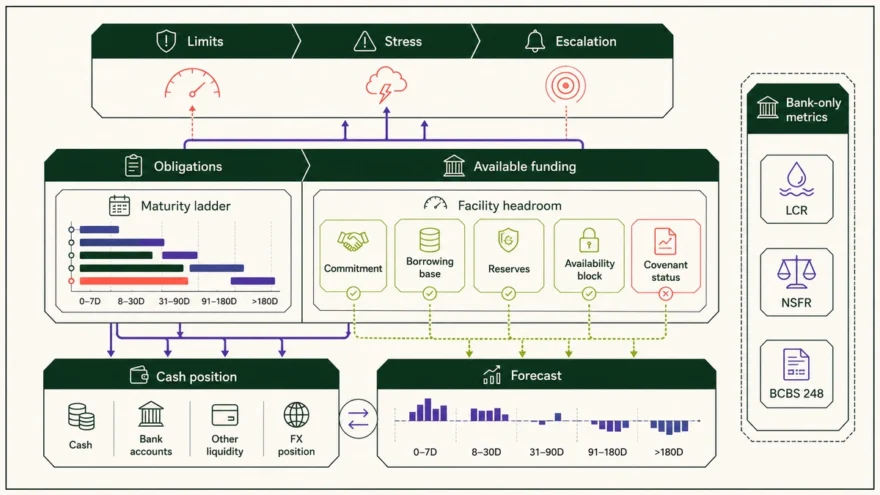
Do not let the cash-positioning stage become a full available-liquidity model. Whether cash is unrestricted, whether a facility is drawable, or whether balances can be pooled belongs to liquidity management. This chain should deliver a reliable cash position and forecast input to that later decision. Where that decision is governed by limits rather than availability alone, the limit and stress layer above it sets out how maturity concentration, facility headroom and breach escalation are specified. The pooling question in particular carries its own intercompany, tax and accounting consequences: which pooling structure the group can actually run is settled separately from the data chain that feeds it.
AR and AP inputs: forecast cash dates, not only due dates
AR needs expected receipt logic
An open invoice has an accounting due date, but the expected cash date may reflect customer behaviour, collection status, disputes, promised-to-pay dates, payment method and settlement lag. Rules can apply terms, historical delay by customer or segment, known promises and cut-off calendars. Models can suggest a date or probability when enough representative history exists. Neither should erase the source due date or the reason for an adjustment.
Route material disputes, large single-customer exposures, new customers, broken promises and low-confidence predictions to AR or treasury review. The reviewer should be able to accept, amend or reject the suggestion with a reason and expiry date. A permanent manual override is a new source of forecast error.
AP needs obligation and payment-run states
AP forecasting should distinguish purchase orders, received but uninvoiced items, approved invoices, overdue invoices, scheduled payment runs, payroll, tax and other recurring disbursements. It should also prevent double counting when an expected payment appears first in the ERP and later as a bank transaction.
Automate date calculation when payment terms, approval status, calendar and payment-run policy are deterministic. Keep review for blocked invoices, disputed amounts, planned payment deferrals, one-off tax or payroll changes and treasury decisions to change execution timing. The forecast records the expected cash effect; it does not authorise the payment.
Categorisation: rules first, models second
Cash-flow categories support forecasting, variance analysis and reporting. Start with deterministic mappings where a stable identifier exists, such as bank transaction code, counterparty account, ERP document type, general-ledger account, payment method, entity or source system. Each rule needs an owner, effective date, priority and version.
Machine learning can help where descriptions are inconsistent or historical patterns add useful evidence. Treat the result as a suggestion when confidence is low, the amount is material, the counterparty is new or the category affects a management decision. HighRadius forecasting documentation describes automated transaction classification, while Nomentia forecast documentation describes transaction-level ownership, timing and classification. Those capability statements do not remove the buyer’s need to test local data and define an exception threshold.
Keep an unmapped queue and a controlled way to convert recurring exceptions into new rules. Changes should be prospective unless an owner explicitly approves reclassification of earlier forecast versions. Otherwise, a rule edit can rewrite history and make variance trends impossible to interpret.
Forecast refreshes: schedule calculation and preserve versions
A refresh schedule should name the source cut-off, legal entities, horizon, time buckets, full versus incremental method, prerequisite jobs and publication time. Microsoft’s calculation and scheduling guidance documents full and incremental cash-flow calculations, scheduled process automation by company, and a separate reporting refresh after calculation. That sequence shows why “the job ran” is not a sufficient control statement.
The baseline should be stored as a dated version before manual adjustments or scenarios are applied. Preserve the source versions, model or rule version, run time and job result. Nomentia documents rolling daily, weekly and monthly forecasts, adjustments that do not overwrite source data, and frozen forecast versions for governance and audit.
For a near-term operating model, connect the automation to a controlled 13-week forecast process. The system can roll the horizon and recalculate. Treasury still owns the weekly cut-off, assumption acceptance, scenario status and sign-off.
Reconciliations and variance: prove what changed
Cash flow automation needs three separate comparisons. Technical reconciliation proves that source records were transferred and accepted. Cash reconciliation connects bank activity to the position and relevant expected flow. Forecast-to-actual variance explains why expected timing or value differed from observed cash.
| Variance class | Question | Typical owner | Automation role |
|---|---|---|---|
| Timing | Did the cash occur earlier or later than expected? | AR, AP, payroll, tax or treasury | Calculate days and move the unmatched item through ageing buckets |
| Value | Did the amount differ from the forecast? | Source process owner | Apply tolerances and quantify the difference |
| Classification | Was the cash assigned to the wrong category? | Forecast taxonomy owner | Suggest a remap and identify repeated exceptions |
| Missing | Was a forecast item or actual transaction absent? | Interface or business owner | Detect gaps using identifiers, control totals and expected populations |
| Duplicate | Was the same event counted more than once? | Interface owner | Block or quarantine based on idempotency and duplicate rules |
| Scope or assumption | Did an entity, account, calendar or business assumption change? | Treasury forecast owner | Show version differences; do not choose the new baseline |
The software approaches documented below commonly include variance or forecast-to-actual analysis. A buyer should test whether the product merely displays a difference or preserves the original forecast, actual transaction, explanation, owner, action and closure state.
Alerts, scenarios and reporting: automate the signal, retain authority
Alerts should describe a condition and an owner
Useful alerts cover stale or failed feeds, missing accounts, unmapped material items, reconciliation breaks, forecast thresholds and unacknowledged exceptions. Define the threshold, measurement window, severity, recipient, escalation and closure evidence. Avoid alerting on every movement; a large volume of low-value notifications trains users to ignore the channel.
Scenarios are calculations, not decisions
Software can copy the approved baseline, apply an assumption set and calculate the effect by date, entity, currency or category. The documented approaches below include scenario comparison, rolling forecast cases and version snapshots. Treasury or finance owners must still decide which assumptions are credible, which scenario is the official case and which management action is authorised.
Reporting can be assembled automatically
Position, forecast, variance and exception reports can refresh from the governed data set and provide drill-down to source transactions. Automation can distribute the pack and record receipt. The named owner remains responsible for explaining material changes, confirming the version, deciding whether the forecast is fit for use and approving any message sent to management, lenders or the board.
Rules-based, review-required and owner-retained work
| Task | Rules-based automation | Review required | Treasury or finance owner retains |
|---|---|---|---|
| Feed ingestion | Schedule, authenticate, receive, count and validate | Late, partial, duplicated or changed source | Source approval, cut-off and fallback policy |
| Cash position | Select balance code, aggregate and convert | Missing close, stale balance, new account or restriction flag | Approved position definition and use in decisions |
| AR expected date | Terms, calendar and accepted behaviour rules | Dispute, promise change, material exposure or low confidence | Override policy and material judgement |
| AP expected date | Terms, approval and payment-run logic | Blocked, deferred or unusual obligation | Payment-timing decision and authorisation boundary |
| Categorisation | Known mappings and high-confidence suggestions | Unmapped, conflicting or material new pattern | Taxonomy, rule approval and retrospective change |
| Forecast refresh | Full or incremental calculation and version creation | Failed prerequisite, stale source or material output anomaly | Baseline status, cut-off and publication approval |
| Reconciliation | Match, tolerate, age and quantify | Open break or ambiguous match | Resolution, write-off or source correction decision |
| Alerting | Detect, route, escalate and log | False positive, repeated exception or missing response | Thresholds, priority and required action |
| Scenario calculation | Apply approved assumptions and compare outputs | Model or assumption anomaly | Scenario selection and management response |
| Reporting | Refresh, assemble, distribute and preserve drill-down | Material movement or unexplained variance | Interpretation, sign-off and external communication |
Software approaches documented as of 19 August 2026
The products below illustrate different architectural approaches. The entries report functions described in official documentation or product pages checked on 19 August 2026. They are not a ranking, do not establish implementation quality, and do not prove performance in a specific treasury environment.
| Approach and example | Documented scope relevant to this chain | Best fit to test | Control question for the demonstration |
|---|---|---|---|
| ERP-native: Microsoft Dynamics 365 Finance | GL, AP, AR, budget, inventory and external inputs; full or incremental calculation; scheduled refresh | Finance teams with core forecast objects in Dynamics 365 | Show a partial refresh, a rejected input and the baseline version sent to reporting. |
| ERP-native: SAP S/4HANA Cloud for cash management | Bank connectivity, cash position, short-term forecasts, flow analysis, and review of actual, forecast and planned flows | SAP estates keeping cash forecasting near operational data | Show each flow state, change authority and source-document drill-down. |
| ERP plus planning: Oracle Fusion Cloud Financials and Predictive Cash Forecasting | Bank, AP, AR, payroll and external transactions; rolling forecasts across short and medium horizons | Oracle estates needing a connected planning layer | Show the closing-balance dependency, failed extracts and transaction lineage. |
| Broad treasury suite: Kyriba | Data integration, scenarios and automated variance tracking in a treasury platform | Teams combining forecasting with other treasury processes | Show version lineage, variance ownership and scenario approval. |
| Broad treasury suite: Ripple Treasury powered by GTreasury | Bank and ERP capture, categorisation, AP/AR inputs, configurable models, reports and variance analysis | Teams wanting forecasting inside a treasury platform | Show rule approval, low-confidence review and non-destructive overrides. |
| Bank-data-led layer: Trovata | Normalised bank data for visibility, forecasting and reporting | Teams first solving multibank data standardisation | Show account coverage, freshness, duplicates and the ERP handoff. |
| Specialist forecasting and liquidity layer: Nomentia | ERP AR/AP ingestion, ownership, rolling forecasts, separate adjustments, frozen versions, scenarios and variance analysis | Teams needing a dedicated cross-source forecast workflow | Show input validation, frozen versions and separate adjustments. |
| AR/AP and treasury data platform: HighRadius | ERP/bank connectivity, classification, scenarios and variance analysis | Finance teams connecting forecasts with receivables and payables data | Show classification tests, exception thresholds, reconciliation and adjustment evidence. |
Official product pages describe capability, not the buyer’s configured result. Treat claims about accuracy, time saved, idle cash or other outcomes as supplier statements until the vendor provides the method, population, period and customer evidence required for verification.
Choose the architecture by the system of record
| Architecture | Use when | Evidence to demand | Avoid when |
|---|---|---|---|
| ERP-native forecasting | Most cash drivers have reliable ownership in one ERP estate | Bank coverage, cross-entity controls, versions and scenarios | Bank data is fragmented or several ERPs lack a governed consolidation layer |
| Treasury-suite module | Treasury wants positioning and forecasting in one platform | ERP mapping, AR/AP detail, lineage, exceptions and reporting controls | Broad scope hides weak data or duplicates ERP ownership |
| Specialist forecast platform | A dedicated model must combine banks, ERPs and contributors | Connector coverage, model governance, separate overrides and reconciliation | The layer would copy governed data and rules without an owner |
| Bank-data-led platform plus ERP feeds | Multibank visibility and normalisation are the first constraint | Coverage, balance semantics, freshness, ERP inputs and reconciliation | Key operational drivers cannot be received or governed |
| Integration or workflow layer around existing models | Forecast logic is accepted but workflow remains manual | Idempotency, audit trail, access, change control and recovery | The model lacks controlled formulas, versions or assumptions |
No architecture fixes ambiguous source ownership. A specialist tool may improve workflow but create another data copy. An ERP module may reduce interfaces but leave bank coverage weak. A broad TMS may host the process but does not make every module the system of record. Record the authority for balances, transactions, categories, expected dates, assumptions, scenario status and report sign-off before selecting the platform.
Implement cash flow automation with acceptance evidence
- Freeze the first scope. Select the legal entities, bank accounts, currencies, source objects, forecast horizon and reporting outputs for the initial release.
- Profile the source data. Measure completeness, duplicates, stale records, missing identifiers, date quality, category coverage and historical depth. Do not train or tune a model on an unrecorded population.
- Approve the authority map. Name the owner of every source field, mapping rule, override, assumption, scenario and report.
- Build the deterministic path first. Prove feed receipt, control totals, cash-position logic, expected-date rules, categorisation, calculation and version creation before adding predictive features.
- Test failures and recovery. Use late feeds, partial files, duplicates, changed schemas, missing balances, currency-rate failures, low-confidence categories and rejected overrides.
- Run in parallel. Compare the automated result with the existing process for enough cycles to observe normal operations, cut-off pressure and at least several material exceptions.
- Measure forecast quality by cause. Separate timing, value, classification, missing, duplicate and assumption variances rather than reporting one aggregate accuracy figure.
- Approve the operating handoff. Record support ownership, job monitoring, access reviews, change control, escalation, evidence retention and the criteria for stopping or reverting the process.
Predictive functions need an explicit data gate. Microsoft’s predictive forecasting prerequisite, for example, states a minimum of 100 transactions spanning more than one year for model training and recommends at least two years with more than 1,000 transactions. That is a product prerequisite, not a universal sufficiency test. Buyers should also assess representativeness, structural changes, seasonality, outliers and the cost of a wrong forecast.
Cash flow automation approval checklist
- Every bank, ERP, AR, AP and external source has a named owner, cut-off, completeness test and fallback state.
- The opening cash position uses defined balance types and exposes stale, pending, missing and unreconciled states.
- Expected cash dates preserve source dates, adjustment reasons, confidence and expiry.
- Category rules, models and overrides are versioned, reviewable and separated from historical forecast versions.
- Refresh jobs preserve source lineage, prerequisites, run state and a dated baseline before scenarios or manual changes.
- Technical, cash and forecast-to-actual reconciliations have distinct owners, tolerances, ageing and closure evidence.
- Alerts and scenarios route decisions to named treasury or finance owners rather than executing unapproved actions.
- The selected architecture has passed production-like failure, recovery, access, change and reporting tests with real company data.