Cerebras Systems reported in its 12 August 2026 results that GAAP cloud and other services revenue reached $125.991 million for the second quarter, up 281% from $33.027 million a year earlier. The same reconciliation put total core gross margin at 40.6%. That margin was 5.9 percentage points below the first quarter but 9.4 points above Q2 2025.
For finance systems leaders, the important caveat is scope. The $126 million line is not a published usage-revenue number, and 40.6% is neither GAAP gross margin nor the cloud-only margin. Cerebras’s June-quarter Form 10-Q combines Dedicated Capacity, On-Demand consumption, support and management services, AI modelling services and certain pass-through data-center amounts in cloud and other services. Finance needs separate commercial, cost and accounting states before those figures enter management reporting.
What changed and what it means
Collapsing those states can misstate revenue bridges, gross-margin attribution, contract conversion and the economics of rented versus owned compute capacity.
- Decision affected
- Define and test the source states and reconciliations that keep Cerebras’s cloud models, hardware, capacity costs, accounting adjustments and OpenAI contract measures separate.
- Evidence in brief
- Cerebras reported $126.0 million of GAAP cloud and other services revenue, 40.6% total core gross margin and $25.4 billion of RPO, while its filing identifies multiple commercial models and accounting adjustments inside those measures.
- What remains unresolved
- Cerebras does not separately disclose On-Demand revenue, Dedicated Capacity revenue or the dollar amount of rented-compute expense in its financial statements.
- Next verification
- Reconcile the metric dictionary, commercial model, capacity source, pass-through treatment, warrant adjustment and contract state before Q3 reporting and forecast updates.
Key takeaways
- Cerebras’s $125.991 million of Q2 GAAP cloud and other services revenue rose 281% year over year, but the line is not disclosed as usage revenue.
- Total core gross margin fell 5.9 percentage points sequentially to 40.6%, while improving 9.4 points from Q2 2025.
- The Q2 cloud reconciliation removes $14.503 million of pass-through revenue and adds back $16.240 million of customer-warrant amortization to reach core revenue.
- Cerebras recognized $56.8 million under the OpenAI arrangement in Q2, while $25.4 billion of companywide RPO included a significant amount attributable to OpenAI.
The $126 million cloud line is not usage revenue
Cerebras describes two primary cloud models. Dedicated Capacity contracts are generally take-or-pay commitments under which a customer pays for reserved compute irrespective of utilization, with revenue recognized over the service term. On-Demand includes pay-as-you-go inference tokens, token bundles drawn down as consumed and training workloads that run for contracted periods.
The reported line also includes support and management services, AI modelling services and pass-through data-center amounts under certain customer arrangements. Almost all Q2 cloud and other services revenue was recognized over time: $125.632 million, compared with $0.359 million recognized at a point in time. That recognition split still does not disclose how much came from On-Demand consumption, Dedicated Capacity or the other service types.
| Q2 reported state | Amount | Why finance must keep it separate |
|---|---|---|
| GAAP cloud and other services revenue | $125.991m | Starting reported line across several commercial and service models |
| Pass-through revenue | $14.503m | Included in GAAP revenue but excluded from core revenue |
| Customer-warrant amortization | $16.240m | Recorded as contra-revenue under GAAP and added back for core revenue |
| Core cloud and other services revenue | $127.728m | Non-GAAP result after the two adjustments, not a usage-revenue subtotal |
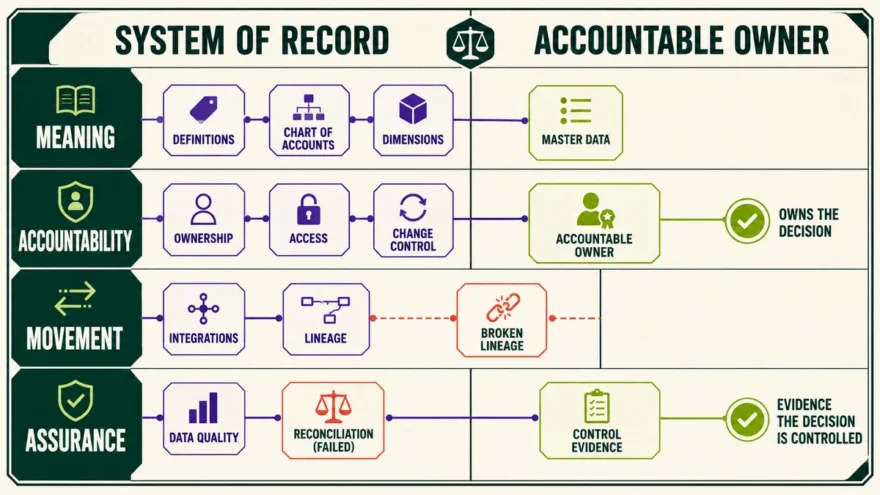
A usable source model therefore needs more than customer and amount. Contract ID, commercial model, deployment, service period, usage basis, billing basis, pass-through flag, customer-warrant adjustment and reporting-measure ID should remain separate. Aggregating those fields too early can make the same quarter look like usage growth, capacity growth or accounting adjustment, depending on which report is opened.
The 40.6% margin fell sequentially, not year over year
The 40.6% figure is total core gross margin. It is not the 41.8% core cloud and other services margin, the 38.8% core hardware margin or the 14.2% total GAAP margin. Cerebras’s first-quarter reconciliation provides the sequential base.
| Measure | Q2 2025 | Q1 2026 | Q2 2026 | Correct reading |
|---|---|---|---|---|
| Total core gross margin | 31.2% | 46.5% | 40.6% | Down 5.9 points sequentially; up 9.4 points year over year |
| Core cloud and other services margin | 26.0% | 52.9% | 41.8% | Down 11.1 points sequentially; up 15.8 points year over year |
| GAAP cloud and other services margin | 25.6% | 48.9% | 19.5% | A separate GAAP measure affected by warrant amortization and stock compensation |
A board pack that says only “gross margin fell” is incomplete. The measure needs a scope, accounting basis, period and comparison base. Cerebras also raised its full-year core gross-margin outlook to 41% to 43% from 38% to 41%. The sequential Q2 decline therefore did not represent a lowered annual margin forecast.
Build the revenue model around commercial states
The finance data path should preserve five types of state. The contract record identifies On-Demand, Dedicated Capacity or another service and holds the enforceable term and pricing basis. The operational record captures tokens consumed, bundle drawdown, capacity availability or the contracted workload period. Billing records invoices, prepayments and pass-through charges. The revenue subledger holds performance obligations, recognition pattern, deferred revenue and contra-revenue. The reporting layer then maps those states into GAAP and core measures.
Those layers should share stable contract, obligation, deployment and customer identifiers. A report should not infer commercial model from invoice description, infer service delivery from cash receipt or infer core adjustment from a general-ledger account name. Each transition needs an effective date and the evidence used to approve it. This is a Finance Circuit control model, not a description of Cerebras’s internal architecture.
Keep rented compute and pass-through costs separate
Reuters reported from the earnings call that CFO Bob Komin attributed about five percentage points of Q2 adjusted-gross-margin pressure to higher costs for renting capacity that had previously been deployed at customers. The filing does not present a separate rental-expense line. It says cloud cost of revenue can include data-center costs, depreciation or equipment rental, personnel, facilities and start-up costs used to accelerate capacity.
The cost model should retain asset source, capacity or system ID, location, customer deployment, service period and cost classification. It should also distinguish a cost that Cerebras bears from a pass-through amount billed to a customer. The Q2 core reconciliation removed $14.503 million of pass-through revenue and $14.075 million of related cost. Without that two-sided mapping, a capacity KPI can rise while the associated rental or pass-through cost remains in an undifferentiated data-center pool.
The OpenAI agreement creates several finance states
The OpenAI master relationship agreement dates from December 2025, so it is prior state rather than a new Q2 contract. The filing says the arrangement combines a services agreement, an approximately $1.0 billion working-capital loan and a customer warrant. Cerebras recognized $56.8 million of Q2 revenue under the arrangement, net of $2.5 million of warrant-asset amortization.
| OpenAI-related state | Disclosed position | Control boundary |
|---|---|---|
| Recognized arrangement revenue | $56.8m in Q2, net of $2.5m warrant amortization | Performance satisfied in the quarter, not total contract value |
| Remaining performance obligations | $25.4bn companywide; a significant amount attributable to OpenAI | Unsatisfied or partly unsatisfied obligations, not Q2 revenue |
| Working-capital financing component | Approximately $19.7m of Q2 interest expense with a corresponding deferred-revenue increase | Financing and revenue timing remain separate |
| Pass-through data-center amounts | Included in RPO only where the related data-center right-of-use assets and lease liabilities were recognized | Other variable amounts remain outside RPO while the consideration depends on factors outside Cerebras’s control |
The contract master cannot carry those items as one “OpenAI value.” It needs obligation-level links to service delivery, billing, deferred revenue, financing, the warrant schedule and pass-through data-center arrangements. The $56.8 million recognized in Q2 and the $25.4 billion RPO balance answer different questions and use different populations.
What finance systems should reconcile before Q3
- Freeze the metric dictionary. Define total versus cloud, GAAP versus core, current quarter versus year-to-date and sequential versus year-over-year comparisons.
- Bridge GAAP cloud revenue to core cloud revenue. Reproduce the pass-through and customer-warrant adjustments from source records, not from a presentation subtotal.
- Test commercial-model completeness. Confirm that On-Demand, Dedicated Capacity, support, modelling and custom pass-through arrangements map once to the reported population.
- Map capacity costs to deployments. Separate owned depreciation, equipment rental, pass-through data-center cost and start-up cost by system, location and service period.
- Reconcile the OpenAI states. Tie recognized revenue, deferred revenue, RPO, financing interest, warrant amortization and pass-through schedules without treating one balance as a proxy for another.
- Reperform the comparison. Make the Q1 and prior-year bases explicit so the same Q2 result cannot be described as both a fall and an improvement without the missing period label.
What Cerebras has not disclosed
Cerebras has not published the Q2 revenue split between On-Demand and Dedicated Capacity, the dollar amount of rented-capacity expense in the financial statements, margin by commercial model, a customer-level OpenAI RPO balance or its internal finance-system design. Those absences do not establish a control failure. They define the boundary between filed evidence and the control framework in this analysis.
The next verification point is Q3 reporting. Cerebras guided to a total core gross margin of 38% to 40% for that quarter. Finance teams should compare the actual total and cloud margins, the capacity-cost explanation and any change in OpenAI revenue, deferred revenue or RPO using the same measure definitions rather than a single “cloud growth” label.