Reuters reported on August 25, 2026, after reviewing Dolce & Gabbana’s latest financial statements, that the group’s lending pool waived remedies related to covenant breaches and suspended covenant testing until March 31, 2028. The filing showed revenue of €1.86 billion for the fiscal year ending March 31, down 2%, an operating loss just above €100 million and net financial debt of €464.5 million, up from €379.6 million a year earlier.
The agreement moves the group beyond the April position, when Dolce & Gabbana said bank negotiations were still ongoing, and beyond July reporting that bank approval had been obtained while technical signing remained pending. For treasury, the relief is time rather than cash. The group committed to extraordinary financing transactions and a net-debt-to-EBITDA ratio below 3 by March 2028, but the opened records do not disclose the transaction amount, instruments, timetable, covenant EBITDA definition or current facility headroom.
What changed and what it means
The waiver pauses remedies and testing but does not create cash or reduce debt; treating planned financing or possible asset proceeds as base liquidity could overstate headroom.
- Decision affected
- Classify each liquidity source as reported raised, committed, conditional or speculative, then set the covenant forecast and control calendar through March 31, 2028.
- Evidence in brief
- Reuters’ review of the latest financial statements establishes €464.5 million of net financial debt, waived remedies and testing suspended until March 31, 2028.
- What remains unresolved
- The transaction amount, instruments, timetable, covenant EBITDA definition, facility headroom and any contracted asset proceeds are not disclosed in the opened records.
- Next verification
- Reconcile reported cash, committed facilities and conditional proceeds to a dated liquidity bridge, then test the lender-defined ratio under base and downside cases.
Key takeaways
- The lending pool waived remedies related to covenant breaches and suspended covenant testing until March 31, 2028.
- Net financial debt rose to €464.5 million from €379.6 million, but the waiver does not itself reduce debt or create cash.
- The €150 million raised through the eyewear-licence extension is a different evidence state from still-unspecified financing transactions or possible asset disposals.
- Treasury should separate reported cash, committed facilities, conditional transactions and speculative proceeds before testing the March 2028 leverage target.
What the disclosed waiver terms change
The public status developed in stages. On April 10, Dolce & Gabbana said negotiations with banks were continuing as lenders sought up to €150 million of fresh cash within a broader €450 million refinancing discussion. On July 6, La Conceria reported that the banks had approved the existing facilities and granted a waiver on certain unmet covenants, while saying the financing agreement had not yet been signed for technical reasons. The August 25 Reuters report supplies the clearest disclosed current terms from the latest financial statements.
| Date | Reported status | Treasury treatment |
|---|---|---|
| April 10 | Bank negotiations ongoing; possible cash injection and asset disposals under discussion | No final waiver terms or transaction proceeds in base liquidity |
| July 6 | Bank approval and covenant relief reported; technical signing still pending | Recognise progress, but retain execution and documentation conditions |
| August 25 | Waived remedies and testing suspended to March 31, 2028; financing and leverage commitments disclosed | Update the control calendar, but do not record the waiver as cash or debt reduction |
The agreement is not a waiver of €464.5 million of principal. Reuters describes relief from remedies associated with covenant breaches and a pause in testing. Treasury should therefore record the disclosed relief separately from the continuing funding model: the breach remedies and testing calendar changed, while debt, interest, maturities, cash needs and the March 2028 leverage objective still require their own evidence.
Separate received cash from conditional liquidity
Reuters says Dolce & Gabbana raised €150 million by extending its eyewear licence with EssilorLuxottica through 2050. That amount should not be presented again as a future financing source. Internally, treasury would still reconcile the bank receipt, transaction costs, restrictions and use of proceeds before classifying the amount as unrestricted available cash.
The phrase “extraordinary financing transactions” does not identify an instrument, counterparty, amount, commitment date or settlement date. Earlier reporting said the group was exploring fresh-money options, including real-estate disposals. Exploration is not a signed sale, and a possible gross disposal value is not net cash available to repay debt.
| State | Evidence required | Forecast treatment |
|---|---|---|
| Reported raised | Source states that funds were raised; internal bank receipt and restrictions still need reconciliation | Use actual available cash only after treasury confirms settlement and permitted use |
| Committed | Binding facility or transaction terms, amount, conditions, draw or closing date and approvals | Include only the amount drawable or expected to settle within the forecast period |
| Conditional | Defined transaction with unresolved conditions, documentation or execution milestones | Place in a dated scenario with dependencies and a probability basis |
| Speculative | Option under consideration without signed terms or a verified process | Exclude from base liquidity; use only for sensitivity or contingency planning |
That separation should flow into the controlled 13-week cash flow forecast. Base liquidity should use reconciled cash and funding that is currently drawable. A transaction with no disclosed amount or timetable belongs in a scenario until its conditions, settlement route and use of proceeds are evidenced.
Build the net-debt-to-EBITDA bridge
The disclosed objective is a net-debt-to-EBITDA ratio below 3 by March 2028. The €464.5 million net financial debt figure is an opening reference, not enough to calculate the required reduction. The opened sources do not provide current covenant EBITDA, permitted adjustments, testing dates inside the agreement, cash-netting rules or the treatment of transaction proceeds.
Treasury should keep the numerator and denominator bridges separate. The net-debt forecast starts with reported net financial debt, adds new borrowing and cash burn, and subtracts debt repayments or cash retained under the lender definition. The EBITDA forecast should use the agreement’s definition and approved adjustments rather than a management or statutory measure selected for convenience. Only then can the ratio be compared with the sub-3 target.
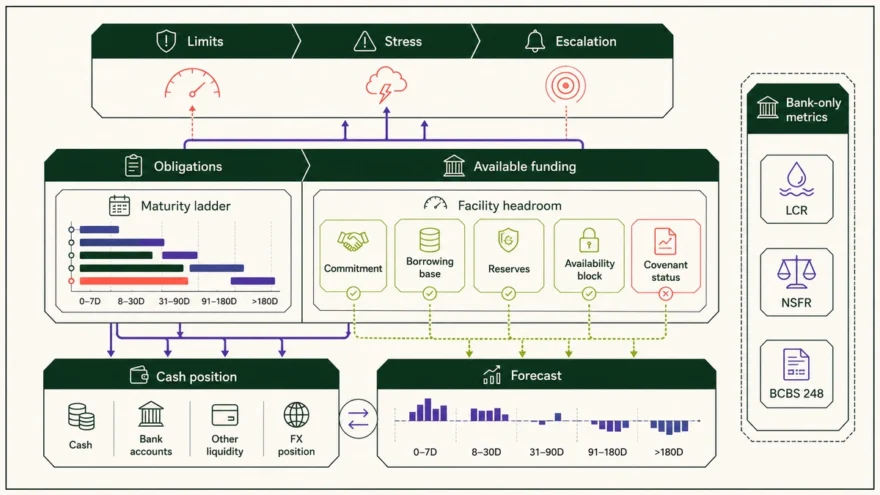
Each forecast version should show the source date, currency, legal entity, evidence state and owner for every movement. A corporate liquidity data model can support that control only when it keeps reported cash, accessible funding, covenant measures and approved actions distinct instead of displaying one consolidated liquidity total.
Control the period while covenant testing is suspended
A testing holiday can reduce immediate breach pressure while also lengthening the period in which forecast error accumulates. Treasury should not wait for testing to resume before rebuilding the ratio. The internal control calendar should include:
- weekly or monthly liquidity forecasts with a base case, downside case and separately approved management actions;
- a debt calendar showing scheduled maturities, interest, amortisation, draw conditions and any refinancing lead time;
- a financing milestone log for mandate, documentation, conditions, pricing, closing, bank receipt and use of proceeds;
- a lender-definition ratio forecast with reconciled numerator and denominator inputs;
- escalation triggers for transaction delay, weaker EBITDA, reduced facility headroom or cash falling below the internal buffer; and
- a dated evidence pack supporting every amount placed in available liquidity.
The source wording also creates two dates that should remain distinct. Covenant testing is suspended until March 31, 2028, while the leverage ratio is to be brought below 3 by March 2028. Treasury should obtain the agreement’s exact measurement date, certificate timing and cure mechanics rather than assuming those phrases create one identical deadline.
What remains undisclosed before March 2028
The opened records do not establish the amount, form, counterparties, pricing, conditions or completion timetable of the extraordinary financing transactions. They also do not disclose facility maturities, undrawn availability, minimum-liquidity requirements, reporting frequency, covenant EBITDA adjustments or the expected path from €464.5 million of net financial debt to the target ratio.
Any real-estate disposal remains an explored option in the available reporting, not verified contracted proceeds. The public record also does not show the bank settlement evidence or restrictions attached to the €150 million reported as raised through the licence extension. Those gaps do not negate the waiver; they limit what an external reader can treat as usable liquidity.
Until further documents or completed transactions change the evidence, treasury can count the waiver as relief from remedies and testing for the disclosed period. It should not count the waiver as a cash inflow. The base forecast belongs to reconciled cash and drawable funding, while financing transactions and possible asset proceeds move into it only as their status becomes documented and executable.