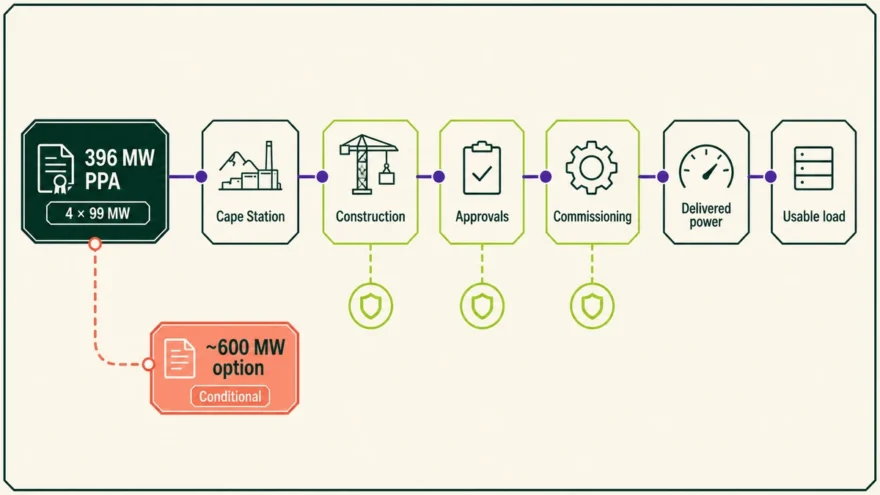
SK hynix said on August 28, 2026 that it had held the Indiana project’s groundbreaking ceremony on August 27 and that the advanced-packaging facility is scheduled to open its cleanroom by October 2028 and begin mass production of next-generation high-bandwidth memory in the second half of 2029. For semiconductor sourcing teams, that moves the project from an announced investment into construction. It does not make the future output available or secured supply.
The same company release also defines an important dependency: cutting-edge wafers will be produced by SK hynix in Korea, shipped to Indiana, then packaged and tested before finished products are supplied to U.S. customers. Procurement therefore needs a staged recognition record that keeps Korean wafer availability, Indiana readiness, qualification, customer allocation and physical delivery separate.
What changed and what it means
Counting announced Indiana capacity too early can overstate continuity coverage while wafer dependency, qualification, allocation and delivery remain unresolved.
- Decision affected
- Decide when SK hynix's Indiana-packaged HBM has enough evidence to enter approved secured-supply coverage.
- Evidence in brief
- SK hynix says the August 27 groundbreaking started the Indiana build, targets cleanroom opening by October 2028 and H2 2029 mass production, and will send Korean-made wafers to Indiana for packaging and testing.
- What remains unresolved
- The reviewed public record does not establish installed production tools, qualified Indiana output, customer acceptance, customer-specific allocation or physical delivery.
- Next verification
- Track cleanroom, tool and qualification milestones, then require buyer-specific product, allocation and delivery evidence before moving quantity into the base secured-supply plan.
Key takeaways
- SK hynix’s August 27 groundbreaking establishes a construction milestone, not installed tools, qualified production or delivered HBM.
- The latest company timetable targets cleanroom opening by October 2028 and next-generation HBM mass production in H2 2029, later than the H2 2028 mass-production target announced in 2024.
- The Indiana operation remains linked to Korean front-end production because SK hynix says cutting-edge wafers will be made in Korea and sent to Indiana for packaging and testing.
- Buyers should count only product- and customer-specific quantity supported by qualification, allocation and delivery evidence, not the project’s eventual headline capacity.
What changed from the 2024 Indiana announcement
SK hynix’s April 3, 2024 announcement put the estimated investment at $3.87 billion and said the new facility would begin mass production in the second half of 2028. The August 2026 release now puts expected investment above $4 billion, sets cleanroom opening by October 2028 and moves mass production of next-generation HBM to H2 2029.
The changed state is therefore narrower than a new supply source becoming operational. Groundbreaking is complete and the project has moved into construction, but cleanroom readiness and mass production remain future milestones. The CHIPS for America award page separately records up to $458 million in direct funding for an HBM advanced-packaging fabrication and R&D facility. Government funding supports the project; it does not establish tool installation, process qualification or buyer acceptance.
Indiana is a U.S. packaging node in a Korea-U.S. production chain
The geography matters to supply assurance. SK hynix describes the Indiana site as operating in close integration with South Korean production. The wafers themselves are expected to be produced in Korea, then shipped to Indiana for advanced packaging and testing. A buyer can therefore gain a U.S. back-end production node without eliminating the upstream dependency on Korean wafer output and cross-border logistics.
That boundary is consistent with Finance Circuit’s supplier-capacity recognition test: a U.S. production address does not by itself prove a self-contained domestic supply chain. For HBM, the sourcing record should preserve where the wafer is produced, which upstream capacity is allocated to Indiana, how transport is protected and what alternatives exist if the incoming wafer flow is constrained.
Use twelve supply states, not one capacity label
The following is a Finance Circuit procurement-recognition model, not SK hynix’s published stage nomenclature. It applies staged capacity and secured-supply control logic to semiconductor production without treating construction, qualification, allocation and delivery as interchangeable.
| State | Current public evidence | Procurement treatment |
|---|---|---|
| Groundbreaking | Occurred August 27, 2026 | Project milestone; count zero usable supply |
| Construction | Project is being built following the groundbreaking | Track schedule and dependencies; count zero usable supply |
| Cleanroom readiness | Company target: by October 2028 | Future milestone only until readiness evidence exists |
| Tool installation | Not established by the public sources reviewed | Keep outside base supply |
| Process qualification | Not established by the public sources reviewed | Keep outside base supply |
| Incoming wafer availability | Korean wafer origin is disclosed; Indiana-specific available quantity is not | Track as a separate upstream allocation and logistics dependency |
| Packaging and testing qualification | Indiana’s intended function is disclosed; qualification results are not | Count zero buyer-ready output until the process is qualified |
| HBM generation and product qualification | Next-generation HBM is planned; buyer-qualified Indiana product is not established | Recognize only the exact approved product or generation |
| Customer acceptance | Not established by the public sources reviewed | Do not treat trial or company production as buyer-accepted supply |
| Allocation | No customer-specific Indiana allocation is established by the public sources reviewed | Use only enforceable buyer quantity and delivery windows |
| Volume production | Company target: H2 2029 | Future ramp milestone, not current supply |
| Physical delivery | Future state | Record delivered and accepted quantity by date and destination |
Several of these states can move quickly once the plant is operating, but they are not interchangeable. A cleanroom can be ready before production tools are qualified. Production can start before a particular HBM configuration is accepted by a customer. A qualified product can exist without an allocation right for a specific buyer.
The annual wafer target is not buyer allocation
Reuters reported from the August 27 event that CEO Kwak Noh-Jung expects the site eventually to reach annual capacity of hundreds of thousands of wafers and plans volume production of HBM4E in the third quarter of 2029. That is a useful scale signal, but “eventually” is not a buyer delivery schedule.
The reviewed public sources do not establish how quickly that eventual capacity ramps, how much incoming Korean wafer supply will be assigned to Indiana, what share will be available to any named customer, or what allocation rights buyers will hold. Procurement should therefore avoid converting the plant-level capacity band into customer-level secured supply. The usable number is the quantity tied to a qualified product, approved process, named buyer, enforceable allocation window and accepted delivery terms.
What procurement should verify next
- Track cleanroom readiness separately from production-tool installation and process qualification.
- Require evidence of the Korean wafer source, Indiana-bound wafer allocation, transport lead time and contingency route for each planned HBM product.
- Confirm Indiana packaging and testing qualification for the exact HBM generation, stack configuration and customer specification being sourced.
- Keep customer acceptance separate from company production qualification, including sample, reliability, yield and retest evidence where applicable.
- Record customer allocation by product, quantity, time window, site and commercial right instead of applying the plant’s eventual annual capacity to the sourcing plan.
- Move quantity into secured-supply coverage only as volume production, accepted allocation and physical delivery evidence support it.
The Indiana groundbreaking is a real project milestone and a meaningful change from the 2024 announcement. It is not the point at which a buyer can count the announced U.S. capacity as secure supply. The decisive evidence will arrive later, when Korean wafer availability, Indiana process qualification, buyer acceptance, allocation and delivery can be tied to a specific product, quantity and date.