An order-to-cash flow can look complete while still failing at the boundaries. A sales order may be accepted, yet pricing authority is unclear. Goods may ship, yet billing never receives acceptable fulfilment evidence. Cash may reach the bank, yet remittance data cannot be matched to the customer’s open items. Each team completed a task, but no one accepted the transfer of responsibility.
This guide starts with an accepted customer order and ends when receivables, payment status, unresolved exceptions and accounting entries are sufficiently evidenced for period close. It treats every handoff as a controlled transfer with an owner, minimum data, acceptance evidence, exception route and stated accounting effect.
Quick answer
Unowned handoffs turn commercial or fulfilment discrepancies into delayed invoices, disputed receivables, unapplied cash and close reconciling items.
Decision: Define the owner, acceptance evidence, control and exception route for every order-to-cash handoff from accepted order through accounting close.
Key takeaways
- An order-to-cash map should continue beyond payment receipt to cash application, receivables reconciliation and the close handoff.
- Every transition needs a sending owner, a receiving owner, minimum data, acceptance evidence and an exception route.
- Billing readiness should be triggered by authorised commercial and fulfilment evidence, not an informal message that the work is done.
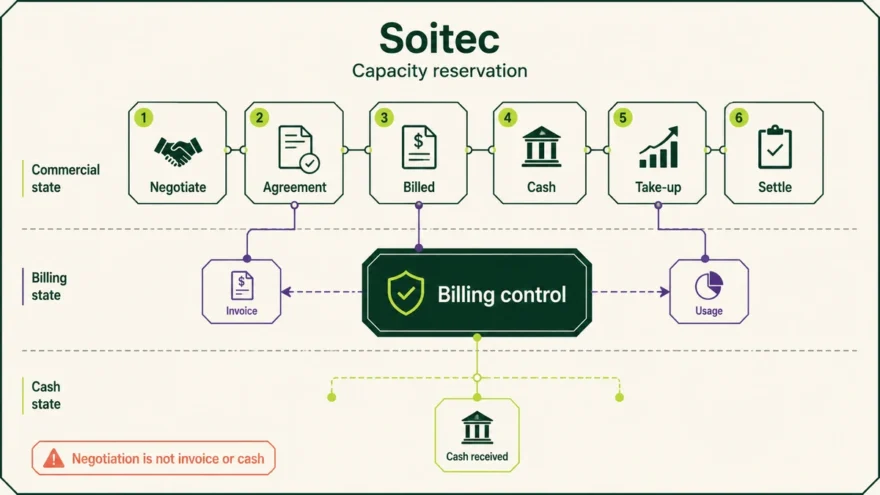
- Payment receipt, customer identification and invoice application are different states; unresolved cash needs ageing, ownership and review.
- Operational evidence supports accounting decisions, but it does not replace the organisation’s revenue-recognition and credit-loss policies.
What an order-to-cash process map must show
Order to cash, or O2C, is the operating and finance process that converts an accepted customer order into fulfilment, billing, a receivable, collection, cash application and financial recording. Microsoft’s current end-to-end O2C process catalogue separates sales-order management, accounts receivable, credit and collections into connected process areas. That is a useful starting point, but a control-ready map must also define how responsibility moves between them.
A stage list answers, “What happens next?” A control map answers four harder questions: what must be true before the next team accepts the transaction, what record proves that condition, who owns a failed transfer, and what financial record is affected if the failure remains unresolved.
| Map field | Question it must answer | Minimum output |
|---|---|---|
| Trigger | What event starts the handoff? | A named status or approved event, not a vague request. |
| Sending owner | Who is responsible for a complete transfer? | One accountable role and a defined delegate. |
| Receiving owner | Who accepts the next stage? | A role that can accept, reject or route the item. |
| Data record | Which fields must agree? | Customer, order, price, quantity, tax, terms, dates, currency and references. |
| Evidence | What proves the stage is complete? | An approved order, release, delivery record, invoice, receipt or reconciliation. |
| Exception route | Who resolves incomplete or conflicting information? | A reason code, owner, due date, escalation path and closure evidence. |
| Accounting effect | What changes if the handoff fails? | The affected invoice, receivable, cash status, journal, cutoff or reconciliation item. |
The model below is a Finance Circuit operating recommendation. It is not a requirement of one software product or accounting framework, and it must be tailored for goods, services, subscriptions, projects, prepayments, returns and other transaction types.
The end-to-end order-to-cash process map
Use eight control gates. A stage is complete only when the next owner can rely on the record without rebuilding the transaction from emails, spreadsheets or verbal explanations.
| Stage | Primary owner | Required output | Exit criterion |
|---|---|---|---|
| 1. Accepted order and commercial validation | Sales operations or order management | Controlled order record tied to approved commercial terms | All required customer, pricing, quantity, tax, currency, terms and delivery fields pass validation. |
| 2. Credit authorisation and release | Credit management or authorised finance role | Credit release, prepayment confirmation or approved exception | The order can proceed under a recorded limit, exposure and approval decision. |
| 3. Fulfilment and delivery evidence | Operations, logistics or service delivery | Evidence of the goods, services or milestone actually delivered | The billed quantity and event are supported by the contractually relevant fulfilment record. |
| 4. Billing readiness and invoice creation | Billing | Validated invoice and posting record | The invoice agrees to the accepted order, approved changes, fulfilment evidence, tax treatment and payment terms. |
| 5. Receivables ownership | Accounts receivable | Open customer item with invoice-delivery evidence | The receivable is posted, assigned, due-dated and visible for customer service and collection activity. |
| 6. Collections and dispute resolution | Collections, with named commercial and operational support | Collection action or controlled dispute case | The balance is paid, formally disputed, approved for adjustment or escalated under policy. |
| 7. Payment identification and cash application | Cash application or receivables operations | Applied, on-account, unapplied or unidentified receipt status | The receipt is posted and either matched to open items or assigned to an owned exception queue. |
| 8. Accounting and close handoff | Receivables accounting or controllership | Reconciled subledger, exception schedule and sign-off | Material differences, cutoff issues and unresolved balances have evidence, owners and approved treatment. |
1. Accepted order and commercial validation
The starting point is an order that the business has accepted, not a sales opportunity or unsigned quote. The order record should identify the customer and legal entity, bill-to and ship-to details, product or service, quantity, unit price, discounts, currency, tax attributes, payment terms, purchase-order or contract reference, requested dates and any non-standard commitment.
The sending owner must confirm that the order reflects authorised commercial terms. The receiving owner should be able to reject the packet when required fields are missing or when a price, discount, payment term or delivery promise falls outside delegated authority. Any change after acceptance should create a controlled order revision rather than overwrite the original evidence.
2. Credit authorisation and release
Credit control should produce a release decision that operations can rely on. For an account sale, the decision may consider approved limit, current exposure, overdue balances, payment history, security, guarantees and exception authority. For prepaid or card transactions, the release event may instead be an authorised payment or deposit status.
The control is not complete merely because a system has a credit-limit field. The order needs a recorded outcome: released, held, partially released, prepaid, or approved as an exception. A person who can change customer credit data should not automatically approve the same order without an appropriate compensating review.
3. Fulfilment and delivery evidence
Operations should pass facts, not assumptions, into billing. Depending on the transaction, the evidence may be a ship confirmation, proof of delivery, customer acceptance, service completion record, usage file or approved milestone. The record should identify the order line, quantity, event date, location, customer or project reference and any short shipment, return or cancellation.
Do not collapse “shipped,” “delivered,” “accepted” and “earned” into one status. Those events can have different contractual and accounting meanings. Under the IFRS Foundation’s IFRS 15 overview, revenue is recognised when a performance obligation is satisfied through transfer of the promised good or service. The O2C process should preserve the operational evidence; the accounting-policy owner should determine how that evidence is treated under the applicable reporting framework.
4. Billing readiness and invoice creation
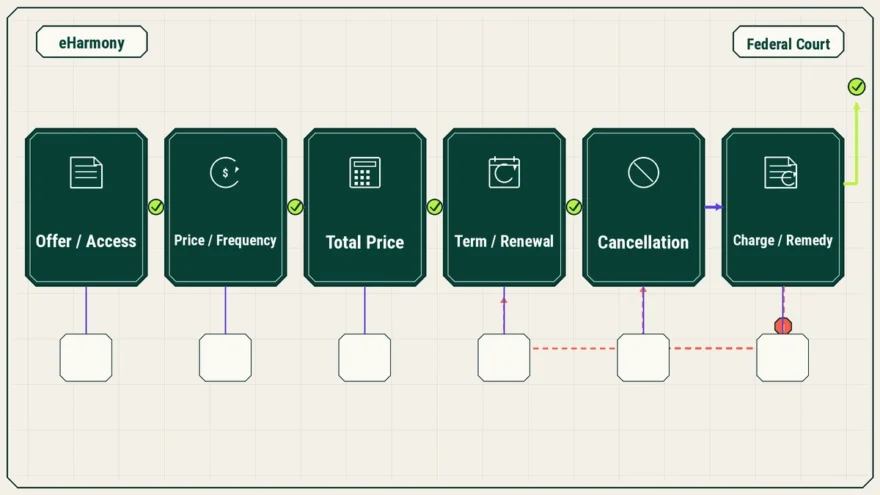
Billing should receive a complete billing packet rather than reconstruct the transaction. The packet normally includes the accepted order, approved changes, fulfilment evidence, customer invoicing instructions, price and discount basis, tax attributes, currency, payment terms, and any customer purchase-order or portal requirement. For recurring consumer services, the subscription promise-to-charge evidence chain also requires the versioned offer, checkout consent, renewal status and cancellation effective date.
Microsoft’s accounts-receivable process guidance describes invoicing as creating and sending the customer bill and posting it to the general ledger, followed by related processes such as customer credits, payments and settlement. The billing control should therefore verify both the customer-facing document and the financial posting. A rejected invoice, incorrect tax treatment or wrong legal entity can require a credit note, rebill and period correction.
5. Receivables ownership
Once the invoice is posted, accounts receivable owns an open item, not just a PDF. The minimum record includes invoice number and date, due date, customer account, original and open amount, currency, payment terms, collection owner, delivery channel and evidence that the invoice reached the customer or required portal.
AR should separate invoice-delivery failure from credit risk. A customer cannot reasonably act on an invoice it did not receive, while a valid overdue invoice requires a collection response. That distinction prevents collection teams from pursuing balances that first need a billing or master-data correction.
6. Collections and dispute resolution
Collections owns the communication and next action on a valid open receivable. It should not own every root cause. Pricing disputes may return to commercial operations, quantity or delivery disputes to operations, tax disputes to the tax owner, and contract interpretation to the authorised commercial or legal function.
Each dispute should carry a reason code, disputed amount, undisputed amount, owner, supporting documents, target resolution date and approval path for a credit memo, write-off or rejection. The undisputed portion should remain visible for collection where policy and customer circumstances permit. The collector should not alter the invoice or post an adjustment merely to clear an ageing item.
7. Payment identification and cash application
Receipt of money is not the same as clearing the customer’s invoice. The payment must first be identified to a payer and customer account, then linked to the intended invoice or invoices, deductions, discounts, fees or other open items. The current ISO 20022 message catalogue maintains payment remittance-advice messages. Its published remittance-advice business justification explains the design need: remittance details can be associated with a payment and can carry invoice-line information used in reconciliation. Revolut’s French-licence migration shows why customer remittance instructions, account identifiers and cash-application rules should change only from account-specific cutover evidence.
Use explicit receipt states. Applied means the receipt has been matched to one or more open items. On-account means the customer is known but the amount is intentionally held for later use. Unapplied means the customer or receipt is known but the open-item allocation is unresolved. Unidentified means the payer or customer cannot yet be determined. Oracle’s Unapplied Receipts Register documentation groups on-account, unapplied and unidentified payments by customer, business unit and accounting period, which is a useful model for exception ownership and close reporting.
8. Accounting and close handoff
The final handoff is not a message that billing ran or that cash arrived. Receivables accounting needs a reconciled state: invoice and credit activity posted, receipts classified, customer balances supported, manual adjustments approved, cutoff exceptions identified and the subledger tied to the general ledger.
Oracle’s receivables-to-ledger reconciliation guidance includes invoices, debit and credit memos, chargebacks, adjustments, applied receipts, on-account receipts, unapplied receipts and unidentified receipts among the transaction types that affect reconciliation. The close owner therefore needs all of those populations, not only the open-invoice ageing report.
Handoff responsibility, control and accounting-consequence matrix
The following matrix assigns the minimum operating responsibility for each boundary. Role names should be replaced with the organisation’s actual job titles, delegations and system permissions.
| Handoff | Required inputs | Sending owner | Receiving owner | Evidence and acceptance control | Exception owner | Downstream accounting consequence |
|---|---|---|---|---|---|---|
| Accepted order to credit or release | Customer, legal entity, items, quantity, price, discounts, tax, currency, terms, dates and contract references | Sales operations or order management | Credit management or authorised release role | Order-validation status; non-standard terms and overrides approved under delegated authority | Commercial owner for terms; master-data owner for customer errors | Invalid orders can create wrong invoices, tax postings, receivables or later credit notes. |
| Credit release to fulfilment | Approved order, exposure decision, hold status, payment or deposit evidence where applicable | Credit management | Operations, logistics or service delivery | System release or signed exception with amount, period and approver | Credit manager; commercial sponsor for requested exception | Unauthorised release increases collection and credit-loss exposure; incorrect holds delay fulfilment and billing. |
| Fulfilment to billing readiness | Order-line reference, fulfilled quantity, event date, delivery or acceptance evidence, returns and changes | Operations, logistics or service delivery | Billing | Billing trigger agrees to the contractually relevant event and approved quantity | Operations for missing evidence; commercial owner for scope change | Late evidence creates unbilled items; incorrect evidence can cause premature, duplicate or unsupported billing. |
| Billing to accounts receivable | Validated billing packet, invoice, posting result and customer-delivery evidence | Billing | Accounts receivable | Invoice totals, tax, currency, due date, customer and ledger posting pass control checks | Billing for invoice defects; finance systems for interface failure | Errors affect revenue-related postings, tax, receivables, ageing and period cutoff. |
| Accounts receivable to collections | Open item, due date, contact details, delivery status, prior promises and account restrictions | Accounts receivable operations | Collections | Balance is valid, customer received the invoice and the collection owner is assigned | AR for allocation errors; billing for document defects | Invalid collection activity can conceal billing errors and distort overdue or expected-credit-loss analysis. |
| Collections or dispute to correction owner | Reason code, disputed and undisputed amounts, correspondence and supporting documents | Collections | Commercial, operations, tax, billing or accounting owner according to cause | Case accepted with owner and due date; adjustment requires separate approval and evidence | O2C process owner when ownership is contested or overdue | Unresolved disputes overstate collectible balances; unsupported credits, deductions or write-offs misstate customer accounts. |
| Payment and remittance to cash application | Bank receipt, value date, amount, currency, payer identity, remittance and customer references | Treasury feed, bank interface or receipt-capture owner | Cash application | Receipt total agrees to source; payer and intended open items are identified or exception-coded | Cash application for matching; collections or customer service for missing remittance | Unapplied or misapplied cash leaves invoices open, distorts ageing and can create duplicate collection contact. |
| Cash application to accounting close | Receipt applications, unapplied and unidentified schedules, adjustments, credits, reversals and AR-to-GL reconciliation | Receivables operations | Receivables accounting or controllership | Subledger totals reconcile; material exceptions have owner, reason, period and approved treatment | Receivables accounting, with finance systems support for interface differences | Unresolved items become reconciling differences, cutoff errors, unsupported journals or misstated customer balances. |
Control rules for every handoff
COSO’s internal-control guidance frames internal control around operational and reporting objectives. For public-company audit work, PCAOB AS 2201 transaction-flow guidance asks auditors to understand how transactions are initiated, authorised, processed and recorded, identify where misstatements could arise, and follow a transaction through systems into the financial records. Those are useful design tests for an O2C owner, although the audit standard does not prescribe this matrix.
Define acceptance, not notification
“Billing notified” is not a completion criterion. “Billing accepted a packet containing the approved order, fulfilment event, quantity, price, tax and customer instructions” is. The receiving owner needs authority to reject an incomplete transfer and a status that records that decision.
Give one role responsibility for the transfer
Several teams may contribute data, but one sending role should be accountable for completeness and one receiving role should accept the next stage. Shared responsibility without a named owner usually becomes delayed responsibility. Delegates and escalation paths should be stated before an absence or period-end peak occurs.
Use a controlled status model
Status names should describe accounting-relevant facts. Examples include order accepted, credit held, fulfilment complete, billing rejected, invoice posted, invoice delivered, disputed, receipt unidentified, receipt unapplied and reconciled. Do not use one generic “complete” flag across the process.
Pass control totals with batch or interface data
When orders, invoices, receipts or applications move between systems, pass record counts and value totals by legal entity, currency or other relevant control dimension. The receiver should compare accepted totals with sent totals and investigate missing, duplicate or rejected records before the next stage is closed.
The finance systems integration map extends this control-total rule into interface contracts, safe retry, monitoring and reconciliation design.
Route exceptions by cause and ageing
An exception queue should show the cause, financial amount, customer or order, original event date, current owner, next action, due date and escalation status. A queue without ageing and ownership is only a storage location. Repeated reason codes should feed process correction at the source.
Restrict changes after acceptance
Accepted orders, credit releases, fulfilment records, invoices, receipt applications and adjustments should not be overwritten without traceable change evidence. Corrections should preserve the original transaction, the revised value, the person or rule making the change, the approval and the effective period.
Keep preparation, approval and review distinct
Segregation should reflect the risk and size of the organisation. The person entering a non-standard price should not be the only approver. The person proposing a credit memo or write-off should not be the only reviewer. Where staffing limits segregation, document a compensating review using independent evidence and defined thresholds.
The accounting and close handoff
The close package should make the O2C state reproducible. A controller should be able to trace the receivables balance and the period’s movement without asking each function to reconstruct its part after the deadline.
| Close item | Source owner | Evidence | Completion test |
|---|---|---|---|
| Order-to-invoice completeness | Order management and billing | Accepted orders, fulfilment events, invoices and interface rejects | Missing or duplicate transitions are identified and assigned. |
| Fulfilled-not-billed and billed-without-evidence | Operations and billing | Exception schedules by order, amount, event date and reason | Material items have approved accounting treatment and next action. |
| Invoice and credit cutoff | Billing and receivables accounting | Last and first document sequences, posting dates, delivery dates and late changes | Documents are recorded in the appropriate period or listed as exceptions. |
| Collections and dispute exposure | Collections | Ageing, disputed amounts, promises, expected corrections and escalations | Material disputed and overdue balances have current evidence and owner. |
| Receipt status | Cash application | Applied, on-account, unapplied and unidentified receipt schedules, including reversals | Receipt totals agree to source data and unresolved amounts are aged. |
| Receivables-to-ledger reconciliation | Receivables accounting | Subledger balance, general-ledger balance and reconciling-item schedule | Difference is zero or every residual item has a supported explanation and disposition. |
| Manual journals, credits and write-offs | Accounting and authorised approvers | Entry support, reason, preparer, approver and linkage to the source transaction | Entries are complete, authorised, period-correct and included in reconciliation. |
Operational completion and accounting completion are not always the same. A delivery can be complete while billing is blocked; cash can be received while application is unresolved; a dispute can remain open while an approved accounting estimate is recorded. The handoff should state both statuses rather than force one team’s “done” to stand in for another team’s conclusion.
How to implement and test the operating model
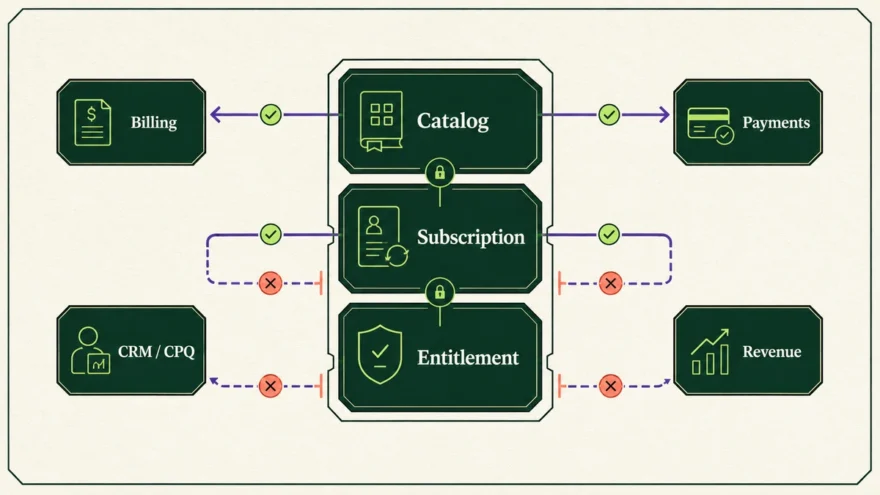
- Separate transaction archetypes. Map at least the flows that materially differ, such as stocked goods, services, subscriptions, projects, prepayments, returns, credit notes and cross-border orders. Do not force every flow through one trigger. For the subscription archetype, the plan, entitlement and change events behind it belong to their own system of record.
- Walk representative transactions end to end. Use the records and systems that staff actually use. Include a normal transaction, a change, a dispute, a short payment, an unapplied receipt and a period-end item.
- Define the state model and exit criteria. For each stage, document allowed statuses, who can change them, required fields, evidence, control totals and the condition for acceptance.
- Assign permissions and review rights. Align system access with the role matrix. Identify incompatible actions and specify an independent or compensating review where full separation is not practical.
- Build exception queues before automation. Define reason codes, owners, due dates and escalation paths first. Automation that moves incomplete records faster only moves the control failure downstream.
- Test the model through a close. Confirm that the close team can reproduce invoice, receipt and reconciliation populations from retained evidence and that late changes remain traceable.
- Measure handoff failure, not only total cycle time. Track rejected order packets, credit-hold ageing, fulfilled-not-billed items, invoice rejections, dispute ageing, unapplied cash ageing, interface differences and post-close corrections.
The process owner should approve the map only when a transaction can be traced from accepted order to financial records using the same evidence staff use in daily work; each exception has one current owner; receipt states are distinguishable; and the close package explains every material residual item without relying on undocumented knowledge.
Frequently asked questions
Why are payment receipt and receivable clearing different states?
Payment receipt and receivable clearing are different states because cash can arrive before remittance data identifies the customer or invoice. The operating model should preserve the receipt, application and clearing evidence separately, allowing finance to see whether cash is available while the accounting treatment or customer allocation remains unresolved. Where that separation is the design problem itself, cash application automation design sets out how remittance capture, matching rules and exception ownership should be assigned.
How should on-account, unapplied and unidentified receipts be handled?
On-account, unapplied and unidentified receipts should remain separate exception populations rather than being collapsed into one cash bucket. Each state reflects a different evidence gap and resolution route, so the process should retain the amount, customer or payer information, ageing, owner and action needed before close reconciliation.
What belongs in the receivables-to-ledger close population?
The receivables-to-ledger close population includes more than open invoices. Credits, adjustments, receipts in different application states and the related accounting records must be included so the subledger-to-ledger reconciliation is complete. The close package should explain material residual items and retain the evidence used in normal operations.