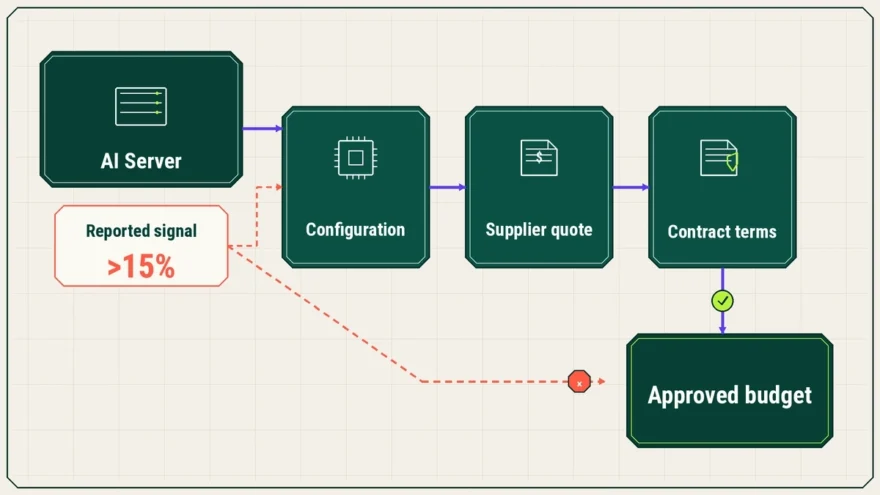
The Financial Times reported on 8 August 2026 that Allianz Trade had been adjusting credit limits for suppliers entering new trading agreements with Vistry. A Reuters follow-up on 10 August said reductions could reach up to 70% for some limits, with final levels tied to Vistry’s financial performance. The reported changes are prospective: they affect new trading agreements and do not apply retroactively. Neither the previous limits nor the supplier-by-supplier revisions have been disclosed.
For procurement, the immediate decision is not whether the report proves financial distress. It is whether the insurer action has produced a supplier response that changes payment terms, order acceptance or continuity risk. Vistry told Reuters that it was not aware of any supplier withdrawing trade and had seen no supply-chain interruption. Until transaction-level evidence appears, procurement should treat the report as a monitored supplier-risk signal, not as proof that terms have shortened or orders are being refused.
What changed and what it means
A confirmed supplier response could bring cash outflows forward or constrain supply; acting on insurer reporting alone could add cost or damage supplier relationships.
- Decision affected
- Decide whether reported credit-limit adjustments justify more supplier monitoring or confirmed changes to order, payment-term and sourcing controls.
- Evidence in brief
- FT and Reuters report individual limit adjustments for new agreements, potentially up to 70% for some limits and non-retroactive; Vistry reports no supplier withdrawal or interruption.
- What remains unresolved
- Supplier count, old and new limits, insured exposure, effective dates, alternative cover and any realised changes to terms or orders are not disclosed.
- Next verification
- Ask strategic suppliers for current cover and term changes, reconcile them with order and AP exceptions, then review Vistry’s 24 September results.
Key takeaways
- Allianz Trade is reported to be adjusting individual limits for new Vistry trading agreements, with reductions of up to 70% for some limits rather than a universal withdrawal of cover.
- Vistry says it knows of no supplier withdrawing trade and has seen no supply-chain interruption.
- Procurement should verify actual limit, term and order changes before altering payment, purchasing or sourcing controls.
- The escalation point is a documented supplier response, not the insurer report by itself.
What is reported to have changed
Trade credit insurance protects a supplier’s receivable if a customer does not pay. Allianz Trade’s credit-limit guidance defines a limit as the value of sales outstanding it can cover between a supplier and its customer. It also says an application can be fully approved, partly covered or rejected. A credit-limit decision is therefore not necessarily binary.
That distinction matters for the reported Vistry change. “Up to 70%” describes the possible reduction for some limits, not a portfolio-wide average and not a confirmed cut for every supplier. A lower insured limit also does not disclose the supplier’s total exposure, whether another insurer covers part of it, whether the supplier will retain uninsured exposure, or whether commercial terms will change.
Allianz Trade’s buyer guidance says restricted or removed insured limits could affect the credit terms a supplier is willing to offer. That establishes a possible mechanism, not a Vistry outcome.
Allianz Trade declined to give Reuters company-specific details. Public evidence therefore does not establish the affected supplier count, the old and new limit for any supplier, the aggregate insured exposure, the exact effective date of each change or the capacity available from other insurers.
Separate insurer action from supplier behaviour
Procurement should keep four states separate. Moving from one state to the next requires new evidence; the earlier state does not prove the later one.
| Observed state | Evidence required | Procurement response | AP or treasury handoff |
|---|---|---|---|
| Reported insurer action | A supplier notice or insurer confirmation naming the buyer entity, revised limit, effective date and affected agreements | Log the signal, map exposed strategic suppliers and request confirmation without changing purchase terms | Awareness only; no base cash-flow change |
| Supplier commercial response | A written request for shorter terms, a deposit, security or lower open-account exposure | Compare the request with contract rights, alternatives and approval authority | AP validates the new terms; treasury quantifies the timing effect |
| Order response | A credit hold, quantity cap, refusal, lead-time change or revised order-acceptance condition from a named supplier | Activate dependency review and sourcing contingency for the affected item or service | Update scenarios when amount, timing and probability are supportable |
| Operational effect | A missed delivery, service interruption or confirmed production impact | Escalate through continuity and incident governance | Revise the base forecast and working-capital view from the confirmed effect |
Vistry’s statement places the public record at the first state: an insurer action has been reported, while supplier withdrawal and interruption have not been observed by the company. That does not eliminate risk. It defines what procurement still needs to prove before changing controls.
The procurement watchlist: terms, cover and order signals
Start with suppliers whose failure or refusal would affect a committed build programme, critical service or long-lead item. For each one, record five checks:
- Buyer and agreement scope: confirm the Vistry legal entity, contract or order type, and whether the supplier says the revised limit applies to new business only.
- Insured and uninsured exposure: ask whether the requested amount was fully or partly covered, whether alternative cover exists, and whether the supplier has set an internal exposure cap.
- Commercial terms: retain written evidence of any requested change to payment timing, deposits, guarantees, credit support or quote validity.
- Order behaviour: track accepted, delayed, capped or rejected orders separately from general supplier commentary.
- Concentration: identify strategic and sole-source suppliers that depend on the same insurer or have limited balance-sheet capacity to carry uninsured receivables.
Use existing purchase orders, supplier correspondence, AP terms and order acknowledgements as the evidence base. Do not turn a press report, market reaction or unanswered supplier enquiry into a coded term change.
When to escalate to AP, treasury and sourcing
A report-only state belongs in monitoring. A written supplier request that changes a commercial or purchasing condition should enter a controlled source-to-pay exception route with a named owner, supporting evidence, approval authority and expiry. Procurement should not make an informal payment promise to preserve supply outside that route.
Bring AP into the decision when a supplier proposes a new due date, deposit, pro forma invoice, security requirement or other payment condition. AP should confirm the supplier record, contract and purchase-order treatment before the change reaches invoice processing. Bring treasury in when the confirmed change moves a material cash outflow, creates a deposit requirement or aggregates across enough suppliers to affect liquidity.
Until then, keep a possible payment acceleration or order disruption in the downside case rather than the base forecast. The 13-week cash forecast controls provide the relevant distinction between an evidenced expected cash movement, a downside assumption and a proposed management action.
Sourcing contingency should move from preparation to action when a supplier confirms an order hold, quantity limit, refusal to extend further credit or inability to meet an agreed delivery. The response should be item-specific and dependency-led, not a blanket instruction to replace suppliers that have reported no change.
When contingency requires a new source, the Strategic Vendor Program supplier-capacity tests show what procurement should verify before treating proposed domestic output as available.
What remains unverified and the next check
Vistry’s 8 July trading update provides company context but does not confirm the insurer action. Vistry said supplier and subcontractor payment timescales had improved, reported net debt of £470 million at 30 June and average daily first-half debt of £799 million, expected a first-half pre-tax loss of approximately £30 million, and maintained its forecast of more than £100 million in year-end net cash.
Those company-stated figures do not disclose supplier-level insurance capacity or subsequent commercial responses. The missing evidence remains the supplier population, old and new limits, insured values, effective dates, alternative cover and any realised change to terms, pricing, order acceptance or delivery.
Vistry’s financial calendar lists half-year results for 24 September 2026. Before that date, procurement should preserve the source and date of each supplier confirmation, distinguish “no change” from “no response,” and escalate only documented commercial or operational changes. The September results are the next company checkpoint, not a substitute for direct supplier evidence.