Moody’s Ratings listed new financial-institutions AI research on 28 July 2026 whose public title says material AI credit benefits will take time to crystallise. Reporting based on the access-controlled study says Moody’s also warned that reliance on a relatively small set of foundation-model and cloud providers “risks creating a systemic dependency” because an outage at one major provider could spread across customers and sectors.
This is a credit-risk assessment, not evidence that a systemic banking outage has occurred and not a new regulatory requirement. For a bank finance-technology leader, the operating question is narrower: before a critical reporting, risk, treasury or control workflow depends on an external model and cloud stack, can the institution prove where the dependency sits, how the service will degrade, what can be moved and who can fund and execute an exit?
What changed and what it means
Concentrated model and cloud dependencies can propagate outages, increase switching costs and give providers pricing leverage across critical finance and risk services.
- Decision affected
- Require a mapped dependency chain, tested fallback, portable assets, contractual access and a funded exit before critical bank workflows rely on external AI model and cloud providers.
- Evidence in brief
- Moody’s public listing confirms the July 28 research, while attributed reporting quotes its warning that reliance on a small set of model and cloud providers risks systemic dependency.
- What remains unresolved
- The access-controlled report does not publicly disclose institution-level exposure, provider shares, tested recovery results or the time and cost needed to switch a critical workflow.
- Next verification
- Map direct and nth-party dependencies, test model and cloud failure separately, and prove portability and a funded exit before renewal or expansion.
Key takeaways
- Moody’s July 28 research says concentrated reliance on foundation-model and cloud providers could create shared outage and vendor-dependence risks for financial institutions.
- A contracted AI vendor is only the visible dependency; the same workflow may also rely on one cloud, identity service, data layer or key subcontractor.
- A second vendor is not proof of resilience when both services depend on the same model family, cloud region or other key nth party.
- Approval evidence should include a current dependency map, tested fallback, portable assets, contractual access and a funded exit rehearsal.
What Moody’s says, and what it does not establish
The public Moody’s listing says financial benefits from AI will take time to crystallise. The detailed report is access-controlled, so its provider-concentration findings must be attributed through reporting that had access to it. The Guardian reports that Moody’s identified two linked risks: an outage at a major model provider could propagate across customers and sectors, and dominant model or infrastructure providers could gain pricing leverage as adoption deepens.
The warning extends an earlier Moody’s position rather than creating it from nothing. In its 12 January 2026 AI outlook, Moody’s said market-share consolidation among a small number of cloud providers was pushing prices higher and that deeper AI integration was increasing exposure to cyber and operational failures. The July research applies that concern more directly to financial companies and adds foundation-model concentration to the cloud issue.
Neither source identifies institution-level exposure, provider market share, tested recovery results or the time and cost of switching a critical workflow. Moody’s has not established a sector-wide AI outage or universal bank lock-in.
One AI workflow can contain several concentrated dependencies
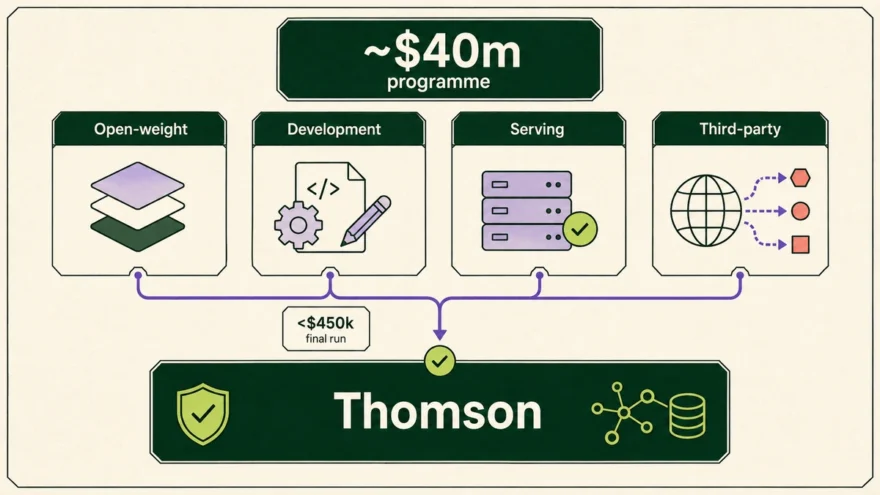
A procurement record may name one AI application supplier while the operating chain contains several separate dependencies:
- the foundation model, model API and version-management service;
- the cloud compute, storage, networking and regional availability design;
- identity, secrets, data retrieval, orchestration and observability services;
- the application vendor, integration layer and any key subcontractors; and
- bank-owned data, evaluation sets, business rules and human approvals.
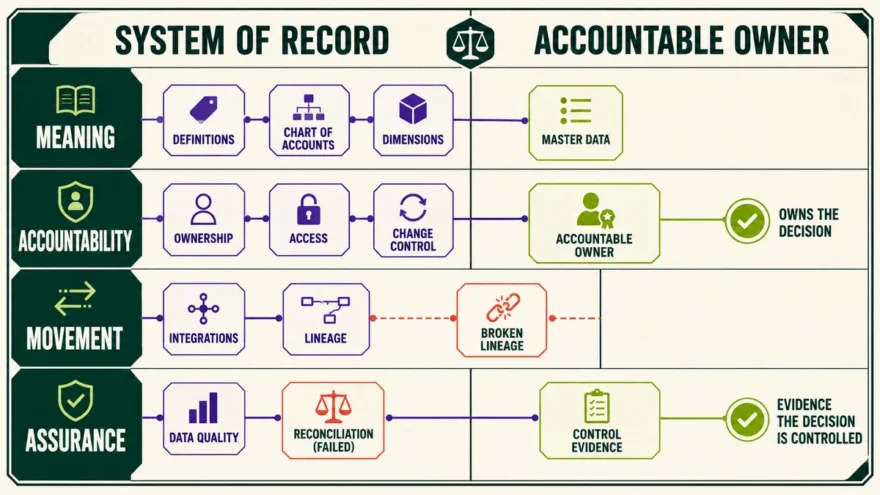
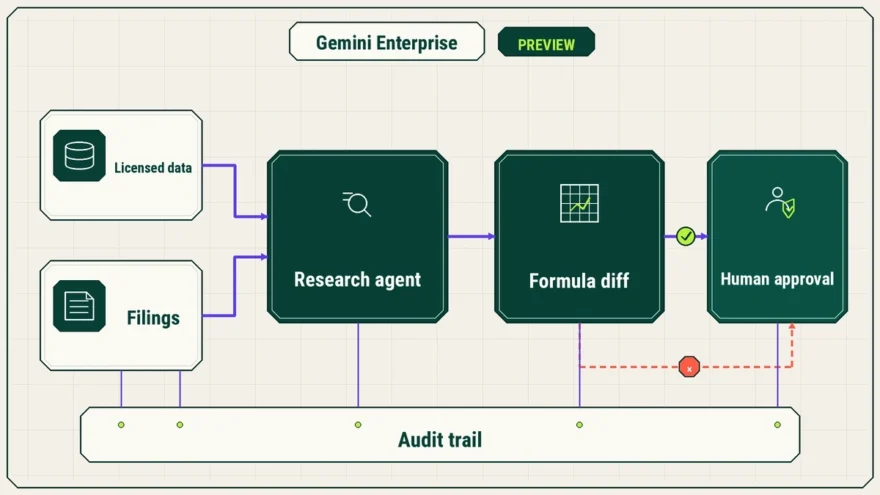
The finance technology stack reference architecture assigns ownership by finance object and lifecycle state. AI concentration adds another dimension: the institution must also identify which provider or key nth party can interrupt each critical state, and whether the bank retains the assets and expertise needed to continue without it. The Gemini financial-services agent control boundary applies that map to a managed research agent, licensed data connectors and spreadsheet outputs.
The final Basel Committee principles for third-party risk, published in December 2025, define bank-level concentration to include multiple providers that depend on the same key nth party. They also call for complete registers of third-party arrangements and key nth parties, including criticality, substitutability and contingent-provider information. The principles are directed to large internationally active banks in Basel Committee member jurisdictions; local legal and supervisory treatment still varies.
Five pieces of evidence before approving a critical dependency
The control standard should be based on evidence that can be inspected and retested, not on a vendor’s claim that its platform is resilient.
| Evidence area | Minimum proof | Decision it supports |
|---|---|---|
| Critical-service dependency map | Named workflow, business owner, model and version, cloud and region, data stores, identity service, integration layer, key nth parties and tolerance for disruption | Shows which shared failure domain can stop the finance or risk service |
| Resilience and degradation test | Scenario, test date, measured recovery result, manual or reduced-service mode, unresolved exceptions and approved remediation | Shows whether the workflow can stay within its operating tolerance during loss of a provider layer |
| Portability package | Exportable data and schemas, prompts and policies, configurations, evaluation cases, audit records, interface specifications and model or tool dependencies | Shows what can be transferred without reconstructing the governed process from memory |
| Contract and access rights | Incident notification, audit and information rights, data and log access, key nth-party change notice, transition assistance, termination rights and any applicable step-in mechanism | Shows whether the bank can obtain evidence and act before or during disruption |
| Funded exit rehearsal | Named decision owner, target option, sequence, elapsed time, budget, people, infrastructure, knowledge-transfer plan and retained test results | Shows whether exit is executable rather than a clause that has never been exercised |
A second vendor is not proof of resilience
Vendor count can misstate diversification. Two model services may run on the same cloud, depend on the same identity service, use the same model family or fail when one shared data-retrieval layer is unavailable. A multi-provider design can therefore preserve the same failure domain while adding integration complexity.
Testing should isolate each layer: model API, cloud region, identity, data retrieval and the full external stack. A fallback not exercised with current data, permissions and transaction volumes is an option on paper, not operating evidence.
Provider resilience is also separate from model and workflow governance. The finance AI platform control checklist covers data boundaries, action authority, logs, reporting lineage and change controls inside a planned platform. The Moody’s warning adds a different question: can those governed controls continue, substitute or shut down safely when the underlying model or cloud provider is lost?
Exit planning must be executable, not contractual
The Basel Committee’s current principles say planned exit arrangements should be updated and tested for budget, people, technical infrastructure, knowledge transfer and access to data. For critical arrangements, they also identify timely transfer of logical assets such as data, applications, APIs, models and intellectual-property rights. Exit detail should be proportionate to criticality and substitutability.
A separate June 2026 Basel Committee range-of-practices report found that surveyed banks use combinations of audit rights, incident notices, data-portability terms, step-in rights, alternative providers and nth-party visibility. It also records difficulty mapping critical services to underlying assets and third parties. The sampled practices are not universal.
For AI, an exit rehearsal should answer more than whether data can be downloaded. The institution needs to know whether it can reproduce an approved workflow, reconnect governed source data, reapply access rules, rerun validation cases, preserve audit history and return the service to an accepted operating state within the approved tolerance. Long-duration infrastructure adds a physical dependency: the Riot Platforms AI lease control framework ties exit rights to capacity milestones, utility dependencies and a funded transition plan.
What finance-technology leaders should verify now
- Classify the workflow. Record the critical service, finance or risk owner, allowed downtime, data sensitivity and actions the AI component may take.
- Map the full provider chain. Trace the application through model, cloud, region, identity, data and key nth-party dependencies rather than stopping at the contracted vendor.
- Test distinct failure modes. Exercise model loss, cloud loss, data or identity loss and full-stack loss, then retain measured outcomes and unresolved exceptions.
- Close rights before renewal. Confirm audit, incident, information, portability, transition and termination terms while the institution still has commercial leverage.
- Fund and rehearse the exit. Assign people, budget, target architecture and decision authority, and report residual concentration where no credible substitute exists.
Moody’s warning is most useful as an approval test, not as a prediction that failure is inevitable. The decision is whether a critical AI-supported workflow has evidence of continuity, substitutability and exit before deeper adoption makes the dependency harder and more expensive to change.