On August 13, 2026, President Donald Trump signed a Section 232 proclamation covering unmanned aircraft systems and components. Its first wave is scheduled for goods entered for consumption, or withdrawn from warehouse for consumption, from 12:01 a.m. eastern time on September 3, 2026. The new layer is 100% for specified large or sensitive drones, docking-station equipment and critical components, and 25% for listed smaller drones without thermal imaging. The proclamation is signed, but those first-wave duties are not yet effective.
Procurement cannot apply one headline rate to every drone-related purchase. Product classification, maximum take-off weight, thermal-imaging capability, component use, certified origin and customs-entry timing all affect the treatment. The Section 232 duty generally sits on top of other applicable duties and charges. The published implementation annex also contains a component-date conflict and UK wording that need official clarification, so line-level mapping should precede any blanket cost reset.
What changed and what it means
Applying one headline tariff can materially misstate landed cost because product tiers, conditional partner treatment, delayed components and existing duties change the stack.
- Decision affected
- Reclassify, reprice, retime or re-source open UAS purchases using product classification, capability, certified origin and customs-entry date.
- Evidence in brief
- The signed proclamation and Annexes I–III establish the product tiers; clauses 1 and 2 set September 3, 2026 and February 9, 2027 entry dates.
- What remains unresolved
- Annex IV prints February 9, 2026 for delayed components and its UK heading does not mirror clause 4; certification and onshoring procedures are pending.
- Next verification
- Validate each HTSUS classification and origin record with the customs owner, then monitor Commerce, CBP and the Federal Register for corrections and implementation guidance.
Key takeaways
- Annex I and II duties are scheduled for customs entries from September 3, 2026, not for POs or invoices dated that day.
- Specified large or thermal-imaging drones and some components fall in the 100% tier; listed smaller drones without thermal imaging fall in the 25% tier.
- Partner treatment depends on product origin and certification of critical components and technology, not simply the supplier’s address.
- Annex IV prints February 9, 2026 for delayed components, while the proclamation states February 9, 2027.
What changed and when the duties start
The prior state was an investigation, not a UAS-specific Section 232 duty. Commerce initiated it on July 1, 2025, and the Federal Register notice published on July 16, 2025 requested evidence on import dependence, domestic capacity and possible measures such as tariffs or quotas.
The signed proclamation sets September 3, 2026 for Annex I and II entries and February 9, 2027 for delayed Annex III components. It also defers the clause 1 date to 180 days after signing for qualifying products and components tied to companies on specified Blue UAS or FCC lists on September 2. The operative trigger is customs entry or warehouse withdrawal, not the PO, invoice or shipment date. The SEC Regulation Crypto timing ladder shows the earlier boundary: a scheduled meeting that is cancelled before a proposal creates no effective or compliance date for an operating calendar.
The procurement tariff map by product and capability
| Purchase line | Annex and scope test | Scheduled treatment | Evidence to retain |
|---|---|---|---|
| UAS above 25 kg | Annex I; listed 8806.24, 8806.29, 8806.94 and 8806.99 provisions | 100% from September 3, subject to qualifying exceptions | HTSUS classification and maximum take-off weight |
| UAS of 25 kg or less with thermal imaging | Annex I; listed 8806.21 to 8806.23 and 8806.91 to 8806.93 provisions | 100% from September 3, subject to qualifying exceptions | Installed sensor configuration and model evidence |
| UAS of 25 kg or less without thermal imaging | Annex II; the same listed weight provisions without thermal imaging | 25% from September 3, subject to qualifying exceptions | Weight, capability and final classification |
| Docking-station equipment | Annex I; 8504.40.9580 and 8537.10.9170 articles described for use in UAS | 100% from September 3, subject to qualifying exceptions | Separate equipment line and intended use |
| Listed 8807 parts for UAS above 25 kg | Annex I; excludes parts for retail delivery, agriculture or sale to the Department of War | 100% from September 3, subject to qualifying exceptions | Platform weight class and end use |
| Other listed 8807 UAS parts | Annex III; listed parts not already controlled by Annex I | 25% from February 9, 2027 under clause 2, subject to the Annex IV conflict | Part classification, UAS use and cohort date |
The annex descriptions are informational and do not supersede the HTSUS. Commercial labels such as “camera drone,” “controller” or “replacement rotor” do not decide the duty without the classification and scope limitation.
Origin treatment depends on certification, not the supplier address
Clause 4 provides conditional partner treatment. For products of Japan, South Korea, Taiwan, Switzerland, Liechtenstein or an EU member state, the total rate is to be no higher than 15% including the Column 1 duty. For UK products, clause 4 says no higher than 10%.
The importer must certify that substantially all critical components and technology are products of the United States or listed partner markets, and Commerce must establish the determination process. Headquarters, invoice address, final assembly or shipping country does not by itself prove eligibility.
Commerce may also approve onshoring plans and allow commensurate covered imports without the Section 232 duties while a qualifying U.S. facility is under construction. Application, approval and monitoring procedures are not yet established in the reviewed sources.
Build the landed-cost stack line by line
The HTSUS implementation in Annex IV makes headings 9903.08.21 through 9903.08.26 mutually exclusive. That prevents two of those UAS headings from applying to one article, but it does not make the Section 232 amount the entire landed cost. The proclamation says the new duties generally apply in addition to other duties, taxes, fees, exactions and charges; Annex IV also preserves antidumping, countervailing and other duties.
Keep separate model lines for customs value, ordinary duty, the Section 232 heading, any trade-remedy duty, customs fees, freight, brokerage, inland transport and other evidenced charges. China’s July input-cost evidence boundary reinforces the same control: an external rate or index does not replace product, contract and shipment evidence.
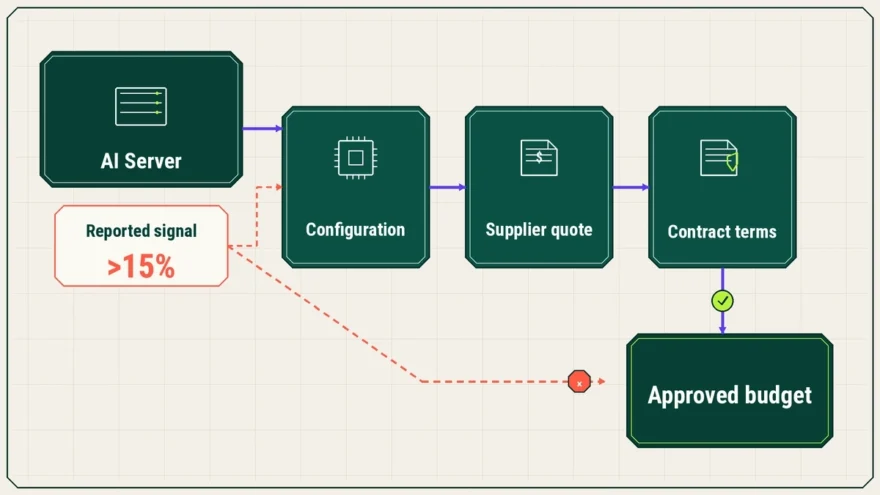
Do not multiply the purchase price by 100% or 25% and call the result landed cost. The Section 232 line still needs the entered value, classification, origin treatment, entry date and any approved exception.
What to test on open POs and in-transit entries before September 3
- Classify each line. Confirm the HTSUS provision with the customs owner.
- Record the product test. Capture weight, thermal capability, docking status and component use.
- Separate component cohorts. Distinguish first-wave large-UAS parts from delayed Annex III parts.
- Build the origin file. Obtain product-origin and component-and-technology support for any partner claim.
- Reconcile entry timing. Match customs entry or warehouse withdrawal to the PO and receipt schedule. The July 2026 container-import signal shows why arrival timing can change inventory and cash before demand.
- Read the contract. Confirm duty ownership under the Incoterm and tariff-change language.
- Update approvals. Reprice the requisition and supplier comparison only after the controls agree.
What remains unresolved in Annex IV
Part B of Annex IV prints February 9, 2026 for the delayed component modification, a date before the August 13 proclamation. Clause 2 expressly states February 9, 2027 and describes a 180-day delay. February 9, 2027 is the defensible planning assumption, but the conflict should remain visible until an official correction or implementation instruction appears.
Clause 4 also says the UK rate is to be no higher than 10%, while Annex IV heading 9903.08.23 prints the applicable subheading duty plus 10%. Those texts can produce different totals when the ordinary rate is not zero. The partner-certification and onshoring procedures are also pending. Customs or trade counsel should review these points before promotion and before a buyer represents a final payable rate.
What procurement should monitor next
Monitor the Federal Register, CBP notices and HTSUS updates for a corrected date, partner-certification rules, onshoring procedures and product or company determinations. The proclamation also requires Commerce to provide an update within 120 days, which falls on December 11, 2026 if counted from signing.
Until then, build a line-level exposure register and approve acceleration or resourcing only where classification, origin evidence, contract allocation and entry timing support the landed-cost conclusion.