Reuters reported on August 13, 2026, citing people familiar with the matter, that Silver Lake and Workday had held discussions about a potential acquisition over recent months and that the talks were ongoing. Reuters also said there was no guarantee a transaction would materialise. The report is a changed information state, not a company-announced deal: the sources reviewed establish no signed agreement, disclosed consideration, committed acquisition financing, regulatory approval, closing timetable or customer-specific notice.
For a finance systems director, that distinction should keep present operations on their normal path. Reported discussions alone do not support changing access roles, integrations, approval ownership, renewal assumptions or control documentation. The useful action now is to preserve the executed contract set and current assurance evidence, assign a monitoring owner and define the official milestones that would trigger vendor-risk review or formal change control.
What changed and what it means
Reported talks raise counterparty, renewal and governance monitoring needs but do not establish changes to customer terms, service levels, integrations, data controls or system ownership.
- Decision affected
- Keep current Workday operations unchanged, preserve executed contract and control evidence, and define which official milestone triggers vendor-risk or formal change-control review.
- Evidence in brief
- Reuters establishes ongoing discussions with no guaranteed deal; Workday’s official materials establish the prior corporate state and current contract, security and assurance baselines.
- What remains unresolved
- No signed agreement, disclosed consideration, committed financing package, approval timetable, closing date, customer notice or contract-specific change is established by the sources reviewed.
- Next verification
- Preserve the executed agreement and current control evidence, keep production changes in the normal approval path, and monitor company statements, filings and any customer-specific notice.
Key takeaways
- Reuters reported ongoing Workday–Silver Lake discussions on August 13, but no transaction is guaranteed.
- A possible invitation to additional investors is not evidence of committed debt or equity financing.
- Customer rights depend on each executed Order Form, UMSA and referenced exhibits, not a generic assumption about ownership changes.
- Finance systems teams should keep current operations unchanged unless official transaction or customer-specific evidence enters their approval process.
What Reuters reports, and what remains unannounced
Reuters said Silver Lake and Workday had discussed a potential deal in recent months. The report attributed the information to confidential sources and said neither company immediately responded to Reuters’ requests for comment. Workday’s latest official investor item reviewed before the report was an August 3 results notice scheduling its fiscal 2027 second-quarter announcement for August 27. It did not announce a sale process or transaction.
The evidence therefore supports “reported talks,” not “Workday is being acquired.” The following stages remain separate:
| Stage | Evidence at the verification cut-off | Customer-side posture |
|---|---|---|
| Reported discussions | Reuters reporting based on unnamed sources | Monitor; do not alter production controls |
| Signed agreement | Not established | Start formal transaction and counterparty review only when evidenced |
| Committed financing | Not established | Do not infer funding certainty or transaction capacity |
| Approval and close | Not established | Track filings, conditions and effective ownership separately |
| Customer-specific change | Not established | Require an applicable notice, amendment or approved system change |
Possible co-investors are not committed acquisition financing
Reuters reported that one source said Silver Lake could bring in additional investors. “Could” describes a possible structure. It does not establish lender commitments, equity commitments, debt terms, leverage, conditions, syndication, certainty of funds or a financing close.
That limit matters because financing status often becomes shorthand for deal probability. A finance team should not turn a possible co-investor group into an assumed transaction date or a budget scenario presented as committed. Any later financing claim should be tied to an executed commitment, company filing or definitive agreement and should still be separated from regulatory clearance and legal close.
Customer contracts: the executed agreement controls
Workday’s public contract hub says that only documents referenced in a customer’s Order Form or Universal Main Subscription Agreement apply. That is the governing practical point. A public template, an AI-generated summary or another customer’s negotiated language cannot decide whether a specific agreement permits assignment, requires notice or changes renewal and termination rights.
For example, Workday’s public Australian UMSA contains a conditional assignment or novation route connected with a merger or acquisition. It requires written notice and states conditions for the receiving entity. That example shows why the clause must be read, but it does not prove that every customer, jurisdiction, reseller arrangement or negotiated contract has identical terms.
The contract file to preserve should include the signed master agreement, every active Order Form, amendments, service-level terms, security and data-processing exhibits, reseller terms where relevant, renewal and termination provisions, assignment language and the notice address. Contract or legal owners should interpret those documents; the finance systems team should make sure the evidence is complete and retrievable.
Reported talks are not a Workday systems-change trigger
Workday currently says customers control the data they enter, their setup and configurations, while administrators can govern data access and permitted actions. Its security materials also describe audit trails, user-activity records and configuration-history reporting. Workday’s compliance page describes SOC 1 and SOC 2 Type II assurance for relevant products. These are current public baselines, not promises about a possible acquisition.
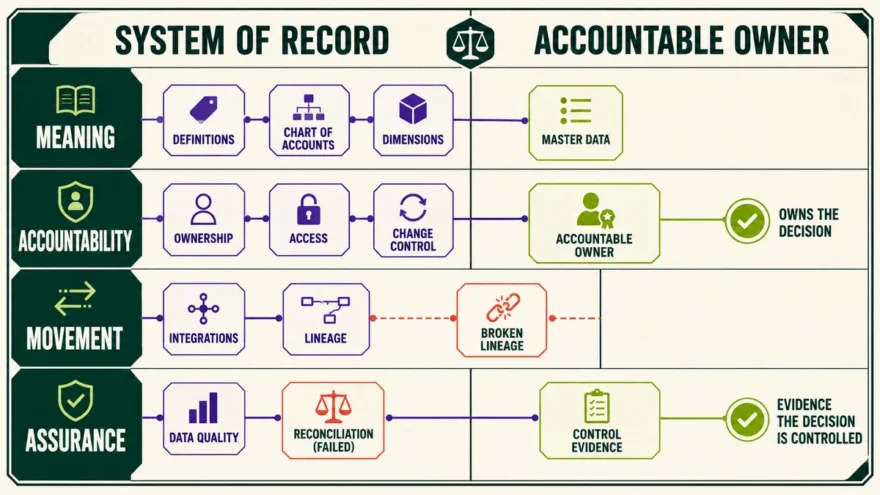
Finance systems teams should therefore keep SSO, roles, business-process approvals, integrations, certificates, data flows and release controls inside the usual approval path. A finance-stack ownership register can identify who owns each governed object and vendor relationship. An integration-control map can show which interfaces, reconciliations and exception owners would need review if an evidenced change later affects the operating model.
Five evidence triggers finance systems teams should set now
- A company-confirmed agreement or filing. Record the exact legal status, parties, consideration and conditions instead of carrying the Reuters report forward as a signed deal.
- Disclosed financing commitments. Separate committed funding from possible investors, and separate both from approval and closing risk.
- A regulatory, shareholder or court milestone. Track each required condition by jurisdiction and do not treat approval as transaction close.
- Effective change of ownership. Verify the closing announcement and effective date before updating counterparty records or ownership assumptions.
- A customer-specific notice or system change. Route any amendment, assignment notice, security or service update, subprocessor change, integration change or revised control evidence through its named owner.
Alongside those triggers, preserve a dated snapshot of the current contract set, renewal calendar, vendor-risk assessment, SOC reports available to the organisation, key configuration evidence and critical-interface inventory. This creates a before-state without manufacturing an operational response to an unconfirmed transaction.
What would require an update to this article
This article should be updated if Workday or Silver Lake confirms or ends the discussions, a definitive agreement or filing supplies transaction terms, financing becomes committed, an approval or close occurs, or Workday issues a customer-specific notice that affects applicable contracts, service obligations, data handling or systems controls. Until then, the defensible status is reported and ongoing discussions with no guaranteed deal and no established customer-system change.