An accounting platform can hold reliable books while orders, inventory, billing, procurement or project activity live elsewhere. An enterprise resource planning system can place more of that work in one suite and still leave weak ownership, poorly designed access or unreconciled exceptions. The useful comparison is not “small software versus big software.” It is a boundary test: which application may create each material record, when authority moves and what proves the resulting accounting is complete.
This guide is for controllers and finance-systems leaders deciding whether the present architecture remains defensible. It stops at the system-class boundary: accounting software, a governed mixed stack or ERP. Requirements, product scoring, requests for proposal, fit-gap analysis, demonstrations and selection governance belong to the broader ERP evaluation and selection process.
Quick answer
Setting the boundary too early adds ERP cost and implementation risk; setting it too late compounds reconciliation, control, close and reporting debt.
Decision: Decide whether to keep accounting software as the financial system of record with governed integrations or move the operational transaction chain into ERP.
Key takeaways
- Accounting software can remain appropriate when it owns the books and receives complete, controlled transactions from operational systems.
- ERP becomes more compelling when shared processes, master data or multi-entity workflows need coordinated authority that separate interfaces cannot govern economically.
- Company size is a weak migration rule; recurring breaks, duplicate ownership, close burden and intercompany complexity provide better evidence.
- Compare implementation, data, integrations, controls, support, training and recurring reconciliation work, not only software price.
- Approve migration against transaction, control, reporting, cutover and acceptance evidence, not a longer feature list.
ERP vs accounting software at a glance
Accounting software centers on recording, controlling and reporting financial transactions. ERP includes accounting functions but usually extends into operations such as procurement, inventory, order management, manufacturing, projects, workforce administration or supply chain. SAP’s current guide describes integrated modules across finance and several operating domains, while noting that ERP finance modules cover many of the same functions as accounting software. That is a category distinction, not a guarantee about a product or configuration. SAP’s ERP definition and module overview also says ERP systems connect to external applications, so ERP does not mean every process must sit in one database.
| Decision area | Accounting software | ERP | Controller’s test |
|---|---|---|---|
| Scope | Ledger, payables, receivables, cash, close and reporting, with product-dependent extensions. | Finance plus selected operational modules and shared process rules. | Which non-finance events must be governed before posting? |
| Record ownership | Usually owns the ledger while specialist systems own operational records. | Can own more of the transaction chain inside one suite. | Is one system authoritative for each object and status? |
| Controls | Controls span the ledger, connected applications and interfaces. | Modules may share administration, but roles and status boundaries still need design. | Can finance reproduce initiation, approval, processing, posting and correction? |
| Multi-entity | May use separate companies plus native or external consolidation. | May add shared data, intercompany workflows and cross-entity operations. | Is the problem reporting, or transaction execution? |
| Integrations | Depends more on governed handoffs to specialist systems. | Can remove some handoffs but still needs external interfaces. | Are breaks, retries and reconciliations controlled at acceptable cost? |
| Cost and risk | Narrower change scope, with possible recurring interface and manual-work cost. | Broader change scope, with possible reductions in duplicate data and handoffs. | Which target state has lower full cost and residual risk? |
Draw the boundary around the transaction chain, not company size
Employee count, revenue and volume help size a solution, but they do not decide the system class. A small manufacturer with inventory, production and intercompany flows may need broader operating control than a larger services company with simple billing. A growing company can also retain accounting software when specialist applications perform distinct jobs and every handoff is controlled.
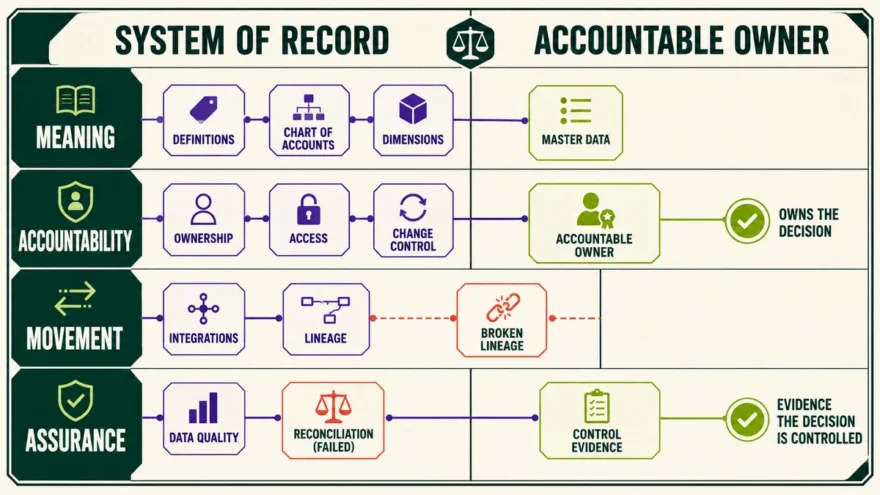
Map material chains such as order to cash, source to pay, inventory to cost of sales, project to billing, payroll to ledger and bank transaction to reconciliation. For each object, record who may create and approve it, the event that transfers authority, the system that posts the accounting effect and the evidence retained when a transfer fails. Use the Finance Technology Stack reference architecture to place each object and lifecycle state in its authoritative layer before comparing product scope.
Product scope overlaps. Some accounting platforms include inventory, projects, purchasing, multicurrency or consolidation. Some ERP deployments use only finance modules and retain separate billing, payroll, warehouse or planning systems. The configured operating model, not the marketing label, determines the real boundary.
Functional differences and system-of-record boundaries
Keep posted actuals under ledger authority
The general ledger should own posted actuals, the accounting calendar, journal status and the controlled correction path. SAP describes its Universal Journal as the book of original entry for Financial Accounting and Controlling transactions. That product design illustrates a wider principle: reporting, planning and operational systems may consume posted actuals, but corrections should return to the authorized accounting process. SAP’s Universal Journal documentation supports the example.
Separate operational and accounting states
An accepted order, fulfilment event, approved supplier, inventory movement or service milestone can be authoritative before a journal exists. The operational system may own the event; billing or a subledger may own the document; the ledger owns the posted effect. ERP can place several stages in one suite, but one database does not remove module, role and status boundaries.
Oracle’s receivables documentation distinguishes transaction data, receivables accounting and general-ledger balances, and provides an AR-to-GL reconciliation report. Oracle’s reconciliation guidance is product-specific, but it shows why subledger and ledger remain separate control states inside a suite.
Govern shared master data
Customer, supplier, item, account, legal-entity, currency and reporting dimensions create duplicate authority when several systems may amend them. ERP may simplify shared administration. An accounting-led stack can still work when one owner accepts or rejects changes and distributes approved identifiers to consuming systems.
When accounting software with integrations remains appropriate
A mixed architecture can be a deliberate target state. Retaining accounting software is defensible when:
- The ledger, subledgers, close and reporting meet entity and management needs without recurring unsupported workarounds.
- Operational platforms have distinct jobs that do not need to be absorbed into one suite.
- Each material object and status has one owner, stable identifiers and a controlled correction route.
- Interfaces carry counts, value totals, acceptance or posting status, rejected items and safe replay rules.
- Reconciliations, reporting latency, access, monitoring and support are owned and sustainable.
Connector count is not the test. Each material handoff needs an interface contract, exception owner and evidence that the expected population reached the accepted and posted states. Use the Finance Systems Integration Map to document system-of-record ownership, timing, control totals, safe retries, monitoring and reconciliation before retaining an accounting-led stack.
Migration triggers: when ERP becomes justified
ERP should solve an evidenced boundary failure, not serve as a general response to growth. The case strengthens when several of these conditions recur:
- Duplicate authority: master data or transaction status can change in more than one system without a precedence rule.
- Manual orchestration: finance repeatedly exports, maps, rekeys or matches material populations before posting or reporting.
- Operational breaks reach the close: missing fulfilment, rejected billing, unposted inventory or incomplete purchasing records become reconciling items.
- Entity complexity exceeds the model: new entities create repeated mappings, manual intercompany entries, delayed eliminations or inconsistent dimensions.
- Control evidence is fragmented: approvals, changes and exceptions are split across email, spreadsheets, tickets and logs.
- Change cost compounds: each new product, location, entity, channel or billing model requires several interface changes and compensating controls.
Measure frequency, value, staff time, close delay, exception ageing, post-close corrections and control impact. Compare that recurring burden with the proposed ERP’s cost and delivery risk. The case is stronger when one root cause affects several transaction chains and a narrower control or integration change will not fix it.
Multi-entity requirements: separate consolidation from operational integration
Multiple legal entities do not automatically require ERP. First determine whether finance needs controlled consolidation or whether entities must share operating processes, master data and intercompany workflows.
Microsoft documents consolidation across companies with different charts of accounts, fiscal years, currencies and even different business-management programs in Business Central. That illustrates that group reporting can be separated from one common operational platform. Microsoft’s company-consolidation documentation also describes data testing and eliminations, which remain control requirements in either system class.
| Requirement | Accounting-led stack can work when | ERP case strengthens when |
|---|---|---|
| Legal books | Each entity has controlled ledgers, calendars, currencies and group mappings. | Shared policy and master data cannot be maintained consistently. |
| Consolidation | Loads, mappings, translation, eliminations and sign-off are controlled. | Source changes and manual adjustments make results hard to reproduce. |
| Intercompany | Paired entries, matching, settlement and differences are complete and owned. | Activity is frequent, operationally generated and repeatedly unmatched. |
| Cross-entity operations | Entities share few order, inventory, project or procurement processes. | Common services need one workflow, shared status and centralized approval. |
| Group dimensions | Account, entity, customer and supplier mappings are governed and traceable. | Local codes proliferate faster than the group can map and reconcile them. |
Oracle’s Financials concepts guide says transfers between related legal entities need tracking and documentation for consolidation, local compliance and tax reporting. Oracle’s intercompany documentation describes an integrated product approach. Finance should still test paired documents, mapping, approval, settlement, elimination and exception ownership.
Compare cost as an operating model
Licence or subscription price is only one line. Use the same decision horizon and transaction scope for both options, then include:
- Platform: subscriptions, modules, environments, storage, support and applications that remain.
- Implementation: process design, configuration, data, integrations, testing, training and external specialists.
- Control: roles, access reviews, approval evidence, monitoring, reconciliations, audit support and remediation.
- Operating labor: transaction handling, exceptions, close, reporting, master data and system support.
- Change and risk: adding entities or business models, disruption, defects, delayed close, vendor dependency and recovery.
An accounting-led stack can be cheaper when it is narrow, stable and controlled. It can become expensive when each requirement adds mappings, manual review or fragile interfaces. ERP can remove duplicate data and handoffs, yet its case fails when scope expands, custom work recreates old processes, specialist applications remain or the organization cannot absorb the change.
Controls and integrations: system class does not create control effectiveness
The 2025 GAO Green Book applies to US federal agencies, so it is not a private-company requirement. It remains a useful design lens because it links reliable reporting and operations to responsibility, control activities, information and monitoring. GAO’s Green Book overview makes its federal scope explicit.
For public-company audit context, PCAOB AS 2201 directs auditors to understand how transactions are initiated, authorized, processed and recorded, where material misstatement could arise and how information technology affects the flow. PCAOB AS 2201 paragraphs 34–36 provide the source. The standard does not prescribe ERP, but its transaction-path lens helps compare architectures.
Test both options against the same questions:
- Who can create, approve, change, cancel, post and reverse each material object?
- Can incompatible duties be separated or independently reviewed?
- What proves a population was received, accepted and posted completely?
- How are duplicates, partial transfers, late records and rejections cleared?
- Can finance trace a reported balance through subledger, document and operational evidence?
- How are configuration, mapping and interface changes tested and released?
Process detail matters. The source-to-pay authority and handoff model follows supplier, contract, purchase-order and receipt evidence into AP. The order-to-cash control map follows accepted orders through billing, receivables, cash application and close.
Implementation and migration risk
ERP implementation exposure is often broader because more operating teams, records and decisions may change. A finance-only ERP module can still be narrower than a heavily integrated accounting-platform replacement, so assess the actual target state.
Process, configuration and data
Separate required controls from product workarounds before design. Recreating every local practice raises complexity, while removing a step without understanding its purpose can create a control gap. Map process, owner, role, configuration, report and evidence for each material requirement. Treat master data, opening balances, open transactions, comparative history, attachments and audit evidence as distinct conversion populations.
Integration and coexistence
List every system that will remain, retire or operate temporarily. During coexistence, state which platform owns new transactions, how late activity is handled and how duplicates are prevented. Microsoft’s Dynamics 365 documentation notes that consolidation can retain source companies as the owners and containers of their data. Microsoft’s consolidation and source-ownership guidance illustrates why a reporting target does not automatically replace source authority.
Cutover and acceptance
Approval should require realistic end-to-end evidence, not configuration completion alone. Test:
- Normal transactions, changes, cancellations, credits, reversals and period-end exceptions.
- Opening balances, open items and subledger-to-ledger agreement by entity, currency and period.
- Interface counts, values, rejects, retries, posting status and reconciliations.
- Role access, approvals, privileged changes and retained logs.
- Reports, cut-off, in-flight transactions, fallback, recovery and unresolved-defect ownership.
Where financial-reporting risk warrants it, run a parallel or reconciled close and set tolerance, defect severity and sign-off in advance. Go-live acceptance should not depend only on the team accountable for schedule.
A controller’s decision test before approval
| Test | Evidence | Accounting software remains credible when | ERP case strengthens when |
|---|---|---|---|
| Boundary | Object, status, owner, write rights and transfer event. | Authority is clear across systems. | Duplicate authority is structural and recurring. |
| Operational fit | Process variants, volumes, exceptions and specialist needs. | Specialist systems fit and handoffs remain controlled. | Shared workflows need common rules and status. |
| Entity fit | Books, currencies, charts, consolidation and intercompany. | Mappings and group reporting are timely and traceable. | Cross-entity execution cannot be governed efficiently. |
| Control fit | Access, approvals, change evidence, completeness and reconciliation. | Controls operate with reproducible evidence. | Gaps arise from the architecture, not isolated discipline. |
| Economic fit | Comparable platform, implementation, labor, control and risk costs. | Full cost is lower without hidden control debt. | Recurring burden exceeds justified migration cost and risk. |
| Delivery capacity | Owners, resources, data readiness, testing, cutover and support. | Targeted improvements can be sustained. | Cross-functional redesign can be funded and accepted. |
A positive ERP case authorizes that broader ERP evaluation; it does not select a product or vendor.
Frequently asked questions
Is ERP the same as accounting software?
No. ERP normally includes the ledger, payables, receivables and reporting, then adds integrated operational modules that share master data, workflow and transaction state. Accounting software owns the financial record and expects other systems to feed it. Product scope varies widely, so compare configured processes and system boundaries rather than relying on the label.
Does every multi-entity company need ERP?
No. Separate accounting systems plus a governed consolidation layer can work when entity books, mappings, currencies, eliminations and intercompany differences are controlled and someone owns each reconciliation. ERP becomes more relevant when entities must share workflows, data, approvals and transaction states, or when manual orchestration between systems starts to fail at scale.
Can accounting software remain the general-ledger system of record when operations use other tools?
Yes. Operational systems can own orders, fulfilment, usage, inventory or purchasing while accounting software owns subledger and posted financial states. The arrangement needs stable identifiers, controlled posting, status returns, exception ownership and reconciliation between each source and the ledger. It fails when nobody can say which system holds the authoritative record.
When should a company switch from accounting software to ERP?
Switch when repeated evidence shows that duplicate authority, manual orchestration, multi-entity execution, interface failures or fragmented controls cannot be corrected economically within the current architecture. Approve the move only when scope, data, controls, cutover and acceptance are funded and owned.