Adyen said on August 13, 2026 that it now expects full-year net-revenue growth of 21% to 23% year over year on a constant-currency basis, up from the 20% to 22% range reported in May. The new range includes Talon.One and Orb, whose acquisitions closed on July 1. Adyen’s prepared remarks attribute one percentage point of full-year growth, or two points in the second half, to the acquisitions and say the underlying organic outlook is unchanged.
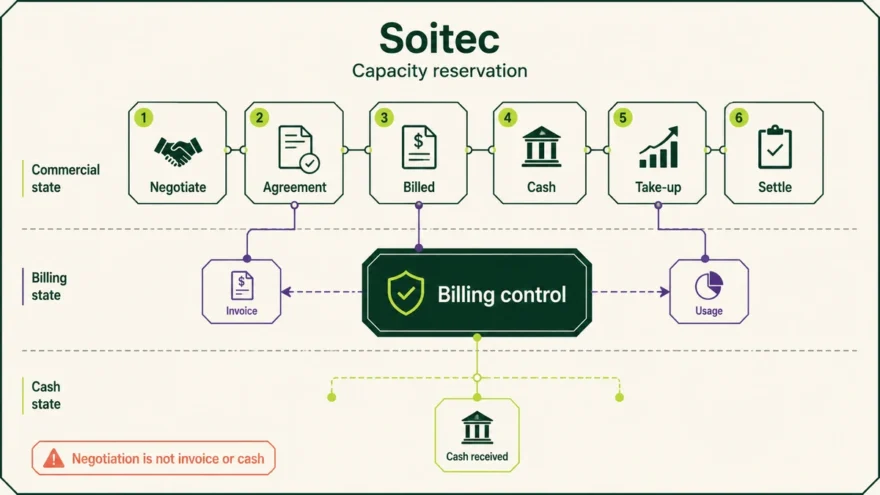
The acquisitions are closed and integration has begun, but the public record does not establish a mandatory merchant migration, a completed single-platform product or a combined control matrix. For a billing operations controller, the decision is whether usage, promotion, invoice, credit, refund, payment and settlement records can remain complete and reconcilable as the system boundary changes. The controls below are Finance Circuit analysis, not controls Adyen says it has deployed across one converged stack.
What changed and what it means
Weak handoffs can create missed or duplicated usage, incorrect promotions, invoice and refund errors, customer-balance differences and unreconciled settlement.
- Decision affected
- Approve migration, consolidation or a new production configuration only after one control matrix assigns system-of-record ownership and demonstrates the complete path from usage and promotion rules through invoice, reversal, payment and settlement.
- Evidence in brief
- Adyen’s releases establish the prior and revised guidance, the July 1 closings and integration status; current product documentation establishes component-level usage, promotion, payment and settlement behaviour.
- What remains unresolved
- Adyen has not disclosed a mandatory merchant migration, unified production architecture, control ownership model, acceptance tolerances or end-to-end operating evidence across the combined products.
- Next verification
- Map systems of record and run a usage-to-settlement parallel reconciliation before approving migration, then check product documentation and the Q3 update for integration changes.
Key takeaways
- Adyen’s 21% to 23% 2026 constant-currency net-revenue growth outlook includes an acquisition contribution; its organic outlook is unchanged.
- Talon.One and Orb closed on July 1, 2026, and integration has started, but Adyen describes billing-and-payments convergence as a later strategic intent.
- Finance needs one evidence chain from raw usage and promotion rules through invoices, reversals, payment status and settlement.
- Migration approval should require system-of-record ownership, parallel-run tolerances, exception owners and rollback criteria.
What Adyen changed in its 2026 outlook
The changed state is acquisition-inclusive guidance, not a higher forecast for the underlying business. The H1 prepared remarks say the acquisitions contribute one percentage point to the full-year growth range and two percentage points in the second half. Excluding Talon.One and Orb, management expects second-half growth to be similar to the first half.
The range remains a forward-looking estimate. Adyen also states that the H1 financial information is unaudited. Those limits matter because the 21% to 23% figure does not prove product integration, merchant adoption or a billing-control outcome. It establishes the financial reason the acquisitions now sit inside the 2026 outlook.
Integration has started, but convergence is not complete
Adyen confirmed both closings on July 1 and said it would begin integrating Talon.One’s promotional engine and Orb’s flexible billing. Talon.One supplies loyalty and promotion decisioning; Orb tracks usage data and translates pricing contracts into billing activity.
Adyen’s current product description draws a clear stage boundary. Orb is initially operating under an incubator model that preserves operational continuity and multi-payment-service-provider support. A single billing-and-payments infrastructure experience is the longer-term intent. No public source reviewed gives a merchant migration timetable, states that current Orb customers must move to Adyen payments or identifies when Talon.One promotion effects will become part of a unified billing record.
Finance should therefore separate current component behaviour from the target architecture. A working connector, a closed acquisition and a product roadmap are different control states. The Workday acquisition-talks control guide applies the same test one stage earlier: reported discussions do not establish a signed deal, committed financing or a customer systems change.
Build one control chain from usage to settlement
The combined workflow needs an authoritative record at every handoff. The table below is a finance acceptance design derived from current component documentation; it is not a published Adyen control matrix. The Stripe–OpenRouter billing-control analysis extends that ownership test to a two-sided AI marketplace, where customer credits and invoices must reconcile to model-provider liabilities and payouts.
| Stage | Evidence finance should retain | Hold or escalate when |
|---|---|---|
| Usage ingestion | Source event ID, customer and product identifiers, event time, quantity, idempotency key and any backfill or replacement reference | An event is duplicated, late, unmatched or replaced without a traceable reason |
| Rating and contract | Billable metric, plan and price version, effective date, contract reference and approval | The billed quantity or amount cannot be reproduced from the approved version |
| Promotion and loyalty | Customer session, campaign and rule version, returned effect, coupon or points movement and rollback event | The discount cannot be tied to the invoice line or a return does not reverse the intended effect |
| Invoice, credit and refund | Invoice version, credit note, balance or credit-ledger movement, original payment reference, reason and approval | Both account credit and cash refund remain available, or an old schedule remains active |
| Authorisation and capture | Orb invoice and customer IDs, Adyen merchant and payment references, authorisation result, capture result and exception owner | An authorisation is treated as final cash collection while capture is delayed, manual or failed |
| Settlement and ledger | Provider, settlement batch, transaction references, fees, payout amount, bank receipt and general-ledger posting | Paid status, settlement, payout and accounting entries do not reconcile |
Orb’s event-ingestion documentation supports per-event idempotency. Talon.One’s integration checklist requires stable session handling and distinguishes open, closed, cancelled and partially returned states. The controller’s task is to connect those technical states to the customer balance, invoice and accounting record without treating any one system response as the whole financial result.
Separate authorisation, capture and settlement
The current Adyen connector exposes a specific acceptance risk. Orb’s Adyen integration guide says Orb treats a successful authorisation as payment received and expects the Adyen merchant account to use automatic capture. Merchants using manual or delayed capture are told to resolve that design before going live.
Finance should retain separate statuses for authorisation, capture, capture failure, refund and settlement. A successful authorisation can support order progression, but it is not transaction-level evidence that funds were captured, paid out or posted correctly. Adyen’s Settlement details report is the transaction-level record for settled and paid-out payments and their costs.
The first-phase multi-provider model adds another boundary. Finance should identify which provider owns each payment and settlement record, then reconcile external-provider activity separately rather than assume one Adyen report contains the full population.
Credits and refunds need one economic outcome
Orb’s customer-balance documentation says a credit note applied to a paid invoice, or the voiding of that invoice, increases the customer balance. For a refund initiated in a payment provider, the documented workflow is to return the money through that provider, create the related credit note in Orb and decrease the Orb customer balance so billing, AR and cash reporting remain aligned.
Talon.One adds a separate reversal path. Its session states can trigger rollback effects when an order is cancelled or partially returned, although not every attribute update is automatically rolled back. Finance should therefore require one reversal identifier that connects the customer request, promotion effect, invoice or credit note, payment-provider refund and final balance. The control should prevent duplicate value and leave an exception owner when one system completes before another.
Set migration acceptance criteria before changing systems of record
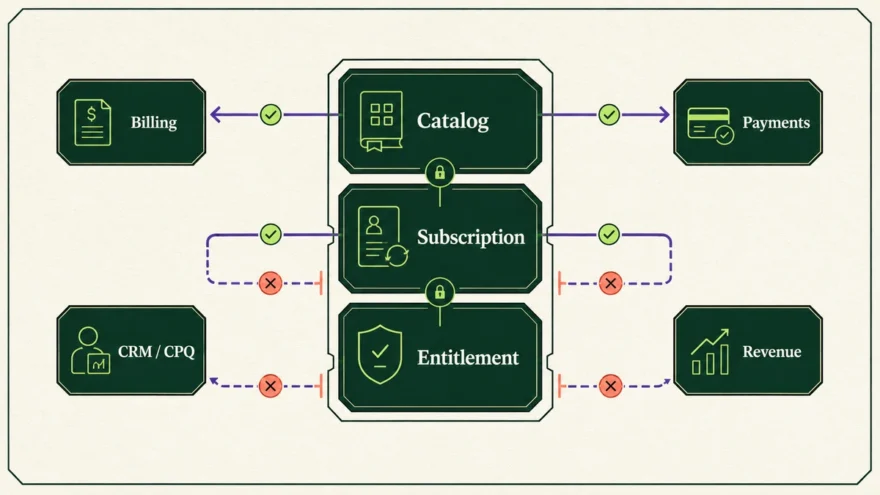
No public Adyen source reviewed announces a required migration. A merchant considering a new configuration or later convergence should still define acceptance evidence before changing production ownership. Start with a system-of-record matrix for customer IDs, product and metric IDs, contract and plan versions, campaign and coupon IDs, invoices, credit balances, payment references, settlement batches and ledger postings.
The Nayax–IPS parking-payment migration controls apply the same boundary to merchant ownership, remittance instructions, in-flight transactions and opening balances before any processor route changes.
Fix the migration population and opening balances, identify in-flight usage events, invoices, payments and refunds, and run old and new paths in parallel for a defined period. Tolerances should cover record counts, quantities, rated amounts, promotion effects, invoice totals, authorisation and capture outcomes, refund values, fees and settlement. Every difference needs a named owner, age, disposition and approval.
The party that builds an interface should not also be the only party accepting the financial result. The Revolut cutover-readiness analysis applies the same discipline to opening and closing records, in-flight items and rollback before a live route changes.
What billing teams should verify next
- Which Adyen, Orb and Talon.One capabilities are live for the merchant today, and which remain roadmap items?
- Which system owns each customer, metric, plan, campaign, invoice, credit, payment and settlement identifier?
- Can an approved usage event, plan version and promotion effect reproduce every billed line?
- Does payment status distinguish authorisation, capture, failure, refund, settlement and bank receipt?
- Can a cancellation or partial return reverse promotion, invoice, customer-balance and cash effects exactly once?
- What parallel-run tolerance, exception limit and rollback trigger must be met before production approval?
This is a control-readiness response to a closed acquisition and a revised forecast, not an allegation that Adyen, Orb, Talon.One or a merchant has suffered a billing failure. The next decision-grade evidence will be a merchant migration notice, updated integration documentation or a named implementation showing how the combined records, exceptions and settlements operate in production. Until then, finance should approve evidence, not product-convergence assumptions.