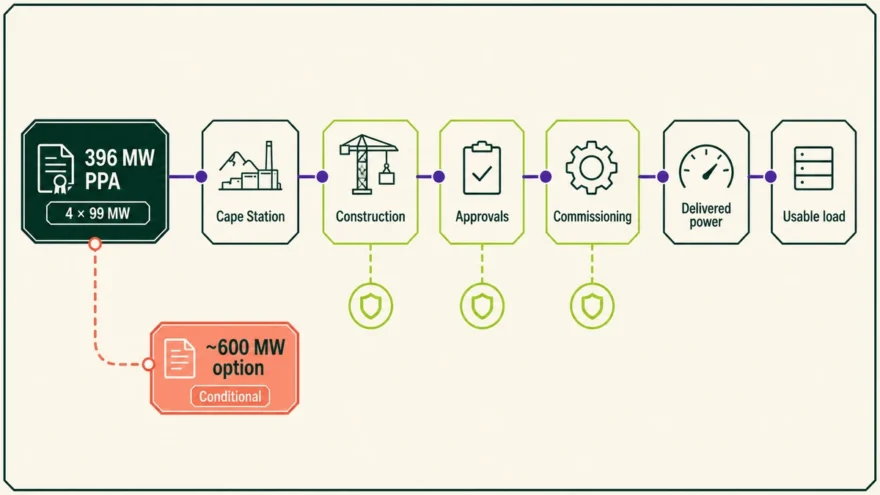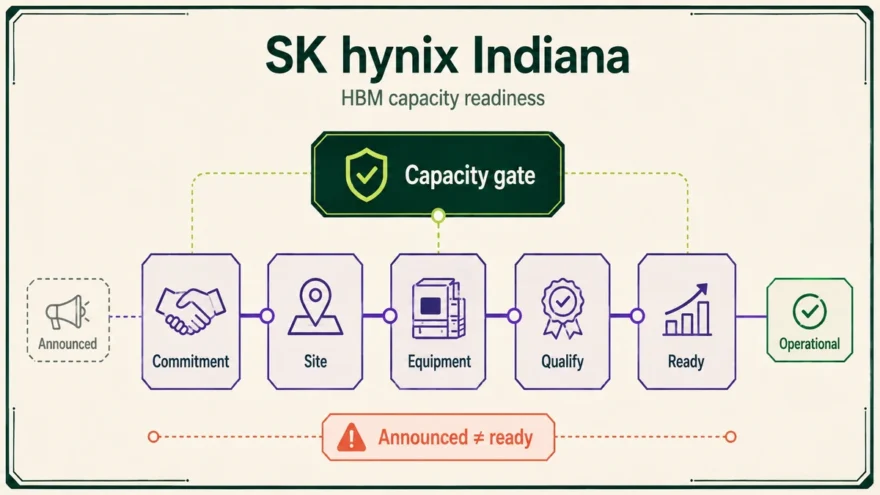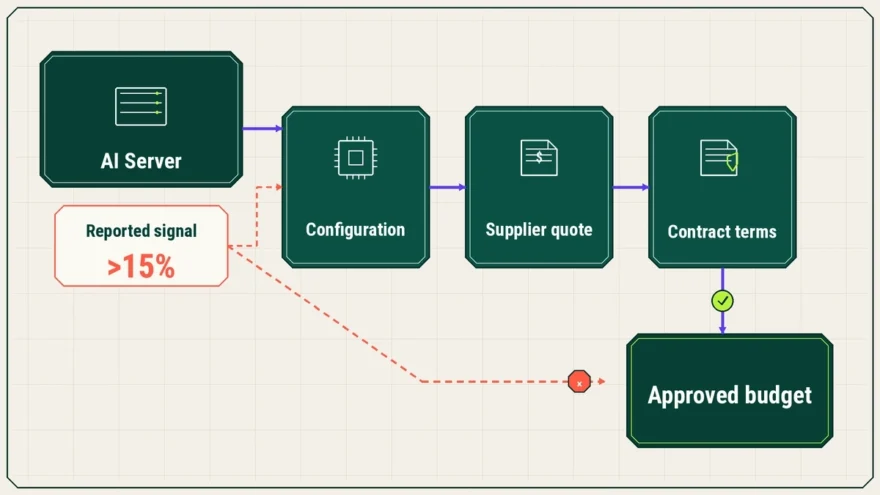
NVIDIA disclosed signed residual value guaranties on August 17, 2026 covering leases for approximately 4.25 gigawatts of IT load at the PORTS-Pike Technology Campus in Pike County, Ohio. Its aggregate initial payment obligation is capped at $105 billion, but the filing says NVIDIA’s obligations are subject to conditions that include SB Energy satisfying the applicable ready-for-service terms for the relevant premises, expected beginning in 2028.
OpenAI separately says it has contracted for approximately 8 IT-GW, with the first 800 MW expected in 2028 and later phases dependent on new generation, transmission, permits, environmental reviews and financing. For procurement, that makes the current status narrower than “8 GW secured.” The agreements secure commercial rights and credit support. They do not yet prove that any tranche has been commissioned, accepted or made payment-eligible as usable compute.
What changed and what it means
Premature classification can overstate usable capacity, start payments before service readiness and leave delay or replacement-capacity costs unprotected.
- Decision affected
- Decide when each OpenAI Ohio capacity tranche has enough evidence to be classified as secured, accepted and payment-eligible supply.
- Evidence in brief
- NVIDIA’s August 17 Form 8-K establishes signed guaranties for an initial 4.25 IT-GW, a $105 billion cap, lease-commencement mechanics and ready-for-service conditions expected from 2028.
- What remains unresolved
- The complete guaranty forms, lease schedules, technical acceptance tests, delivery remedies, replacement-supply rights and OpenAI exit rights are not public.
- Next verification
- Build a tranche register now, then inspect the guaranty forms in NVIDIA’s next 10-Q and verify each 2028 delivery against commissioning and acceptance evidence.
Key takeaways
- NVIDIA’s filed initial guaranties relate to approximately 4.25 IT-GW and carry a cumulative $105 billion cap; support for approximately another 3.8 GW is discretionary.
- OpenAI’s 8 IT-GW agreement and the 10 GW energy programme do not prove delivery of usable compute.
- The first 800 MW is expected in 2028, while later phases require additional generation, transmission and infrastructure.
- Procurement should track each tranche from contract through ready-for-service, commissioning, acceptance and payment instead of using one “secured capacity” status.
What the signed Ohio agreements actually secure
The controlling filing identifies OpenAI as the tenant and SB Energy as the lessor. Each NVIDIA guaranty generally becomes effective when the applicable lease commences. After an OpenAI insolvency default or payment failure, NVIDIA would generally cover the shortfall between a guaranteed minimum lease value and recoveries from a replacement lease or sale, subject to its stated remedy choices.
That is residual-value credit support, not a blanket guarantee of every lease payment from signing or a capacity-acceptance certificate. The filing makes support conditional on ready-for-service requirements for the relevant premises. OpenAI says it will pay only as completed capacity becomes available for lease. The public record does not show whether lease commencement, ready-for-service, acceptance and payment use identical tests or dates.
This distinction also keeps the story separate from the earlier NVIDIA compute-financing analysis. That article classifies financing-platform targets and contingent support for treasury. The Ohio procurement decision starts later: what evidence turns a signed capacity commitment into usable and payable supply?
Keep 800 MW, 4.25 GW, 8 GW and 10 GW out of one capacity bucket
The public announcements use several figures for different layers of the project. Procurement should preserve the unit, scope, status and decision attached to each one.
| Figure | What it describes | What it does not prove |
|---|---|---|
| 800 MW | First capacity expected to become available in 2028, largely using existing AEP infrastructure | Completed commissioning, tenant acceptance or a payment start date |
| 4.25 IT-GW | Initial NVIDIA guaranty scope and planned DSX deployment | That all initial premises are ready at one time |
| Approximately 3.8 GW | Additional credit support NVIDIA may provide in its sole discretion; the press release describes the remaining amount as 3.75 IT-GW | An exercised commitment or accepted expansion |
| Approximately 8 IT-GW | OpenAI’s stated customer agreement for capacity at the site | That the full amount is covered by the initial guaranties or available in 2028 |
| At least 10 GW | Planned new energy generation supporting the broader campus and grid programme | 10 GW of delivered IT load |
In March, the U.S. Department of Energy described 10 GW of planned generation and a 10 GW data-center development. The August filing adds a named tenant, signed guaranties and a defined initial IT-load scope. Generation, development, lease scope and accepted compute remain different measures.
Use five procurement states for every tranche
A single “secured” field hides the evidence still required. The data-center project-readiness gate separates development, capital commitment, financial close and draw availability before construction. OpenAI’s Ohio agreement needs a complementary tenant-side register after the commercial commitment is signed.
| State | Minimum evidence | Procurement treatment |
|---|---|---|
| Contracted | Executed lease or capacity schedule, identified premises, quantity, term and parties | Record as committed supply, not usable capacity |
| Ready for service | Contract-defined landlord certificate and satisfaction of site, shell and utility conditions for the premises | Release only the contractual consequences tied to that certificate |
| Commissioned | Integrated power, cooling, network and compute tests under the agreed configuration and load | Record tested capability and unresolved defects |
| Accepted | Authorised tenant sign-off for the exact tranche, with exceptions, retests and retained defects documented | Count only the accepted quantity as usable contracted supply |
| Payment-eligible | Contractual payment trigger, accepted billing unit, commencement date and invoice support | Release rent or service payment for the approved unit |
These states may occur close together, but procurement should not assume they are interchangeable. The NVIDIA filing uses ready-for-service as a condition for its own obligations. OpenAI uses completed capacity becoming available for lease as the stated payment boundary. The complete forms and lease schedules are needed to determine the exact connection.
Evidence required before acceptance and payment
For each phase, the acceptance pack should follow the physical dependency chain. Land evidence should identify the controlled parcel, access rights, remediation status and permits. Grid evidence should identify interconnection, transmission and generation milestones, energisation, curtailment, metering and backup mode. A planned $4.2 billion grid programme is not an energised handoff.
Shell evidence should cover completion, life-safety approval and the premises actually handed over. Cooling and network records should show performance at the agreed rack profile and network demarcation, not only a design statement. OpenAI says the project will use closed-loop, air-cooled systems and that the companies will collaborate on design, testing and commissioning. Those statements do not publish the acceptance thresholds or results.
NVIDIA’s exclusive-provider role does not establish chip allocation or delivery. Procurement needs the system bill of materials, allocation confirmation, installation records, configuration, load and thermal tests, resilience and security evidence, and an authorised defect list. The Riot Platforms phased-capacity analysis gives the broader contract-control framework; this Ohio record should apply it to each premises and payment event.
Delay, replacement and exit terms remain undisclosed
The SEC filing describes NVIDIA’s choices after an OpenAI payment or insolvency trigger. Those choices are not OpenAI’s remedies if SB Energy delivers late or a tranche fails testing. The public materials do not disclose the tenant’s long-stop dates, delay damages, service credits, withholding rights, substitute-capacity obligations, step-down rights or termination tests. They also do not disclose how a partial failure affects the remaining phases.
Procurement should record those items as not disclosed, not absent. Legal and commercial owners need to inspect the lease schedules and guaranty forms before relying on a remedy in the sourcing plan. Finance should model the cost of replacement capacity, duplicated migration, idle equipment, continued charges and schedule delay for each failure scenario. An exit right has little operating value if no alternative site, transition window or funded overlap is available.
What procurement should verify next
- Create one tranche register covering premises, IT load, planned date, lease status, guaranty status, dependency owner, evidence source and expiry.
- Map the first 800 MW separately from later phases that depend on new generation and transmission.
- Require one test pack for site, power, shell, cooling, network and installed NVIDIA systems before tenant acceptance.
- Reconcile the accepted capacity certificate to the payment trigger and the applicable NVIDIA guaranty.
- Retain delay, replacement-supply and exit terms beside the capacity record rather than in a separate legal summary.
- Inspect the full guaranty forms when NVIDIA files them with its next Form 10-Q, then update the state definitions where the executed terms require it.
OpenAI has a signed long-term capacity agreement, and NVIDIA has filed material credit support for an initial 4.25 IT-GW. The supply plan should count only the quantity supported by readiness, commissioning, acceptance and payment evidence. A guarantee can protect residual value without proving that usable compute has arrived.