Wabash entered an effective Sixth Amendment on August 12, 2026 that sets its asset-based revolving facility at $300 million, down from the prior $350 million commitment. The stated maturity moves from September 23, 2027 to August 12, 2031, but the agreement can mature earlier through dates tied to Wabash’s 2028 notes, 2032 convertible notes or other qualifying debt.
For treasury, the $300 million figure is only the first ceiling. Drawability depends on the borrowing base, lender reserves, outstanding usage and a temporary $40 million block. The $90 million pre-conversion covenant is a separate defined-liquidity test, not a cash-only floor or proof of drawability. Wabash has not disclosed the effective-date borrowing base, reserves, usage or exact amount available.
What changed and what it means
The $300 million commitment overstates usable liquidity unless treasury applies the borrowing base, reserves, facility usage and $40 million block; the $90 million test is a separate covenant measure.
- Decision affected
- Decide how much of the amended ABL can enter the 13-week forecast as drawable capacity and what covenant headroom to preserve before conversion.
- Evidence in brief
- Wabash’s filed 8-K and signed amendment establish the $300 million commitment, borrowing-base mechanics, $40 million block, defined-liquidity covenant and springing maturities.
- What remains unresolved
- The effective-date borrowing base, reserves, Revolver Usage, qualifying cash and exact drawable amount are not disclosed.
- Next verification
- Reconcile the agent-accepted borrowing-base certificate, actual availability and Financial Covenant Liquidity to the 13-week forecast, then monitor conversion and springing-maturity triggers.
Key takeaways
- Wabash’s maximum revolver fell from $350 million to $300 million, while the conditional $175 million accordion remained.
- The commitment must still pass through borrowing-base, reserve, usage and $40 million block mechanics before it becomes drawable capacity.
- The $90 million covenant uses pre-block excess availability plus qualifying cash, so it is not a cash-only floor or a drawability measure.
- The filing does not disclose the exact closing availability; treasury needs the agent-accepted borrowing-base and covenant calculations.
What changed from the $350 million facility
The prior $350 million facility was scheduled to mature in September 2027, carried margins 25 basis points below the amended ranges and allowed a $35 million swingline. Its 1.0-to-1.0 fixed-charge-coverage covenant was springing rather than continuously tested.
Wabash had previewed the block and liquidity covenant in July with $275 million of lender commitments and no assurance that definitive documents would be completed. The August agreement finalises the refinancing at $300 million and makes the terms effective.
| Term | Previous state | Amended state |
|---|---|---|
| Maximum revolver | $350 million | $300 million |
| Accordion | Up to $175 million, subject to lender commitments | Up to $175 million, still subject to lender commitments and conditions |
| Scheduled or stated maturity | September 23, 2027 | Earliest of August 12, 2031 and specified springing dates |
| Availability block | None stated in the 2022 filing summary | $40 million until the Financial Covenant Conversion Date |
| Swingline | $35 million | Up to $30 million |
| Term SOFR margin | 1.25% to 1.75% | 1.50% to 2.00% |
| Pre-conversion covenant | Springing fixed-charge-coverage test | $90 million of defined Financial Covenant Liquidity |
The $300 million commitment is only the first ceiling
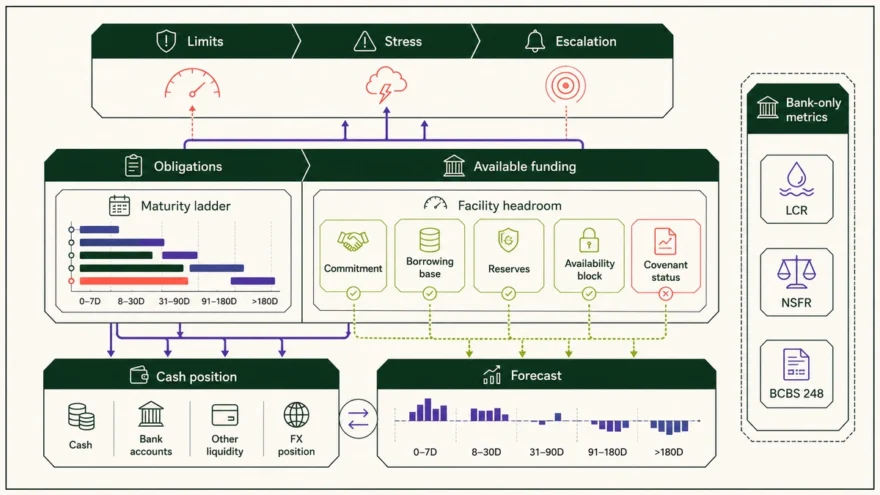
The signed amendment defines the borrowing mechanics through measures that should remain separate. The Line Cap is the lower of the $300 million Maximum Revolver Amount and the certified borrowing base, which applies advance rates, eligibility rules, caps and lender reserves to receivables, inventory and leasing inventory.
| Measure | What it means for usable liquidity |
|---|---|
| Maximum Revolver Amount | The contractual commitment ceiling before collateral and usage limits. |
| Borrowing Base | Collateral-supported capacity after eligibility rules, advance rates, caps, reserves and the agreement’s block mechanics. |
| Revolver Usage | Outstanding advances, including swing loans, plus letter-of-credit usage that already consumes capacity. |
| Availability | The amount the borrowers are entitled to borrow after giving effect to outstanding obligations. |
| Excess Availability | Availability after a further deduction for specified aged trade payables and book overdrafts. |
The $25 million letter-of-credit subfacility and $30 million swingline sit inside the overall facility; they are not additive. Treasury should also avoid subtracting the block twice. The agreement incorporates it into the lending mechanics, while an internal report may show it separately for reconciliation.
The $90 million test is not a cash-only floor
The agreement defines Financial Covenant Liquidity as pre-block excess availability plus qualifying unrestricted cash in controlled U.S. accounts. Before conversion, Wabash must maintain at least $90 million, apart from no more than three consecutive business days in any month.
The block reduces borrowing capacity, but the covenant calculation looks through it. Wabash could therefore satisfy the $90 million test while $40 million remains unavailable to draw. Covenant compliance cannot substitute for actual availability.
The block becomes zero only after the agent receives evidence of a fixed-charge-coverage ratio above 1.0 to 1.0 for two consecutive trailing-12-month periods ending at fiscal quarters, with the first quarter ending no earlier than December 31, 2026, and no default. After conversion, a springing coverage test applies when pre-block excess availability falls below the greater of 10% of the line cap or $25 million.
What treasury should enter in the 13-week forecast
The base forecast should start with the latest agent-accepted availability, not the $300 million commitment. The conditional $175 million accordion belongs in a financing scenario until lenders provide additional commitments and all conditions are met. A signed credit agreement still does not make every committed dollar drawable. A Dolce & Gabbana waiver-to-liquidity bridge applies the same rule when covenant testing is paused but the financing transactions remain unspecified.
Treasury should maintain separate fields for commitment, borrowing base, reserves, usage, the block, actual availability, excess availability and Financial Covenant Liquidity. The 13-week model should use expected drawable capacity after an internal buffer; the covenant forecast should use the agreement’s defined measure.
The amendment lists at least $120 million of Excess Availability after the transaction as an effectiveness condition, subject to satisfaction-or-waiver language. It is not a disclosed closing certificate and does not state the exact amount available on August 12 or later.
Availability affects reporting, pricing and maturity
The amended reporting schedule requires monthly borrowing-base certificates before conversion at or above the greater of 20% of the line cap or $110 million of pre-block excess availability. Three consecutive business days below that threshold move reporting to weekly.
Both margin ranges rose by 25 basis points, and the applicable tier depends on monthly average excess availability. Lower headroom can therefore reduce access, increase reporting frequency and raise interest cost together.
The 2031 date is an outer maturity. The facility matures 91 days before Wabash’s 2028 notes, 2032 convertible notes or other loan-party debt above $40 million, while that debt remains outstanding. Treasury should place those springing dates beside the stated maturity in the debt calendar.
What remains undisclosed and what treasury should monitor
The filing does not disclose the effective-date borrowing base, reserves, advances, letter-of-credit usage, qualifying cash, exact Financial Covenant Liquidity, current pricing tier or expected block-removal date.
Treasury should obtain and reconcile:
- the latest borrowing-base certificate and agent reserve schedule;
- daily actual availability, excess availability and revolver usage;
- the separate Financial Covenant Liquidity calculation and its qualifying-cash support;
- the fixed-charge-coverage certificates needed for conversion;
- the reporting-frequency threshold and any move to weekly certificates; and
- the 2028, 2032 and other debt milestones that can bring the maturity forward.
Wabash has a signed $300 million revolver with a longer stated maturity, but treasury can count only the capacity that survives the borrowing-base, reserve, usage and block controls on each forecast date.