Cisco said on 12 August 2026 that it took $4 billion of AI-infrastructure orders from hyperscalers in its fourth quarter, bringing the fiscal 2026 total to $9.3 billion. It separately said it delivered approximately $4 billion of AI-infrastructure revenue for the year. Those figures are reported historical outcomes, but they are not one order-to-revenue conversion schedule.
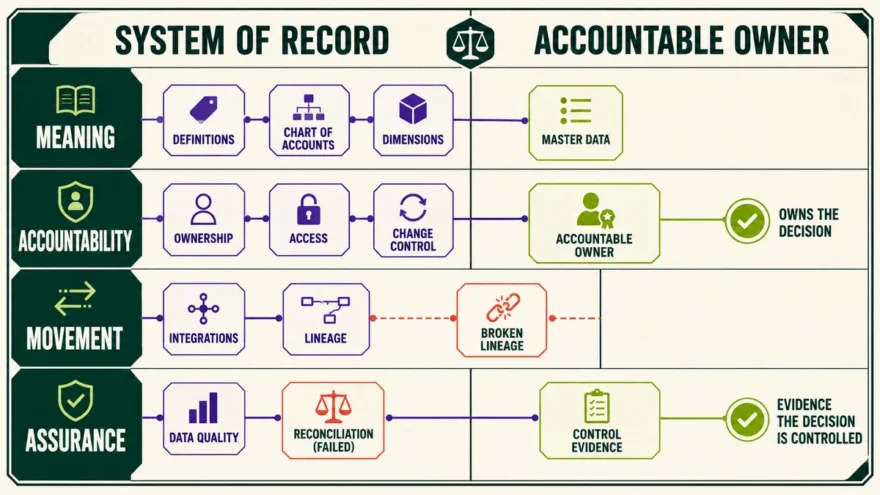
For finance systems leaders, the control question is whether every relevant contract line can be traced across the commercial order record, remaining performance obligations, fulfilment evidence, billing, contract assets or liabilities, and recognized revenue. Cisco reported $17.252 billion of total company revenue in Q4, $46.7 billion of total remaining performance obligations and $29.8 billion of total deferred revenue. It did not publish an AI-specific bridge among those measures, so finance should not infer one from the headline amounts.
What changed and what it means
Weak lineage can distort conversion analysis, forecast timing, close evidence and support for management order disclosures.
- Decision affected
- Define and test the identifiers, state ownership and reconciliations that separate commercial AI orders from RPO, fulfilment, billing, contract balances and recognized revenue.
- Evidence in brief
- Cisco reported $4bn of Q4 hyperscaler AI-infrastructure orders, $9.3bn for fiscal 2026 and approximately $4bn of fiscal-year AI-infrastructure revenue, alongside companywide RPO and deferred-revenue balances.
- What remains unresolved
- Cisco does not disclose which AI orders entered RPO or how those orders map to billing, contract assets, deferred revenue and recognized revenue.
- Next verification
- Map contract-line identifiers across order management, contract records, fulfilment, billing, the revenue subledger and disclosure reporting, then test each measure independently.
Key takeaways
- Cisco’s $9.3 billion fiscal 2026 AI-infrastructure order figure is an order metric, not the company’s RPO, deferred-revenue or GAAP revenue balance.
- The public figures use different scopes: AI orders and AI revenue are hyperscaler measures, while Q4 revenue, RPO and deferred revenue are companywide.
- A dependable lineage must preserve contract enforceability, performance-obligation allocation, transfer-of-control evidence, invoice timing and accounting state.
- Cisco has not disclosed which AI orders entered RPO or how they map to contract assets, deferred revenue and recognized revenue.
The $9.3bn order metric is not Cisco’s $46.7bn RPO
The previous state helps define the change. In its 13 May third-quarter release, Cisco reported $5.3 billion of fiscal-year-to-date AI-infrastructure orders from hyperscalers. It raised expected fiscal 2026 orders to $9 billion from $5 billion and expected AI-infrastructure revenue to $4 billion from $3 billion. The Q4 result therefore moved the order measure from a raised expectation to a reported $9.3 billion full-year outcome.
RPO answers a different question. Cisco’s Q3 Form 10-Q showed $43.462 billion of RPO at 25 April, comprising $28.599 billion of deferred revenue and $14.863 billion of unbilled contract revenue. Cisco described the unbilled component as noncancelable contracts that had not been invoiced, still required performance and had not produced recognized revenue. The Q4 release later reported total RPO of $46.7 billion, but it did not identify an AI-specific amount.
| Measure | Publicly reported scope | What finance must prove |
|---|---|---|
| AI-infrastructure orders | $9.3bn for fiscal 2026 hyperscalers | The order definition, contract version, cancellation rights and included value |
| Remaining performance obligations | $46.7bn companywide at Q4 | Which enforceable obligations remain unsatisfied and unrecognized |
| Deferred revenue | $29.8bn companywide at Q4 | Which contract liabilities await fulfilment and recognition |
| Contract assets | Not quantified in the Q4 release | Where transfer of control preceded scheduled billing |
| Recognized revenue | Approximately $4bn of FY26 AI revenue; $17.252bn total Q4 revenue | Which performance obligations produced each posted revenue entry |
Build the lineage around contract-line states
The system design should not force every transaction through a single order-to-RPO-to-invoice-to-deferred-revenue sequence. An order can change or be cancelled before it becomes an enforceable noncancelable obligation. A contract may contain hardware, software and service elements that become separate performance obligations. Billing can occur before revenue, creating a contract liability, or revenue can occur before scheduled billing, creating a contract asset.
The durable control is a set of identifiers and versioned states. The commercial order line should retain the customer, offer, quantity, price, currency, order date and management-metric inclusion flag. Contract management should add enforceability, termination and cancellation terms. The revenue subledger should hold the performance-obligation ID, allocated transaction price, satisfaction pattern and recognition schedule. Fulfilment and billing systems should contribute shipment, delivery, acceptance where required, invoice and credit-memo events. The Cerebras cloud-revenue and margin analysis extends that model to On-Demand consumption, Dedicated Capacity, pass-through amounts, customer-warrant contra-revenue and capacity costs inside one reported cloud line.
Each interface should pass the original identifiers rather than recreate them from customer name, purchase-order text or reporting-period totals. Where a source system cannot carry the full key, a governed cross-reference table should map it, record effective dates and preserve prior versions. Otherwise a later contract amendment can make the current record appear to support an earlier accounting entry when it did not.
Separate transfer of control from invoice timing
Cisco’s filing says revenue is recognized when control of promised goods or services transfers. For hardware and perpetual software, that can generally occur on shipment, electronic delivery, or transfer of title and risk of loss. Software maintenance, SaaS and services can be recognized over time. The filing also notes that some service-provider and cloud arrangements include acceptance provisions that can delay recognition.
That policy makes three timestamps essential: the operational fulfilment event, the contractual transfer-of-control event and the accounting posting date. An invoice date is a fourth event, not a substitute for the other three. Finance should also retain the evidence type used for each conclusion, such as carrier proof, electronic entitlement, title transfer, customer acceptance or a service-period schedule.
The same distinction explains why deferred revenue and contract assets point in opposite timing directions. Deferred revenue is a contract liability because billing or consideration precedes recognition. A contract asset can arise when revenue is recognized before scheduled billing. Any dashboard that treats “billed” as a universal midpoint between order and revenue will misclassify at least one of those paths.
Reconcile orders, RPO, contract balances and revenue separately
Finance should operate four reconciliations with common identifiers but different inclusion rules. The order roll-forward should explain opening orders, new orders, amendments and cancellations under the published management definition. The RPO schedule should identify enforceable unsatisfied obligations and distinguish deferred revenue from unbilled contract revenue. The billing and contract-balance reconciliation should connect invoices, receivables, contract assets, deferred revenue, credits and cash application. The revenue reconciliation should tie satisfaction events and schedules to the revenue subledger and general ledger.
Control totals should exist at contract line, customer, offer, currency and reporting-period level. Exceptions need a named owner and reason code, not a balancing journal that erases the source-state difference. Useful reason codes include cancellation after order reporting, order value excluded from RPO, contract modification, partial shipment, acceptance pending, invoice hold, revenue before billing, billing before fulfilment, credit memo and foreign-exchange remeasurement.
A disclosure-control layer should then reproduce the published order KPI independently from the accounting measures. That layer needs a controlled definition, approved source fields, period cut-off, review evidence and a bridge to prior reporting. It should not make the order number equal RPO or revenue merely to simplify an executive dashboard. Whether that layer is a quarterly build or a system output depends on the revenue recognition tooling behind it.
What Cisco’s disclosure does not establish
The public record does not show which fiscal 2026 AI orders were noncancelable, when they became enforceable contracts, how transaction price was allocated, which amounts entered RPO, or whether billing occurred. It also does not show the related contract-asset or deferred-revenue balances, shipment or acceptance status, or the revenue recognized from the same order cohorts.
For that reason, subtracting approximately $4 billion of AI-infrastructure revenue from $9.3 billion of orders and calling the difference backlog would be unsupported. The figures may cover different order cohorts, contract terms, cancellation rights and recognition periods. Cisco’s $46.7 billion RPO and $29.8 billion deferred-revenue balances are companywide and cannot be treated as AI-specific corroboration.
What finance systems leaders should test now
- Definition ownership: name the owner of the AI-order KPI and freeze the inclusion rules used for each reporting date.
- Identifier continuity: sample contract lines from the reported order population through contract management, fulfilment, billing, the revenue subledger and disclosure reporting.
- State evidence: verify that cancellation, modification, shipment, acceptance, invoice and recognition events carry timestamps, source documents and approvers.
- Bidirectional reconciliation: test from the order population forward and from posted revenue and contract balances back to source obligations.
- Exception aging: review unmatched or stale items by value, reason and owner before close and before management metrics are released.
The objective is not to make every order convert on one path. It is to prove which path each contract line took and why its status belongs in one reported measure but not another.
Next verification: Cisco’s fiscal 2026 Form 10-K
The next controlling record is Cisco’s fiscal 2026 Form 10-K when filed. Finance teams should check the year-end RPO composition, contract assets and liabilities, revenue-recognition policy, and any additional discussion of AI-infrastructure demand or conversion. The filing may still leave the AI-specific bridge undisclosed. Any later definition of the order metric or cohort-level conversion evidence should update this analysis rather than be inferred from the August earnings release.