A treasury management system can become the operating core for cash, banking, payments, funding and financial risk. It may receive bank data, calculate the daily position, initiate payments, maintain debt and derivative records, generate accounting entries and send results to the general ledger. A weak scope decision can move manual work into a new interface without settling which system owns each financial state.
Evaluation should begin with treasury’s operating model: entities, banks, currencies, payments, instruments, accounting, controls and integration boundaries. This guide defines the category, separates narrower software types, maps required workflows and sets a dated documentation method for product testing without naming a universal winner.
Quick answer
A TMS design that matches treasury’s operating model can centralize cash, risk and payment control; a scope or ownership mismatch can preserve fragmentation behind a new interface.
Decision: Approve a treasury management system shortlist and target architecture only after each option proves the required workflow scope, system ownership, controls, integrations and acceptance criteria.
Key takeaways
- A treasury management system is a broad treasury data and workflow platform, but the category label does not prove that every module, bank, instrument or accounting method is included.
- Treasury automation, liquidity management software and cash flow automation can improve important stages without replacing the wider TMS record, control and integration model.
- Bank connectivity, payments, cash, risk, accounting and reconciliation must be tested as linked state changes, not as separate feature demonstrations.
- The architecture decision is as important as the product decision: buyers must assign authoritative records across the TMS, ERP, banks, payment hub, trading venues and data platform.
- A credible shortlist uses scripted cases, buyer data and acceptance evidence rather than vendor rankings, feature counts or a generic “best TMS” label.
What is a treasury management system?
A treasury management system, or TMS, is a corporate treasury application that centralizes data and workflows for cash, liquidity, banking, payments, funding, investments and financial risk, then connects them to accounting and enterprise systems. The
Association for Financial Professionals’ TMS overview
covers cash and liquidity, forecasting, bank-account administration, transactions, risk, payments, accounting and reporting. AFP’s
treasury technology guidance
adds debt, investments, foreign exchange, bank communication and internal-system integration.
This is category breadth, not a contract promise. A supplier may offer a broad suite, separate modules or partner-delivered scope. An enterprise resource planning system may cover similar work through treasury components. Buyers must define the target state and verify every required capability in the proposed edition and configuration.
This guide uses TMS to mean software for a corporation’s treasury function. It does not use the term for a bank’s own treasury or asset-liability systems, or for treasury-management services a bank sells to business customers. Those services may provide accounts, payments, liquidity products or connectivity, but they are not automatically the corporation’s treasury system of record.
How a TMS differs from adjacent treasury software
The following boundaries are decision rules used in this guide. They reflect the workflow each category primarily owns, not protected industry definitions.
| Category | Primary job | Typical scope |
|---|---|---|
| Treasury management system | Own or coordinate the broader treasury operating record and workflow | Bank data, cash position, forecast, payments, accounts, liquidity, debt, investments, FX and rate risk, hedging, accounting and reconciliation |
| Treasury Automation | Automate selected steps and exception routing | Data collection, rules, approvals, payment preparation, forecast updates, reconciliation and alerts |
| Liquidity Management Software | Measure and act on available liquidity | Cash visibility, positions, forecasts, facilities, pooling, restrictions, scenarios, stress and liquidity actions |
| Cash Flow Automation | Collect, calculate and roll cash forecasts | ERP, AP and AR ingestion, forecast drivers, scenarios, variance analysis and reporting |
A category label sets expectations it does not always meet, so test the limits before adopting the name.
| Category | What the label does not prove | Use it when |
|---|---|---|
| Treasury management system | That all modules are native, licensed, configured or suitable for the buyer’s banks, instruments and accounting policies | Treasury needs one governed platform or suite across several connected domains |
| Treasury Automation | That the automation layer is the authoritative record for balances, deals, payments or accounting | The primary problem is manual handling across known systems and controls |
| Liquidity Management Software | Broad payment execution, complete debt and investment lifecycle, market-risk management or treasury accounting | The decision centers on cash availability, funding capacity and liquidity actions |
| Cash Flow Automation | Bank-account governance, payment control, debt, investments, hedging or a complete treasury ledger | The central gap is forecast preparation, update speed and assumption control |
Cash management is narrower. AFP describes
cash management as a subset of treasury management
centered on daily cash flow and liquidity, including collections, disbursements, banking and short-term borrowing or investment. That may be enough for a bounded requirement, but it does not establish full TMS scope.
What a TMS should own across the treasury workflow
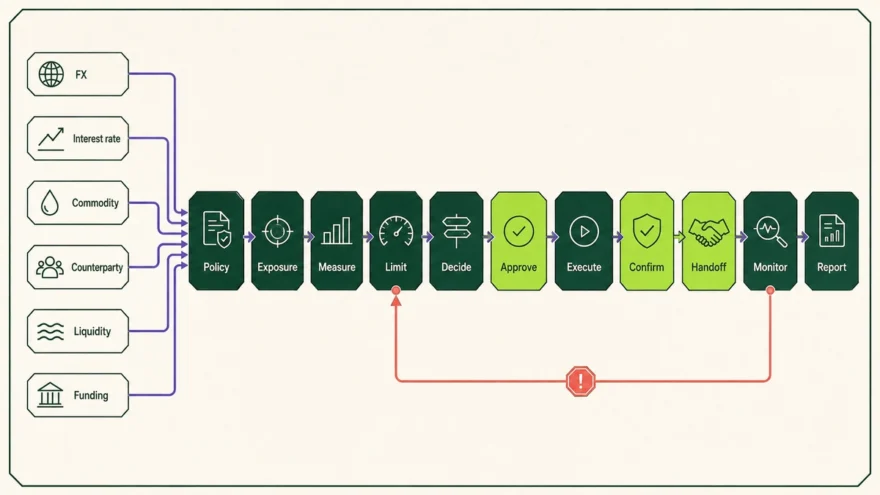
The useful question is not whether a product has a feature. It is whether the product can receive the right evidence, maintain the required state, apply the control and pass an accepted result to the next system. The minimum scope below turns the category into testable operating outcomes.
| Domain | System outcome | Evidence retained | Buyer test |
|---|---|---|---|
| Bank connectivity | Receive reports and statuses; send approved instructions | Channel, format, cut-off, message ID, timestamp, status, exception | Test normal, late, rejected, duplicate and unavailable feeds |
| Cash positioning | Calculate cash by entity, account, bank and currency | Booked, value-dated, pending, restricted, swept and in-transit amounts | Reconcile to bank evidence and explain exclusions |
| Cash forecasting | Maintain controlled forecast versions and scenarios | Source, owner, assumption, cut-off, actual and variance | Change one assumption without overwriting the baseline |
| Payments | Validate, approve, release, track and reconcile instructions | Origin, beneficiary, authority, bank response and settlement | Test rejection, recall, duplication and beneficiary change |
| Bank-account management | Govern accounts, signatories, mandates and lifecycle | Purpose, owner, authority, status and retained history | Complete one account or signatory change |
| Liquidity | Combine usable cash, facilities, restrictions and buffers | Availability conditions, maturity, draw status and scenario | Separate drawable capacity from cash under stress |
| Debt and investments | Maintain terms, events, schedules, positions and approvals | Principal, rate, maturity, counterparty, settlement and status | Process a draw, reset, repayment and maturity |
| FX and rate risk | Aggregate exposures, apply limits and track responses | Source exposure, netting, tenor, curve, limit and action | Trace exposure through hedge and residual position |
| Hedging and accounting | Connect exposure, deal, valuation, designation and posting | Method, market data, approval, result, exception and journal status | Reperform an approved accounting case |
| Reconciliation | Match bank, payment, deal, subledger and ledger records | Basis, unmatched item, reason, age, owner and sign-off | Resolve partial, duplicate and timing differences |
| Controls and reporting | Enforce access, segregation, limits and change control | User, action, prior value, approval, timestamp and audit export | Demonstrate denied actions and material changes |
Bank connectivity is a controlled state flow
Connectivity is not a bank-logo count. Buyers need the channel, operator, expected timing and failure path for every account and message. SWIFT describes
SCORE as a closed user group
for corporate and financial-institution interaction, while
FileAct supports large file transfers
.
ISO 20022 supplies a message framework
;
SWIFT’s corporate guidance
identifies pain.001 and pain.002 for payment initiation and status, and camt.052, camt.053 and camt.054 for cash reporting.
Standards do not settle the architecture. A TMS may connect directly or through bank APIs, host-to-host links, SWIFT services, a managed provider or payment hub. The
corporate bank-connectivity architecture
should separate transport, format, authentication, acknowledgement, retry and reconciliation. Transfer, bank acceptance, execution and settlement are different states.
Cash position, forecast and liquidity are different records
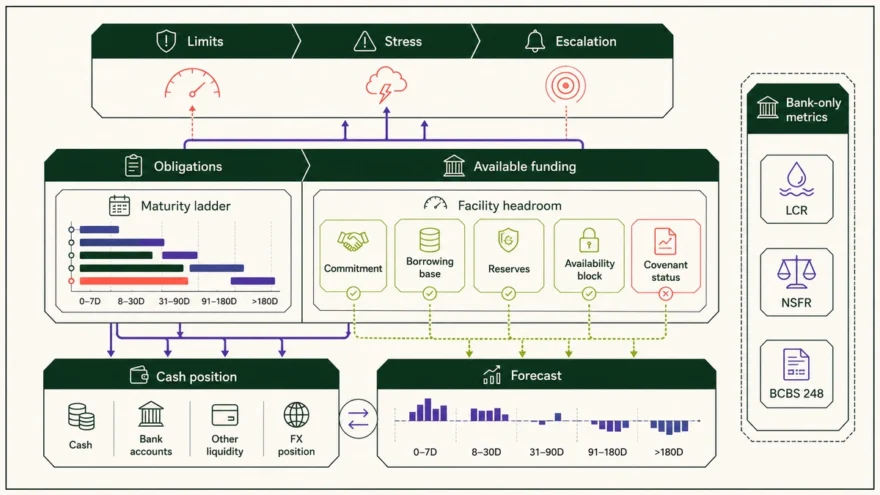
The cash position states what cash is present and usable at a defined time. The forecast states what may move and why. The liquidity view adds facilities, restrictions, buffers and scenarios. A TMS can connect them, but should not collapse restricted cash, pending receipts, unpresented payments, overdrafts and undrawn facilities into one number.
For near-term planning, preserve the assumptions and locked versions used in a
controlled 13-week cash forecast
. Reviewers should trace each amount to its source and owner, see scenario changes and compare the prior version with actual bank movement.
Payments and bank-account management require lifecycle evidence
A payment should move through proposed, validated, approved, released, accepted, executed, settled and exception states without losing prior evidence. Source approval must remain separate from bank authorization, and a changed beneficiary or amount must not inherit an earlier approval. Where a payment hub owns execution, the TMS needs authoritative status and reconciliation.
Bank-account management should record legal owner, purpose, bank, currency, signatories, mandates, services and lifecycle approvals. Electronic bank-account management is bank-dependent, so test the exact banks and actions rather than accept a general eBAM claim.
Debt, investments, risk, hedging and accounting must share identifiers
Debt and investment modules should preserve terms, events, rates, schedules, counterparties, limits and settlement. FX and rate workflows need the source exposure, netting logic, hedge decision, executed deal and residual risk. The TMS should apply approved policy limits and retain how each position changed. Those limits come from a written policy, and how treasury policy limits are set and approved stays a governance decision the product does not make. A TMS module is one of several places those steps can sit, so settle which category of FX solution can own each of those steps before assuming the module owns all five.
Hedge accounting is a specialist boundary. Software may support designations, valuations, effectiveness tests and journals, but the company owns policy, accounting conclusions, source completeness and review. The responsible accounting specialist should validate each required method, instrument and jurisdiction before acceptance.
Reconciliation closes the operating loop
Bank data, payments, deals and journals can be missing, duplicated, delayed or mis-mapped. Reconciliation should test completeness and value across interfaces, with reason, amount, age, owner, action and sign-off for every exception. The
account reconciliation control standard
supplies the wider evidence model.
Choose the implementation architecture before choosing the product
A product can pass a feature review and still fail as an architecture. Treasury, finance systems, accounting, security and payments teams should assign each object and state to an authoritative platform. The
finance technology stack ownership model
allows creation, approval and posting to sit in different systems, but ownership cannot remain implicit.
| Architecture | Where it fits | Main design risk | Evidence to require |
|---|---|---|---|
| Broad standalone TMS | Multi-bank, multi-entity treasury needing depth across several domains | Duplicate master data and complex interfaces with ERP, payments and accounting | Object ownership, connector scope, posting model, export rights and end-to-end support |
| ERP-native treasury | ERP-centered organization prioritizing a shared data and control model | Licensed components or treasury depth may not match the operating requirement | Exact modules, non-ERP bank and market connections, upgrade path and treasury test cases |
| Modular treasury suite | Phased adoption by cash, payments, risk, debt or accounting domain | Modules may create separate data, workflow or commercial boundaries | Shared identifiers, cross-module controls, entitlement model, roadmap and contract boundaries |
| Overlay or specialist hub | Existing ERP or TMS retained while a forecast, liquidity, connectivity or payment gap is addressed | The overlay becomes another reconciliation point and its authority is unclear | Read and write paths, write-back controls, exception ownership, data portability and exit design |
The integration model should cover banks, ERP, AP, AR, payroll, trading, market data, identity and reporting. For every interface, record sender, receiver, object, frequency, cut-off, format, validation, control total, retry, monitoring owner and reconciliation. A
finance systems integration map
separates technical receipt, business acceptance and financial posting.
Also test availability, recovery, data location, encryption, identity, privileged access, logging, retention, peak-volume performance, releases, test environments, support and export. A cloud label or certificate does not show how the buyer’s treasury service will recover, evidence a change or leave the platform.
Product map based on official documentation, 18 August 2026
This representative map required an accessible official page on 18 August 2026, a corporate treasury use case and enough scope detail to classify the offering. Two narrower products are included because buyers meet them in TMS research and need to see where their documented scope stops. No scores, market-share estimates, prices or outcome claims were used. Operating-model fit is Finance Circuit analysis, not endorsement.
Official pages show what suppliers say they cover. They do not establish the modules in a proposal, buyer-bank connectivity, accounting configuration, production control effectiveness, implementation effort or total cost. Those remain RFP, contract, proof-of-concept and acceptance questions.
| Product | Documented scope | Fit to examine | Buyer must still test |
|---|---|---|---|
|
Kyriba Treasury | Cash and liquidity, payments, risk, forecasting, in-house banking, analytics and connectivity | Broad SaaS suite for multi-entity treasury | Buyer banks and ERPs, licensed risk and accounting scope, payment controls, exports and service levels |
|
Ripple Treasury, formerly GTreasury | Cash visibility and forecasting, payments, reconciliation, netting, risk, debt, investments and connectivity | Modular TMS for staged adoption | Current module roadmap, connectors, deal and accounting methods, shared data and migration |
|
FIS Treasury and Risk Manager, Integrity Edition | Cash, forecasting, accounts, payments, FX, debt, investments, accounting, compliance and hedge accounting | Broad daily-cash through instrument-accounting scope | Instrument models, payment authority, interfaces, upgrades and buyer-specific accounting output |
|
ION Reval | Cash, liquidity, financial risk, complex instruments, accounting and reporting | Treasury with material derivative and hedge-accounting requirements | Cash and payment depth, model governance, policy fit, implementation and support |
|
SAP S/4HANA treasury components | Cash Management; Treasury and Risk Management; Advanced Payment and Multi-Bank Connectivity | ERP-centered treasury using the SAP data model | Licenses, components, non-SAP interfaces, embedded or sidecar design, roles and end-to-end depth |
|
Nomentia Smart Treasury Suite |
Connectivity, account administration, eBAM, payments and cash; loans, FX, derivatives, valuation and risk control | Modular model with bank and risk emphasis | US bank coverage, eBAM actions, accounting outputs, cross-module flow and data location |
|
Embat | Bank and ERP connectivity, cash, forecasting, payments, reconciliation, debt, intercompany activity and risk | Modern modular platform for growing multi-entity teams | Bank coverage, payment and risk depth, accounting, resilience, scale and migration |
|
HighRadius Treasury Management Applications | Cash Forecasting Cloud and Cash Management Cloud integrated with ERP, TMS, accounting systems and banks | Cash or forecast overlay with another authoritative system | Record ownership, write-back, lineage, reconciliation and scope beyond cash |
|
Bottomline Payments Hub and Global Cash Management Hub | Payment standardization, bank connectivity and controls; related cash position and forecast visibility | Payment or cash hub without a full TMS | Position source, downstream status, reconciliation, missing domains, exports and support |
Omission does not mean a product is unsuitable, and a narrower application may be right when an existing ERP or TMS remains authoritative. The error is assuming a cash, forecast or payment layer also covers debt, investments, hedging, accounting and wider treasury control.
Build the shortlist from operating evidence
Start the RFP with the target operating model, not a copied feature list. AFP’s
standardized TMS RFP resource
advises customization and removal of irrelevant questions. Its
provider-evaluation guidance
also treats long-term provider support as part of selection, not an afterthought.
The requirements matrix should list entities, banks, accounts, currencies, payment rails, ERPs, instruments, risk methods, accounting outputs, users, volumes and controls. Mark each as first release, later phase or out of scope, then state whether the product owns the record, performs the workflow, calculates, approves or receives a copy. For the risk-methods row, how liquidity risk methods are specified separates market-risk analytics from funding limits, concentration tests and stress output.
Use scripted proof-of-concept cases
| Scenario | Buyer data | Evidence retained |
|---|---|---|
| Daily position and late feed | Accounts, currencies, restrictions, overdrafts and one delayed report | Coverage, timestamp, exception, prior-balance rule and reconciliation |
| Forecast and liquidity stress | AP, AR, payroll, debt schedules, facilities and one scenario change | Lineage, baseline, assumption, availability treatment, result and variance |
| Controlled payment | Realistic files, authorities, bank formats and changed beneficiary | Validation, segregation, approvals, bank status, failure handling and settlement match |
| Bank-account lifecycle | Account inventory, signatories and one open, change or close request | Authority, bank evidence, effective date, history and access update |
| Debt and investment event | Facility draw or repayment and an investment maturity | Terms, approval, cash schedule, limit, settlement and accounting |
| FX or rate hedge | Source exposure, policy, market data and representative derivative | Aggregation, limit, deal, valuation, residual risk and accounting link |
| Failure, recovery and access | Duplicate, malformed and late records plus a material role or rule change | Totals, retry, alert, denied action, approval, recovery and audit export |
| Close, reconciliation and exit | Bank, payment, deal, journal and export population with differences | Completeness, match rule, exceptions, sign-off and usable historical export |
Require each scenario in the proposed edition and configuration. Score the observed result, configuration, dependency, gap and contractual commitment separately. A roadmap item or generic demonstration is not acceptance evidence.
Test commercial and operating fit
Compare the same term, scope, volumes and service assumptions across subscription modules, implementation, connectors, environments, migration, testing, training, support, service levels, releases, storage, export, renewal and exit. Do not compare one list price with another vendor’s negotiated total.
Provider fit includes treasury expertise, implementation capacity, partner dependency, continuity, security response, product governance and relevant references. A reference for cash visibility does not prove a complex hedge-accounting implementation.
Implement the TMS as a controlled change
Implementation should produce an accepted treasury service, not just a configured application. Source data, integration, processing, controls and outputs must agree before build.
| Layer | Design decision | Acceptance output |
|---|---|---|
| Sources | Which banks, ERP ledgers, AP, AR, payroll, market data, trading and identity records enter scope | Approved inventory, data owner, sample, quality result and source cut-off |
| Transport and integration | Channel, format, frequency, security, validation, retry and monitoring for every interface | Interface contract, positive and negative test results, control totals and support runbook |
| Treasury data model | Entity, account, bank, currency, counterparty, instrument, forecast and accounting identifiers | Approved master-data design, mapping, duplicate controls and migration reconciliation |
| Workflow and calculation | Rules, approvals, limits, calendars, rates, valuations, scenarios and exception routing | Configured requirement trace, expected result, reviewer sign-off and unresolved-gap log |
| Accounting and reconciliation | Posting ownership, chart mapping, period controls, match rules and close handoff | Reperformed entries, interface totals, reconciliations, exceptions and accounting approval |
| Security and operations | Roles, privileged access, monitoring, recovery, support, release and evidence retention | Access review, recovery test, operational readiness file and accountable service owners |
Run the work in controlled stages
-
Baseline and bound scope.
Inventory systems, banks, accounts, interfaces, instruments, payments, controls and known exceptions. -
Assign target ownership.
Give every master and transaction state an authoritative TMS, ERP, bank, hub or other owner. -
Choose a coherent first release.
Deliver an end-to-end outcome, such as bank reporting through reconciled cash position, rather than disconnected features. -
Clean, map and connect.
Correct masters, retain migration totals and build interfaces, identities, approvals, limits, monitoring and reconciliation together. -
Test buyer cases and failures.
Use production-like data, negative cases, volume, cut-off, recovery and accounting tests; retain expected and observed results. -
Run in parallel and gate cutover.
Compare cash, forecasts, payments, positions, valuations and entries until timing and exceptions are understood. Retire the prior process only after acceptance. -
Operate post-go-live controls.
Review feed coverage, failed interfaces, aged exceptions, access, changes, payment status, forecast variance and close reconciliations.
Phasing does not remove the need for early architecture. Shared identifiers, accounting boundaries and integration capacity must anticipate later modules, or the first cash release can obstruct payments, risk and debt.
Make the approval decision on fit, proof and ownership
A full TMS is justified when treasury needs governed depth across several domains and the current stack cannot provide it at acceptable control and operating cost. ERP-native, modular-suite and overlay models can be better where their documented scope matches the target state and another system remains authoritative.
Use a weighted model tied to approved requirements, with mandatory failures separated from preferences. Stop an option when it cannot support a critical bank, payment, instrument, accounting method, authority, recovery requirement or data right and no acceptable contracted design closes the gap. Compare passing options on observed results, dependencies, implementation, ownership and total contractual scope.
No public product page can choose for the company. The defensible option proves required treasury states from source evidence through controlled action, accounting and reconciliation, with a named system and owner at each boundary.
Frequently asked questions
Is a treasury management system the same as an ERP treasury module?
No. An ERP treasury module may cover much of the category, but the buyer must still test bank connectivity, cash positioning, payments, instruments, risk, accounting and workflow depth against real data. Capability and architecture decide the fit, not where the product sits. A module inside the ERP is not automatically the authoritative treasury record.
Can liquidity management software replace a TMS?
Yes, when the bounded need is cash visibility, positions, forecasts, facilities, scenarios and liquidity actions, while other systems govern payments, deals, risk and accounting. It is not full TMS scope unless those wider domains are documented and tested. Confirm which system holds the authoritative record for each domain before treating the narrower product as a replacement.
What are the top treasury management systems?
There is no evidence-based universal top five. Start with the documented product map, then shortlist only the options that fit the required operating model and pass buyer-data tests for scope, controls, integrations, implementation and support. A ranking built from vendor marketing says nothing about how a platform behaves on your banks, entities and currencies.
What is the difference between corporate treasury and bank treasury software?
A corporate TMS supports a company’s cash, funding, payments and financial-risk workflows. A bank’s treasury or asset-liability platform serves the financial institution’s own operating context. Bank treasury-management services sold to companies may connect accounts and payments, but they do not automatically become the company’s treasury system of record.