Search results for financial management ERP system return the same shape of answer: a definition, five core modules, a benefits list. None of it helps the person writing the requirement. A general ledger appears on every vendor page. What differs is which ledger model that ledger supports, which subledgers post into it without intervention, and what a buyer may inspect before signing.
This guide works through the finance capabilities an ERP is expected to carry, states where each normally stops, and names the evidence to ask for. It then reviews eight products whose official documentation was opened on 22 August 2026, with the inclusion rules stated in full. Documentation establishes what a vendor says its product does, not configuration quality or control effectiveness.
Quick answer
Scoping by capability rather than by feature list determines which reconciliations, approvals and reports stay inside the governed system and which fall back to spreadsheets after go-live.
Decision: Decide which finance capabilities the ERP itself must own, which belong to adjacent systems, and what documented evidence to require for each before drawing a shortlist.
Key takeaways
- Settle the ledger model before the module list. NetSuite documents that an account type cannot change once the account carries posting transactions, making the chart of accounts close to irreversible in production.
- Group consolidation stays a separate boundary even inside one suite: SAP, IFS and Workday each document it as its own scope rather than a ledger feature.
- Of the eight products reviewed, two publish per-user list prices, three publish packaging without figures, and three published neither on any reachable page.
- Documentation proves stated scope only. Configuration quality, implementation effort, control effectiveness and terms all need buyer-run evidence.
What a financial management ERP system covers
A financial management ERP system is the finance footprint of an enterprise resource planning suite: the general ledger and its accounting structures, the subledgers posting into it, the cash records reconciled against it, the controls governing who may change what, and the reporting drawn from all of it. The rest of the suite carries supply chain, manufacturing, projects or human resources. The footprint is the part a controller answers for.
Vendors package it differently, and the packaging is a buying fact. Microsoft ships Dynamics 365 Finance as an application distinct from Supply Chain Management. SAP places Finance at section 3.9 of its S/4HANA Cloud Public Edition Feature Scope Description, split across management accounting, close, treasury and financial operations. A requirement written against “ERP” rather than a named scope gets priced against whichever bundle the vendor prefers.
| Capability | What the ERP should own | Where ownership usually stops | Evidence to request |
|---|---|---|---|
| General ledger | Ledgers, chart of accounts, dimensions, calendars, journals, period control | Statutory filing and disclosure | A closed-period posting rejection |
| Accounts payable | Supplier master, capture, matching, approval, payment proposal | Due diligence and contracting | A three-way match exception and approval trail |
| Accounts receivable | Billing, open items, cash application, credit limits | Collections strategy and disputes | A partial application and the resulting ageing |
| Fixed assets | Register, capitalisation, parallel books, disposal | Tax provision and lease classification | One asset on book and tax bases at once |
| Cash and bank | Account master, statement import, reconciliation, payment release | Liquidity modelling, debt, hedging | An unmatched statement line and its ageing |
| Multi-entity | Legal entities, ledgers, currencies, shared and local master data | Local filing and jurisdiction tax advice | An entity added mid-year |
| Intercompany | Partner tagging, offset generation, balancing rules | Dispute management, netting, settlement | An unbalanced pair and the correction route |
| Consolidation | Group hierarchy, translation, eliminations in the group layer | Complex ownership and disclosure | A period-specific ownership change |
| Planning | Budget load and control against commitments | Driver models, scenarios, rolling forecasts | A budget-control rejection and its override authority |
| Controls | Roles, duties, privileges, approval workflow, audit trail | Continuous monitoring and certification | A conflict report from the standard role set |
| Reporting and integrations | Statements, drill-back, accounting interfaces, control totals | Board commentary; non-finance design | One figure traced to source; one rejected batch |
Settle the ledger model before the module list
The ledger model classifies every transaction the system will ever hold: how many ledgers exist, what the account segment carries, what is carried as a dimension instead, how many parallel books are needed, which calendar governs the period. These are the decisions hardest to change afterwards.
NetSuite makes the point concretely. Its documentation states that every account must have a type, that types map to the accounting equation of assets and expenses against equity, liabilities and income, and that an account type cannot be changed once the account carries posting or non-posting transactions. Report structure follows from the account model, not the report writer.
Dimensions carry the same weight. Microsoft documents two kinds in Dynamics 365 Finance: custom dimensions, whose values finance maintains and which are always shared across legal entities, and entity-backed dimensions, whose values come from another record such as Projects or Customers and cannot be edited from the dimension page. Values are capped at 30 characters. Ordinary product constraints, each one a constraint on the chart of accounts.
Oracle’s ledger scope has a comparable shape. Its Fusion Cloud Financials Using General Ledger guide for release 26B is organised as journals, allocations, intercompany transactions, period close, financial reporting, budgets and average balance processing. That contents list works as a checklist: any ledger under consideration needs a defensible answer for all seven. Where the target architecture is open, the finance technology stack reference architecture assigns each governed object to a layer first.
Subledgers: payables, receivables and fixed assets
Payables and receivables
The payables boundary is matching and approval, not supplier selection. Microsoft documents invoice matching and a separate invoice capture solution inside payables, the usual split: capture is one problem, tolerance-based matching another, the approval hierarchy a third. Ask which the licensed scope includes, and whether tolerances are configurable per supplier or only globally. Where invoice volume rather than ledger scope is the constraint, dedicated payables automation products answer another question.
Receivables owns the open item, cash application, credit limits and posted accounting. What it rarely owns well is collections strategy: worklist segmentation, promise tracking, escalation and dispute workflow. Where that work is material it sits in specialist collections applications reading from the subledger.
Fixed assets
Fixed assets is where parallel books stop being theoretical. A US filer must generally use the Modified Accelerated Cost Recovery System for property placed in service after 1986. IRS Publication 946 (2025 revision) sets out two systems within MACRS, one using declining-balance methods and an alternative using straight line over longer recovery periods, plus three conventions: half-year, mid-quarter where more than 40 percent of the year’s additions fall in the final quarter, and mid-month for real property.
None of that matches book policy, so the register must carry both bases on one asset without a spreadsheet in between. Ask the vendor to depreciate one asset on two bases with different conventions and show both in one register view.
Cash, bank connectivity and where treasury begins
Bank connectivity is the part of the footprint most likely to change under a buyer. The Federal Reserve Board announced on 27 June 2022 that the Fedwire Funds Service would adopt the ISO 20022 message format on a single day rather than in phases, and Federal Reserve Financial Services confirmed on 18 June 2025 that it would proceed on 14 July 2025. A US buyer signing in 2026 inherits a messaging estate that changed within the last eighteen months and will change again.
That makes format maintenance a contractual question rather than a technical one. Workday’s financial management datasheet states that bank connectivity includes proactive monitoring of changing file formats and delivery requirements, and that one settlement engine processes supplier payments, expense reimbursements, customer payments and payroll. Those are company-stated capabilities. Ask who absorbs the cost and timeline when a bank changes a format.
Reconciliation is the other half. Microsoft documents advanced bank reconciliation and cash flow forecasting as distinct areas. ERP cash management generally holds the account master, imports statements, matches and posts, and controls payment release. It is not usually built for in-house banking, debt and investment portfolios or hedge management, and SAP separates those under advanced treasury rather than core accounting. That work belongs to a treasury management system.
Multi-entity operations: three problems that get confused
Buyers routinely compress three requirements into the phrase “multi-entity”: entity and ledger structure, intercompany accounting, and group consolidation. A product can be strong at one and thin at the next.
The first is structural, and Microsoft’s dimension documentation carries a useful warning. Financial dimensions can represent legal entities, but they are not designed to address the operational or business requirements of legal entities: sales tax functionality works only with legal entities, and some reports omit financial dimensions entirely. That is the shortcut taken to avoid entity licence cost, and why it fails at the second statutory filing.
The second is transactional. Oracle devotes a chapter of its general ledger guide to intercompany transactions, covering account definitions, reconciliation reporting, cross-ledger allocations and multitier operations. Most suites generate the offsetting entries. Fewer manage the matching, dispute and settlement cycle, which is where intercompany matching and settlement applications sit.
The third is group reporting, separate almost everywhere. SAP lists corporate close and group reporting under advanced accounting and financial close, not financial accounting. IFS documents a distinct group consolidation source at release 25r2. Workday names close and consolidation as its own area. Three vendors drawing the same line is fair evidence that comparing specialist consolidation products is a parallel exercise rather than duplication.
Planning sits beside the ledger more often than inside it
Almost every ERP includes something called budgeting, and it usually means two things. Microsoft documents budget planning and budget control separately: budget control is a ledger-side check stopping a commitment exceeding an approved figure, which is a control rather than a forecast. Vendor packaging confirms the split, since Workday prices Adaptive Planning apart from Financial Management. Where finance needs driver-based models, versioned scenarios and rolling reforecasts, that is a different product decision, addressed by independent evaluation of FP&A platforms and by scenario planning tools. The ERP must supply a clean dimensioned actuals feed and a documented override authority.
Controls, segregation of duties and the audit trail
An ERP does not create control effectiveness. It creates the conditions under which controls can be designed, operated and tested, and a buyer should evaluate that and nothing more.
Microsoft’s role-based security documentation shows the usual structure: permissions grant access to objects, privileges group them into tasks such as cancelling payments, duties group privileges into parts of a process such as maintaining bank transactions, and roles are assigned duties. Related duties can be held apart deliberately, and the documentation states that segregating duties helps comply with requirements such as Sarbanes-Oxley.
PCAOB AS 2201 governs what an auditor later does with all of it. It requires testing of design and operating effectiveness and of entity-level controls including period-end reporting controls, and it observes that an automated control would generally carry lower risk where the relevant information technology general controls are effective. Amendments take effect on 15 December 2026. Automated controls therefore earn reliance only if the surrounding access and change controls hold, which makes the access model part of the product decision.
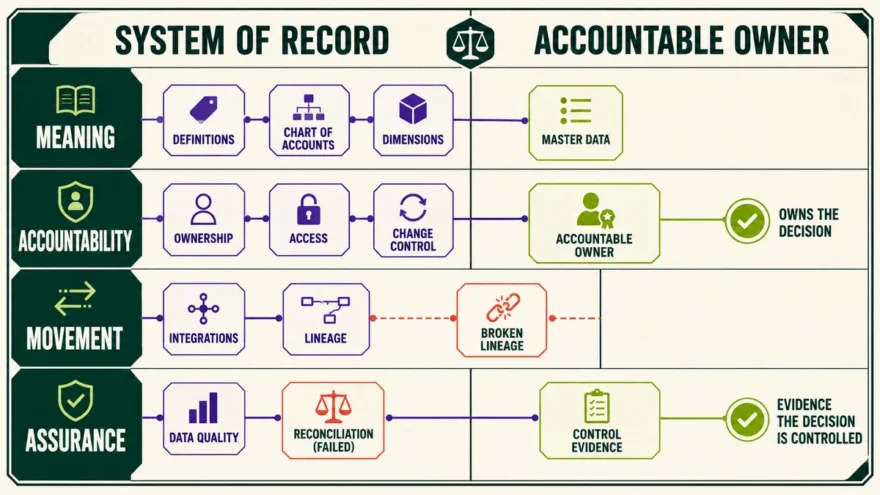
Three requests are worth making before any shortlist: a segregation-of-duties conflict report from the standard role set, the record produced when a conflict is knowingly accepted, and the change log behind a posted and reversed journal. Reconciliation evidence is a separate discipline, designed in reconciliation control design.
Reporting lineage and the integration boundary
Everyone has a report writer, so reporting claims are hard to compare. One test cuts through it: take a figure from a statutory output and trace it back through the group layer, the ledger, the subledger and the originating document without leaving the system. Any step needing an export is where the evidence chain breaks during an audit. The structural half is settled earlier than buyers expect, because NetSuite ties account type to statement placement and Microsoft makes dimension values into ledger account segments.
Integrations decide whether the ledger stays authoritative. Every other system creating an accounting event needs a documented inbound interface, a control total, a rejection path and an owner for the rejects. An API is not the answer. Can an interface post straight to the ledger and bypass the subledger, and under what authority? What happens to line 400 of a 1,000-line batch when it fails validation? Pattern, ownership and reconciliation design are worked through in the finance systems integration map.
How this product set was selected
The pool started with products visible in the supplied United States Google capture for the exact query on 22 August 2026, plus suites named in its image block, People-also-ask entries and related searches. A product entered only when a live official page, documentation set or published document could be opened that day and showed a named finance scope covering at least a general ledger and its posting subledgers. Order is alphabetical, there are no scores, and the set is not exhaustive. Two Oracle products appear because the capture lists Oracle and Oracle NetSuite separately.
Six candidates were excluded, and the reason is a limitation of this review rather than a judgement on the products. Epicor, Infor, Rootstock, Sage Intacct, Tyler Technologies and Unit4 all publish product material, but no current official page documenting their finance scope could be retrieved here: each request returned an HTTP error, or the only reachable document was a brochure page or a guide dated 2015 and marked confidential. A page that cannot be opened cannot be cited.
Every entry in the last column below is a buyer task, not a criticism.
Financial management ERP products documented as of 22 August 2026
| Product | Documented finance scope | Source and date label | Still to verify |
|---|---|---|---|
| Acumatica | Ledger, receivables, payables, cash, fixed assets, tax, multi-entity accounting, currency, deferred revenue, project accounting | Financial management page, copyright 2008 to 2026 | Which modules sit inside the subscription |
| IFS Cloud | Ledger, payables, receivables, fixed assets, project accounting, separate group consolidation | Financials information sources, release 25r2 | Statutory depth; connector boundary |
| Microsoft Dynamics 365 Finance | Ledger, payables with capture and matching, receivables with collections, budgeting and control, cash and bank, cost accounting, fixed assets, leasing | Documentation hub, article dated 25 August 2025, updated 22 December 2025 | Premium and attach licence boundaries |
| Odoo | Double-entry bookkeeping, chart of accounts, journals, multi-currency, bank synchronisation, reconciliation, fixed assets, analytic accounting | Accounting documentation, version 19.0 | Statutory depth at scale; consolidation |
| Oracle Fusion Cloud Financials | Journals, allocations, intercompany transactions, period close, financial reporting, budgets, average balance processing | Using General Ledger guide, release 26B, part G51880-01, copyright 2011 to 2026 | Which guides map to licensed modules |
| Oracle NetSuite | Accounting features, currency, chart of accounts, period management, close manager, ledger impact, journals, exceptions, budgets | Accounting Overview, Applications Suite help, no version label | Which capabilities arrive as licensed SuiteApps |
| SAP S/4HANA Cloud Public Edition | Management accounting, financial accounting, advanced close including group reporting, treasury and cash, financial operations, governance | Feature Scope Description 2602, version 5.0, dated 11 June 2026 | Scope items needing a separate licence |
| Workday Financial Management | Ledger with multibook reporting, payables and receivables, fixed assets, revenue and cash, bank connectivity, close and consolidate, audit | Accounting and finance page, plus a datasheet created February 2024 | Where planning becomes separate |
Beyond the table: Acumatica keeps module scope and subscription boundary separate because its model is resource-based rather than per seat. IFS Cloud documents a financial connector for the case where the ledger stays in another system, so it expects to coexist with an incumbent. Microsoft Dynamics 365 Finance publishes its deprecations: the financial dimension service is marked for removal from 11 September 2026 with version 10.0.49. Odoo alone publishes complete documentation and complete list pricing together.
Oracle Fusion Cloud Financials runs to 430 pages on the general ledger alone at release 26B, so test scenarios can be written from the vendor’s own text before any demonstration. Oracle NetSuite documents scope through undated help, so date every capability claim by the day the page was read. SAP publishes the most explicit scope contract of the eight. Workday names capability areas on the product page, but the most recent detailed document located here dates from February 2024.
Commercial disclosure: what each vendor actually publishes
Building a normalised five-year case belongs in the five-year ERP total cost of ownership model. What matters while scoping is how much a vendor discloses publicly, and therefore how much must be extracted in writing. No figures are reproduced below, only the form of disclosure observed on 22 August 2026.
| Product | Disclosure state | What is published | What to require in writing |
|---|---|---|---|
| Microsoft Dynamics 365 Finance | Published list price | Two named plans, per-user monthly prices, on the official pricing page | What requires the higher plan or an attach licence |
| Odoo | Published list price | Per-user pricing across named tiers on the public pricing page | Which apps the plan includes at that price |
| Acumatica | Packaging published, price withheld | A resource-based model on the pricing page; no figures | Metric definitions and tier triggers |
| Oracle NetSuite | Packaging published, price withheld | Five user licence types; no price stated | The licence type each finance role needs |
| Workday Financial Management | Packaging published, price withheld | Named tiers and a quote request on the Adaptive Planning pricing page; no equivalent page for Financial Management | The pricing denominator for Financial Management itself |
| IFS Cloud | Not established in this review | No official pricing page could be opened | The licensing denominator |
| Oracle Fusion Cloud Financials | Not established in this review | No official pricing page or price list could be opened | The metric for each Financials cloud service |
| SAP S/4HANA Cloud Public Edition | Not established in this review | Scope published per release; no reachable list price | Which scope items carry a separate licence |
Published scope and published price are independent variables: SAP publishes the most precise scope contract of the eight and no reachable price, while Odoo publishes both. Withholding price is normal for enterprise software. Declining to commit functional scope to a dated document is a different matter, because it asks the buyer to rely on a demonstration.
Questions to settle before a shortlist exists
Scoping is finished when these can be answered from documents rather than conversations.
- Which named modules or scope items make up the quoted footprint, and which capabilities fall outside it?
- What account and dimension structure is proposed, and which parts cannot change once transactions post?
- How many parallel books does the asset register support, and can book and tax conventions differ?
- Who absorbs the cost and timeline when a bank changes a statement or payment file format?
- Is group consolidation inside the quoted scope, separately licensed, or absent?
- What conflict report does the standard role set produce, and how is an accepted conflict recorded?
- Can a reported figure be traced to its originating document without an export?
- What happens to a rejected line inside an inbound accounting batch, and who owns resubmission?
Those answers scope the requirement. Choosing between finalists is a separate discipline with its own gates and evidence caps, set out in the finance-led ERP evaluation scorecard. If whether an ERP is warranted at all is still open, that case is argued in ERP versus accounting software. After approval, acceptance moves to the phase-by-phase implementation gates.
Frequently asked questions
Is an ERP finance module the same as a financial management ERP system?
Usually yes in conversation, but they are priced differently. A finance module is one licensed component; a financial management ERP system is the whole finance footprint across ledger, subledgers, cash, controls and reporting. SAP publishes finance as several separate scope items, and Microsoft ships Finance as an application distinct from Supply Chain Management, so ask which named items a quote contains.
Does a financial management ERP system replace consolidation software?
Not reliably. SAP documents corporate close and group reporting as a scope item under advanced accounting rather than core financial accounting, IFS documents group consolidation as a separate source at release 25r2, and Workday names close and consolidation as its own area. Test period-specific ownership changes, minority interests and disclosure outputs before assuming the ledger covers group reporting.
What audit evidence should we require before signing an ERP contract?
Ask for three artefacts produced by the product itself: a segregation-of-duties conflict report from the standard role set, the record created when a conflict is knowingly accepted, and the change log behind a posted and reversed journal. PCAOB AS 2201 notes that automated controls are generally lower risk where information technology general controls are effective, so access and change evidence carries weight.
Can we build our own financial management ERP instead of buying one?
It is possible, and the cost sits in the parts buyers underestimate: parallel book and tax depreciation, closed-period enforcement, dimension validation, role and duty separation, bank format maintenance, and an audit trail an external auditor will rely on. Open-source suites such as Odoo publish complete accounting documentation, which usually makes extending an existing ledger cheaper than originating one.