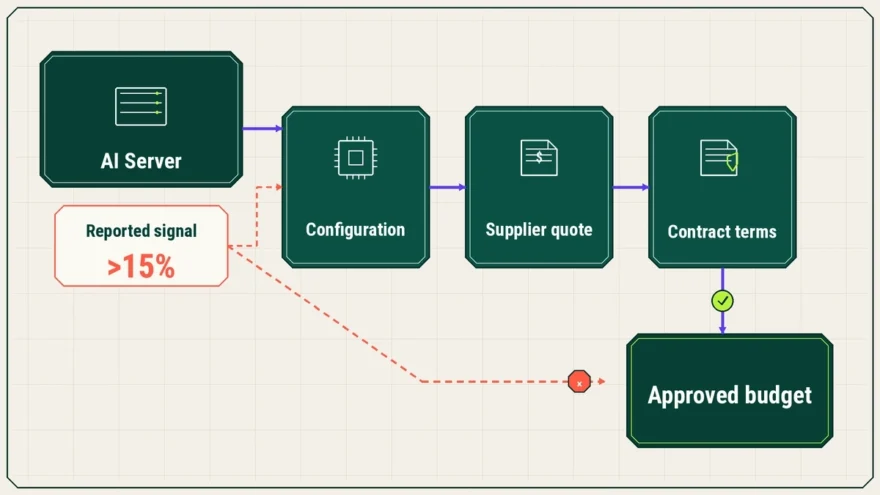
A single purchase request can touch legal, information security, tax, finance and procurement before anyone agrees it should be bought. The systems holding those answers were bought separately, by different owners. The request itself travels by email, and the requester learns its status by asking someone.
The commercial answer to that problem now has a name. The Hackett Group’s 2026 Procurement Key Issues research describes teams absorbing an 8% workload increase against declining headcount and operating budgets, which is the pressure this category is sold into. This guide defines what the orchestration layer actually owns, separates it from procure-to-pay software and procurement suites, and sets the control tests that decide whether it reduces fragmentation or adds to it.
Quick answer
A coordination layer bounded to routing and request state can shorten approval cycles and make policy binding at the point of request; one permitted to write records the ERP, contract or supplier system already governs creates a second source of truth instead of removing one.
Decision: Approve a procurement orchestration layer only after its write boundary, delegation-of-authority model, per-rule policy strength and exception behaviour have been proved against a real category, and confirm which records stay with the systems that already own them.
Key takeaways
- Orchestration coordinates work across systems it does not own. The moment it becomes the authoritative record for a purchase order, contract or supplier master, it has added a second source of truth rather than removing one.
- Intake field design decides routing, policy and downstream reporting quality. A free-text front door relocates the triage problem instead of closing it.
- A policy binds only where the layer can block or reroute a request. A rule that merely displays guidance is advice, and it will not survive an audit sample.
- Exceptions decide the outcome, not the clean path. Test reopened requests, mid-flight policy changes and integration failure before signing anything.
What procurement orchestration is
Procurement orchestration is a coordination layer that sits above existing systems and drives a purchase request through intake, routing, cross-functional review, approval and system updates, without becoming the system of record for the objects those systems already own. It is defined by what it connects rather than by what it stores.
Published definitions agree on the coordination claim and differ on scope. Art of Procurement describes it as a digitally supported methodology coordinating procurement processes, systems and stakeholders across the source-to-pay lifecycle. Zip frames it as the integration of people, systems and data across the spending lifecycle into one workflow from intake to payment. GEP treats it as the synchronization of business functions, and Tropic as the coordination of procurement activities, tools and stakeholders.
Two points follow. Every one of those definitions is written by a party selling into the category, so the buyer has to set the scope boundary. And none of them says the layer owns the purchase order, the contract or the supplier record. That omission is the useful part.
Analyst framing adds a maturity dimension. Levelpath’s summary of Gartner’s Innovation Insight on procurement orchestration platforms, attributed to analysts Magnus Bergfors and Chaithanya Paradarami and dated 10 September 2025, reports three stages: integrate, meaning data synchronised between systems; execute, meaning coordinated workflows and automated static processes, which it places as the current state of most providers; and orchestrate, meaning workflows and integrations created dynamically from policy, data and context. Finance Circuit could not open Gartner’s own pages to verify that wording, so treat it as a reported summary rather than a confirmed quotation.
Read against that scale, most products sold as orchestration today sit at the execute stage. That changes the business case: a layer running predefined routes is a different investment from one that composes routes at runtime.
Why orchestration is not P2P software, a suite or a workflow tool
The category names overlap in marketing and diverge in system authority. The distinction that matters is which application is permitted to create or change a governed record, and which is only permitted to move work between applications that can.
| Layer | What it owns | What it never owns | Decision test |
|---|---|---|---|
| Procurement orchestration | The request object, its route, its state and the cross-functional task list | Purchase orders, invoices, contracts, supplier master data, payment execution | Use when: The transactional systems are adequate but the path between them is manual Failure mode: It is allowed to write records the ERP or contract system already governs |
| Procure-to-pay software | Requisitions, purchase orders, receipts, invoice matching and the AP document chain | Sourcing events and contract negotiation in most configurations | Use when: The transactional chain itself is broken or absent Failure mode: It is bought to solve an intake problem it was not designed for |
| Procurement suite | A broad set of source-to-pay modules under one vendor and one data model | Records held in the finance ERP, and usually payment execution | Use when: Consolidation is the goal and the migration budget exists Failure mode: Adopted modules leave gaps that still require an overlay |
| Generic workflow tool | Forms, task routing and notifications | Procurement semantics: category, supplier identity, contract state, spend authority | Use when: The process is simple, stable and low value Failure mode: Procurement policy has to be encoded by hand and maintained by hand |
Intake and orchestration are also not the same thing, although they are sold together. Payflows separates them as the front door versus the end-to-end coordination behind it, and Precoro’s guide makes the same split, casting intake as capture and orchestration as what decides where the request goes next. Buying intake alone gives a better form. It does not give a governed route.
If the underlying transactional chain is the actual problem, the decision belongs to a different evaluation. The comparison of requisition, order, receipt and matching coverage sits with procure-to-pay platform selection, and the upstream process design that feeds either category is covered in the source-to-pay control model.
Intake: one front door and the fields that decide everything downstream
Intake is the point where an unstructured business need becomes a routable object. Its design question is not how friendly the form looks. It is which fields must be resolved before the request can move, and which may stay empty.
Every field falls into one of three classes. Routing fields determine who sees the request: category, estimated value, entity, data sensitivity, whether a supplier is new. Policy fields determine which rules fire: renewal or new spend, contract presence, personal data involvement. Reporting fields determine whether the resulting data is usable later, and they are the ones most often left optional and therefore empty.
That last class is where intake design meets analytics. Category and supplier identity captured at the request, from a requester guided to a controlled value, is worth more than the same field reconstructed from an invoice description months later. The failure modes behind an unreliable spend cube are set out in the guide to spend data readiness, and most originate upstream of the invoice.
Natural-language intake is the current product direction. Ivalua states that its intake capability provides a single access point through a natural language interface where employees submit and track needs. Levelpath states that a requester describes what is needed in plain language and a concierge agent captures category, urgency, budget and stakeholders. The control question is unchanged by the interface: when the model infers a category or value band, is that inference recorded, visible and correctable, or does it silently set the route?
Routing and approvals: turning a request into a reviewed decision
Routing decides who is asked, and in what order
Routing converts intake values into a task sequence, and three design choices carry most of the operational risk. First, whether reviews run in sequence or in parallel: sequential is easier to reason about and slower, parallel is faster and creates contention when two reviewers return conflicting conditions. Second, whether a route is fixed per request type or assembled from rules, which is the practical difference between the execute and orchestrate stages. Third, what happens when a routing input changes after the route is set, covered under exceptions below.
Vendors describe this as automatic triage. Ivalua states that requests are triaged to relevant owners, processes and systems. Levelpath states that agents analyse each request and route it across workflows, catalogs, third-party applications and policies without manual triage. Tonkean, which sits over an existing suite, states that it routes requesters to workflows from plain-language queries and requests to the right approvers in Coupa. All three are company-stated, and none establishes how routing behaves on a request that fits no defined pattern.
Approval authority is a finance control, not a workflow setting
An approval step in an orchestration tool is only as good as the authority model behind it. CIPS practice guidance on separation of duties sets out three authorities that should not sit with one person: budget holder authority, authority to seek quotations and commit, and authority to accept and pay. It recommends a documented table of delegations of authority covering each process, and states that no single individual should hold more than one of those roles. It also notes that e-procurement supports compliance because authorisation and tolerance limits can be configured so buyers commit only within the agreed framework.
That produces four evaluation questions. Where does the delegation table live, and is it one table or a copy per system? When a threshold changes, how many places change? Can the layer prove, for a sampled transaction, who approved what under which authority version? And can a requester approve their own request under any configuration, including delegation and absence substitution?
CIPS also treats a nominated representative for absence as good practice, so the delegation model has to handle substitution deliberately rather than by informal password sharing. A layer that lets an absent approver be bypassed rather than substituted has weakened the control it was bought to enforce.
Policy enforcement: where the rules actually bind
Policy in this category exists at three strengths, and vendors rarely distinguish them. Advisory policy shows the requester guidance and records nothing. Guided policy defaults the requester toward a preferred supplier or contract and records the deviation. Binding policy prevents the request from progressing, or forces it onto a different route, and records the attempt.
Only the third is a control. The first two are user experience. A useful test during evaluation is to ask the vendor to demonstrate a request that policy should stop, then check three things: that it stopped, that the requester was told why, and that the blocked attempt is retrievable in a report later.
Guided policy still has real value, because it redirects spend toward agreed suppliers before a commitment exists. Levelpath states that intake surfaces preferred suppliers so stakeholders reach approved options immediately; Ivalua states that its routing keeps requests compliant, auditable and traceable, and positions that as prevention of maverick spend. A buyer should establish which strength applies to each rule rather than accepting one compliance claim for all of them.
Policy versioning is the part most often missed. Rules change, and requests outlive rule changes. If the system cannot state which version of a policy applied to a request approved four months ago, the approval evidence is incomplete regardless of how the workflow looked on screen.
System coordination and integration design
The integration question for an orchestration layer is unusually precise, because the layer is defined by not owning things. It should be specified as three separate lists.
What the layer reads
To route correctly the layer reads supplier master records, contract headers and expiry dates, category structures, cost centres, budget availability, entity and tax data, and open commitments. The design risk is staleness rather than corruption, so each read needs a refresh expectation and a visible timestamp on anything a reviewer relies on.
What the layer writes
Writes should be narrow and named. In most designs the defensible set is a requisition or request record in the transactional system, a task and its outcome, a status update, and an approval evidence package. Every additional write is a claim on authority that belongs elsewhere. Zip states that it integrates with enterprise resource planning and existing business tools and acts as a single source of truth for vendor information, contracts, purchase orders and invoices. The buyer should convert that broad claim into a field-level list of what is created, updated and only displayed.
What it must never own
The general rule is that the layer must not become a second writer to a governed object. A useful integration specification starts from business objects and control states rather than product names, and records which system is authoritative for each object at each lifecycle stage. That method is set out in the finance systems integration map, and it applies here without modification.
ORO Labs states that its integration platform connects to any technology stack with real-time data sharing, naming SAP, Oracle, Coupa, Ariba, DocuSign and supplier risk systems. Ivalua states that it orchestrates across existing systems without requiring replacement. Both are the right architectural claim for this category, and both still require the buyer to define the write boundary: a connector that can write is not the same as a design that should.
Exceptions: the test orchestration usually fails
Demonstrations show the clean path. Production is mostly the other one. Six exception classes should be scripted into any evaluation, and the answers recorded before commercial discussion.
- The changed request. Scope, value or supplier changes after approvals have begun. Does the route recalculate, and are prior approvals invalidated or retained with a recorded reason?
- The mid-flight policy change. A threshold changes while requests are open. Which version applies, and can that be evidenced?
- The absent approver. Substitution, delegation and escalation behaviour, and whether escalation can skip an authority level.
- The integration failure. The target system rejects the write. Does the request hold in a visible state with an owner, or report success while nothing was written?
- The duplicate. Two requesters raise the same need. Is that detectable before commitment, or only in spend analysis afterwards?
- The withdrawn or reopened request. What happens to downstream records already created, and who reverses them?
The fourth case quietly damages financial records. A layer that marks a step complete without confirming the downstream write creates a request believed to be approved and ordered, with no order in the system that pays invoices. The consequences surface in invoice exception handling when an invoice arrives with no matching commitment.
Exception ownership should be explicit. Every class needs a named accountable role, a queue that ages visibly, and a closure record. A queue with no owner becomes a backlog that the layer’s own reporting shows as work in progress rather than as a control failure.
Implementation architecture and sequencing
The architecture decision precedes the product decision. Three patterns are in use, and the correct one depends on the condition of the transactional systems rather than on the orchestration tool.
An overlay pattern places a standalone layer above unchanged systems: fastest to deploy, most exposed to integration drift, because every downstream change becomes a change to two things. A suite-native pattern uses the intake and orchestration modules of a suite already in place, which reduces integration surface but constrains the layer to what that vendor supports outside procurement, such as legal and security review. A hybrid pattern keeps suite-native coordination inside procurement and uses an overlay only for cross-functional review. It is the most defensible in a large estate and the most expensive to govern.
Sequencing should follow evidence rather than enthusiasm. A workable order is: agree the request taxonomy and the delegation table first, because both are organisational decisions that no product supplies; specify the read and write boundary per object; build one complete journey end to end, including its exceptions, rather than the intake screens for many journeys; run it against real requests for a bounded period in one category or entity; then measure first-pass completion, rework and exception ageing before extending.
Representative orchestration products checked 20 August 2026
This is a source map, not a ranking. Products were included only where an official product page could be opened and read on 20 August 2026, and where that page describes intake capture, routing and cross-functional coordination over systems the product does not claim to replace. Coupa, JAGGAER, SAP Ariba guided buying and Oracle were excluded on that rule alone: their official pages returned an HTTP 403 response to our request on the check date, so their scope could not be verified from the source. Their absence is an access outcome, not an assessment.
Every capability below is company-stated. Official pages show what a supplier says it covers. They do not establish licensed module scope, configuration effort, control effectiveness, implementation burden or total cost for any specific buyer. No pricing appears because none of the reviewed pages published a US dollar amount.
| Architecture lens | Product | Publicly documented coverage | Proof and boundary test |
|---|---|---|---|
| Orchestration-first overlay | Zip | States a single front door for every procurement request, routing through an approval workflow that captures compliance information, no-code workflow configuration, and integration with enterprise resource planning and existing business tools. | Proof question: Which fields does it create, update or only display in the finance system of record? Boundary: The single-source-of-truth claim over vendor, contract, order and invoice data |
| Orchestration-first overlay | ORO Labs | States intent-based intake guiding users to category, channel and suppliers, composable agentic workflows, no-code agents for supplier onboarding, contract validation, risk triage and policy enforcement, and connections including SAP, Oracle, Coupa, Ariba and DocuSign. | Proof question: When an agent enforces a policy, what evidence of that decision is retained and reportable? Boundary: Which agent actions are advisory, which are binding, and who approves agent changes |
| Orchestration-first overlay | Levelpath | States plain-language intake through a concierge agent capturing category, urgency, budget and stakeholders, agent-based routing across workflows, catalogs, third-party applications and policies, and automatic approvals based on request type. | Proof question: How does an automatic approval by request type map to the documented delegation of authority? Boundary: Whether inferred category and value can change the approval path without review |
| Overlay on an installed suite | Tonkean | States plain-language intake with guided form sequences, routing of requesters to workflows and of requests to approvers in Coupa, cross-functional approvals spanning IT, information security, legal and finance, and integration with Coupa and SAP. | Proof question: Which steps execute in the overlay and which execute in the underlying suite? Boundary: Duplicate state between the overlay and the suite when either is updated directly |
| Suite-native intake and orchestration | Ivalua | States a natural-language single access point for submission and tracking, triage of requests to relevant owners, processes and systems, self-initiating workflows, pre-built integrations, and orchestration across existing systems without requiring replacement. | Proof question: For a non-procurement review such as security or legal, does the task leave the suite? Boundary: Module licensing, and which capabilities require the wider suite to be adopted |
Tropic’s category description, last updated 18 November 2025, lists approval workflow management, reporting, supplier and contract information, policy compliance and enterprise integration as the defining requirements, a fair minimum specification for every candidate including those excluded above.
What to verify before committing budget
Six checks separate a coordination layer that reduces fragmentation from one that adds a system.
- Write boundary, field by field. A named list of objects and fields the layer creates, updates or displays. Anything not on the list is not permitted to be written.
- Delegation of authority. One authoritative table, a defined change process, and version evidence retrievable per transaction.
- Policy strength per rule. Each rule classified as advisory, guided or binding, with a demonstration of a blocked request and a retrievable record of the block.
- Exception behaviour. The six classes above, scripted, with the failure behaviour observed rather than described.
- Evidence retrieval. For one sampled request, produce requester, inputs, policy version, approvers, authority basis, downstream records created and closure, without vendor assistance.
- Reversibility. What the organisation retains if the contract ends: request history, policy configuration and integration logic, in a usable form.
None of that requires a completed procurement. All of it can be established in a scripted proof against a real category, and every answer belongs in the approval paper rather than a vendor deck. The requisition-level control tests that pair with these checks sit in the guide to requisition software control boundaries.
Frequently asked questions
Does procurement orchestration replace an ERP or a procure-to-pay system?
No. Vendors in this category position the layer as coordination over existing systems rather than replacement, and Ivalua states explicitly that it orchestrates across existing systems without requiring replacement. Orders, invoices, contracts and supplier master data should stay with the systems that already govern them. Replacement is a separate decision carrying a separate business case.
What happens to requests already in progress when a policy or threshold changes?
That depends entirely on configuration, and it is rarely covered in a demonstration. Ask whether open requests keep the policy version they started under or adopt the new one, whether approvals already given are invalidated, and whether the applicable version can be evidenced per transaction months later. Untested, this becomes an audit finding.
Who owns the audit trail when approvals happen in an orchestration layer?
The organisation does, but the evidence is usually split. Approval decisions sit in the orchestration layer while resulting orders and invoices sit in the transactional system. Define before implementation which system retains approval evidence, how the two are linked by a stable identifier, and what the retention period is on each side.