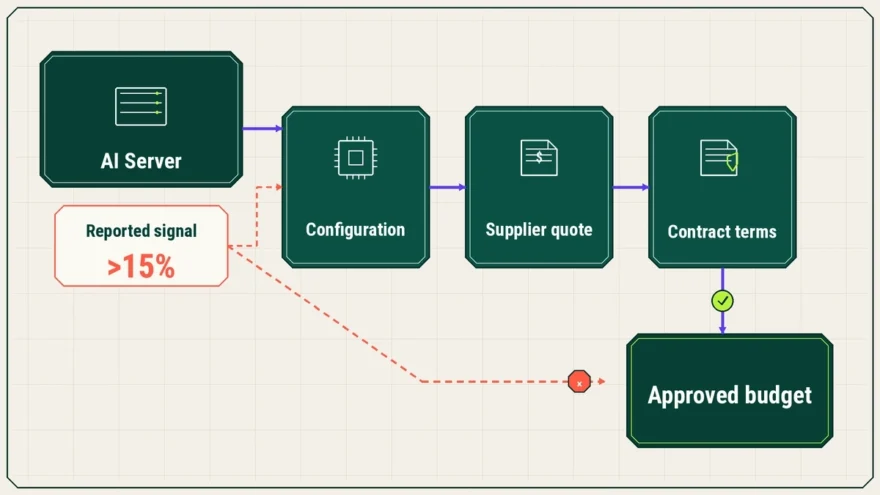
Purchase requisition software is often bought from a feature list: forms, approvals, budgets, integrations and reporting. The buying risk is that identical labels can describe materially different behavior. A “budget check” may display a balance, issue a warning, reserve funds at submission, reserve them only after approval or permit an override routed to a separate authority. An “ERP integration” may be a one-way export with no accepted, rejected or reconciled state.
This guide is for a procurement operations lead selecting a system with finance and controller input. It covers the internal request from creation through approval and the controlled handoff to purchase order automation. The wider procure-to-pay platform decision sits above both. It does not rank vendors, estimate savings or treat a demo as proof. The aim is to convert product claims into tests using the organization’s own accounting structure, approval policy, exceptions and downstream systems.
Quick answer
A weakly configured requisition tool can digitize requests while leaving unauthorized commitments, stale budget checks, broken integrations and incomplete evidence unresolved.
Decision: Select a platform only after it passes scenario-based tests for budget semantics, approval authority, policy enforcement, ERP handoffs and audit evidence using the company’s own data and exceptions.
Key takeaways
- Define whether a budget feature only shows availability, warns, blocks, reserves funds or supports an independently approved override.
- Model approvals from delegated authority, financial dimensions and exception risk rather than copying the reporting hierarchy.
- Treat ERP connectivity as a controlled handoff with stable IDs, business acceptance, retries, reconciliation and a named owner.
- Require the shortlisted product to pass scripted scenarios and produce an exportable evidence pack before commercial approval.
Purchase requisition software at a glance
Purchase requisition software manages an internal request to buy goods or services before a supplier-facing order is issued. It normally captures the requester’s need, accounting and delivery data, applies policy and budget rules, routes approval, records decisions and passes an approved request into purchasing. Microsoft’s current requisition overview distinguishes the internal requisition from the external purchase order created after approval, while Oracle’s requisition business-object definition describes internal demand for an item or service.
The first design choice is not a vendor name. It is where requisition authority should sit in the technology estate.
| Pattern | Use when | Main control advantage | Main buyer test |
|---|---|---|---|
| ERP-native requisition module | Ledger dimensions, budget control, supplier master and purchasing already operate in one ERP | Fewer authority transfers and direct access to finance data | Can occasional requesters use it without bypassing the process? |
| Specialist requisition platform | Intake and approvals need a simpler front end across several entities or finance systems | Flexible requester experience and workflow configuration | Can it prove accepted ERP posting and reconcile every failed transfer? |
| Broader procure-to-pay or source-to-pay suite | The program also owns catalogs, suppliers, orders, receiving, invoices or sourcing | Connected transaction evidence across more stages | Is the wider scope justified, and which objects remain authoritative in the ERP? |
The right pattern depends on authority boundaries, not the longest feature list. The finance technology stack reference architecture explains how to assign authority between suite and specialist systems before choosing a product.
Representative purchase requisition products, checked 18 August 2026
This neutral starting set is not a ranking or complete market inventory. Scope statements come from official product documentation checked on 18 August 2026 and are company-stated. Packaging, editions and integrations can change.
| Listed here as | Product | Company-stated requisition scope | Buyer verification focus |
|---|---|---|---|
| ERP-native module | Oracle Fusion Cloud Self Service Procurement | Catalog, punchout and noncatalog requests with delivery, project, attachment and status fields | Reservation timing, override authority, project budgets and occasional-requester usability |
| ERP-native module | Microsoft Dynamics 365 Supply Chain Management | Catalog and noncatalog requisitions, header or line review, account distributions and PO generation | Budget configuration, consumption versus replenishment and post-approval changes |
| ERP-native module | SAP S/4HANA Cloud Public Edition | Self-service catalogs, account-assignment defaults, approval status and follow-on document visibility | Edition-specific workflow, budget checks, free-text controls and document ownership |
| Procurement suite | Coupa Procure-to-Pay | Official playbook covers requisition, approval, PO, receipt, invoice, budgets and ERP exchange | Master-data authority, budget refresh, PO-change acceptance and reconciliation |
| Procurement suite | SAP Ariba Buying and Invoicing | Guided buying, catalogs, policy-compliant purchasing, supplier collaboration, invoicing and multi-ERP processes | Approval ownership, catalog and contract enforcement, and ERP object authority |
| Procurement suite | Ivalua Procure-to-Pay | Central intake, eProcurement from requisition to receipt, AP automation and ERP connector claims | Licensed modules, accounting authority and rejected-transfer ownership |
| Specialist intake or requisition platform | Zip Intake-to-Procure | Request intake, approval routing, budget matching, preferred suppliers, activity logs and integrations | Object ownership, budget timing and downstream acceptance |
| Specialist intake or requisition platform | Procurify Purchase Requisition | Desktop and mobile requests, catalogs, configurable approvals, budget checks, audit trails and integrations | Available-funds meaning, edit invalidation and ERP reconciliation |
| Specialist intake or requisition platform | Precoro Purchase Requisition | Custom forms, multi-step approvals, budget checks, request-to-PO flow, receiving, reporting and audit logs | Multi-entity rules, overrides, reservation semantics and integration failures |
Categories overlap: a suite may front an ERP, while an intake platform may orchestrate an object owned elsewhere. Shortlist by authority boundary and process scope, then apply this guide’s control tests. Official documentation proves only what the supplier states, not production control performance. Where that boundary is the whole question, the procurement orchestration layer sets out which records a coordination tool may write and which must stay with the system of record.
Map the requisition workflow before selecting software
A requisition workflow should be drawn as controlled states, not just a sequence of screens. A practical baseline is:
- Draft: the requester enters the business need, item or service, quantity, expected value, legal entity, delivery information and supporting evidence.
- Validated: required fields, supplier or category eligibility, accounting combinations, duplicates and policy conditions are checked.
- Budget assessed: the system identifies the applicable budget, calculation basis, check time and result.
- In review: managerial, budget, procurement, project, security, legal or other reviews run according to defined conditions.
- Approved: the exact version and distributions have passed all required authority checks.
- Released or handed off: the approved record is accepted by the purchasing or ERP process and receives a downstream identifier.
- Changed, cancelled or closed: later events trigger reapproval, release reserved funds where applicable and preserve history.
Header-only routing can be efficient for a simple request charged to one owner. Line-level routing is needed when different lines carry different cost centers, projects, categories or approvers. Microsoft’s purchase requisition workflow documentation shows that a requisition may be routed as one document, by individual line or through a combination of both. It also allows reviewers to be selected from roles, management relationships and financial responsibilities. These are product-specific examples, but they expose questions every buyer should test.
Map the workflow into the wider controlled source-to-pay operating model. A requisition is not complete merely because its status says approved. The next process must accept the correct entity, supplier, coding, amount, contract or catalog reference, delivery requirement and acceptance owner.
Test budget controls as operating states, not a checkbox
Budget control is the most easily overstated capability in this category. The evaluation team should ask five separate questions: what balance is checked, when it is checked, what action follows, whether funds are reserved and how an exception is approved.
| Control element | Evidence to obtain | Failure to avoid |
|---|---|---|
| Budget source and dimensions | Authoritative source, ledger, legal entity, cost center, account, project, period and currency | A green result against the wrong budget slice |
| Available-funds calculation | Whether actuals, open orders, requisitions, transfers, drafts and other commitments are included | Two products displaying different “available” amounts without explanation |
| Enforcement action | Informational display, threshold warning, hard stop or permitted exception route | A warning marketed as prevention |
| Reservation timing | No reservation, reservation at submission, reservation after approval or another defined event | Concurrent requests consuming the same apparent balance |
| Release and override | Who may override, limits, evidence, expiry, cancellation treatment and release status | Reserved funds remaining after cancellation or an override approved by the ordinary approver |
Configuration can change the meaning materially. Oracle’s 26C requisition funds-reservation documentation states that reservation can occur when a requisition is submitted or after it is approved, and that applicability depends on the charge account, budget date and project at distribution level. Its separate funds-override documentation describes a privileged exception routed to an identified override approver before funds are reserved.
Microsoft’s budget-control documentation distinguishes requisition pre-encumbrances from purchase-order encumbrances and lets configuration determine dimensions, periods, source documents, line or document checks, available-funds inputs, thresholds and override permissions. The lesson is not that one ERP model is universally correct. It is that a buyer must document the required semantics and make each vendor demonstrate them.
Budget inputs also need the right grain. Finance Circuit’s ocean-freight budget example shows why a carrier-wide average should not replace lane, contract and pass-through assumptions. A requisition check is only as precise as the approved budget model it reads.
Design approvals around authority, risk and exceptions
Approval software should implement the delegation-of-authority policy without turning every request into a long serial chain. Start with the decision each reviewer owns:
- the requester confirms the need and delivery details;
- the budget owner accepts the economic priority and funding route;
- procurement confirms the permitted channel, supplier, contract and commercial route;
- a project or cost-center owner accepts the relevant distribution;
- specialists review defined legal, security, tax, privacy, safety or supplier-risk conditions;
- an exception owner approves only the deviation within a stated scope and expiry.
Test amount thresholds in the transaction currency and the policy currency. Test split distributions, multiple legal entities, acting on behalf of another employee, vacant positions, temporary delegates and approver conflicts. A substitute should have a start date, end date, scope and traceable source of authority. An administrator should not be able to grant permanent approval power through an undocumented user edit.
Changes after approval need explicit treatment. Quantity, price, supplier, entity, account, project, contract reference, delivery location and payment-related terms may alter the risk or authority basis. Define which changes restart all approval, which restart only affected lines and which are immaterial. The system should preserve the approved version and show who made the later change.
The 2025 U.S. GAO Green Book applies to federal agencies, not private-company procurement. Its emphasis on preventive control activities, documented risk assessment and documented change assessment is still a useful design reference when adapted to the organization’s own obligations and policy.
Enforce policy in the requester journey
Policy enforcement should guide a requester before submission rather than rely on an approver to repair a weak request. Configure the form and buying path by category, entity, location, employee type, project and value band. Useful controls include required business justification, approved catalogs, preferred suppliers, contract references, quote requirements, restricted categories, receiving rules and a coded nonstandard route.
Microsoft’s purchasing-policy documentation provides company-stated examples of rules governing visible catalogs, category access, vendor selection, required requisition fields, order quantities, accounting dates, request-for-quotation conditions and the conversion of approved lines into purchase orders. Use those examples as test categories, not as proof that the buyer’s required policy is configured correctly.
Supplier-risk signals also need graduated actions. Finance Circuit’s supplier credit-limit watchlist example separates a reported insurer action from a confirmed supplier response. A requisition workflow should be able to monitor, warn or route review without turning an unverified signal into an automatic organization-wide block.
Do not confuse a mandatory text box with an effective control. A policy field should use controlled values where possible, validate dependent data and route a genuine exception to an owner. Free text remains useful for context, but it is weak evidence for a repeatable rule.
Define ERP and procurement integrations as controlled handoffs
An integration claim is incomplete until the buyer knows the direction, timing, objects, acceptance state and failure treatment. Define the authoritative owner for employees, suppliers, catalogs, contracts, accounts, cost centers, projects, budgets, requisitions, purchase orders and receipts. Then specify which fields move and which system may change them.
At minimum, the requisition handoff should preserve a stable requisition and line ID, legal entity, requester, supplier or sourcing state, item or service description, quantity, price basis, currency, accounting distributions, tax-relevant fields where required, contract or catalog reference, approvals, budget result, exception status and attachments or durable attachment references.
The interface design should answer:
- Does the receiving system validate the business record or only acknowledge transport?
- What identifier proves that an approved request became the intended purchase order?
- Can a retry create a duplicate order, reservation or approval event?
- How are partial failures handled when one line succeeds and another fails?
- Who reconciles sent, accepted, rejected and unresolved records by count and value?
- What happens during an ERP outage, master-data delay or closed accounting period?
The finance systems integration map provides the broader method for system-of-record ownership, business acceptance, retry safety and reconciliation. For requisitions, the acceptance evidence should be visible to procurement operations rather than buried in an integration log controlled only by IT.
Receiving and invoice processing remain downstream. The requisition should carry the acceptance owner and create a usable commitment reference, but it does not prove that goods or services arrived or that an invoice is valid. The separate invoice automation control model covers capture, matching, invoice approval and exceptions after the upstream package is ready.
Require audit evidence that survives export and review
An on-screen activity feed is not enough. The buyer should be able to export a complete record for a selected requisition without administrator reconstruction or vendor support. The evidence pack should show:
- the original request, every material version and the final approved version;
- the rule and approval-path version applied at submission;
- requester, preparer, approvers, delegates and administrators involved;
- timestamps, decisions, comments, returns, rejections and reapprovals;
- budget source, dimensions, check result, reservation status and override evidence;
- policy exceptions, attachments and any edits made after approval;
- downstream acceptance, purchase-order ID, integration failures and retry history.
The official NIST SP 800-53 control catalog is an information-security reference rather than a procurement standard. Its audit-record model is a useful minimum lens: the record should establish the event, time, source, outcome and associated identity or object. A finance control review also needs the business version, authority basis and downstream result.
Ask about retention, export format, time zone, clock synchronization, access restrictions, administrator activity and protection from alteration. Retention should follow the organization’s legal, accounting, audit and contract requirements; the software vendor should not invent the policy.
Build a weighted software evaluation scorecard
A scorecard prevents a polished demo from displacing the owned decision. The weights below are a Finance Circuit evaluation model, not a market benchmark. Adjust them before issuing a request for proposal, record the reason for any change and score only evidence demonstrated against a scripted requirement.
| Area | Weight | What earns the score |
|---|---|---|
| Budget semantics and financial control | 25 | Authoritative balances, defined calculations, dimensions, reservation, overrides, releases and period handling |
| Approval and policy design | 20 | Line and header routing, authority limits, delegates, exceptions, reapproval and controlled requester paths |
| Integration and data authority | 20 | Complete objects, stable IDs, business acceptance, safe retries, reconciliation and clear ownership |
| Evidence, access and administration | 15 | Exportable history, role separation, identity lifecycle, administrator logs, retention and controlled configuration changes |
| Requester and approver usability | 10 | Low-friction intake, accessible interfaces, status clarity, mobile suitability and useful error messages |
| Implementation and commercial fit | 10 | Realistic data work, configuration ownership, support model, release process, contract terms and total cost |
| Total | 100 | Set pass thresholds and non-negotiable disqualifiers before demos begin |
Do not let a high total compensate for a critical failure. A platform that cannot enforce the required funds rule, preserve authority evidence or prevent duplicate downstream commitments should fail even if its user interface scores well. Separate “available now,” “configurable,” “requires custom development,” “roadmap” and “not supported.” Price each dependency rather than scoring a roadmap promise as a feature.
Run acceptance tests before signing
Give each shortlisted supplier the same tenant assumptions, sample master data and expected results. Require the demonstrator to show the configuration, run the transaction and export the evidence. A recorded video or slide is not a substitute for the configured test.
| Scenario | Expected result |
|---|---|
| In-budget catalog request | Correct defaults, policy route, approval and downstream identifier with no duplicate entry |
| Over-budget request | Defined warning or block; any override uses separate authority, justification and limits |
| Split cost across two departments | Each distribution uses the correct budget and approver; header status reflects all line outcomes |
| Amount or supplier changed after approval | Affected approval is invalidated according to policy and the prior version remains visible |
| Temporary delegated approver | Delegation works only within its dates and scope and appears in the evidence export |
| Restricted category or inactive supplier | The normal route is blocked or redirected to a coded exception before commitment |
| ERP unavailable during release | The request remains in a clear pending or failed state; retry does not create a duplicate |
| Approved request cancelled | Reserved funds are released or an unresolved release failure is owned and visible |
| Concurrent requests against one balance | The result follows the defined reservation and availability model without hidden overcommitment |
| Audit sample export | One package reconstructs versions, rules, people, decisions, budget events, exceptions and handoff outcome |
Add organization-specific tests for multi-currency requests, projects, capital expenditure, services, subscriptions, confidential requests, intercompany purchases and regulated categories where they exist. A pass means the observed result and evidence match the documented requirement. It does not mean the product has a similarly named screen.
Plan implementation and control ownership
Implementation begins with policy and data cleanup. Confirm legal entities, charts of accounts, cost centers, projects, categories, suppliers, catalogs, contracts, employee-manager relationships, approval limits, delegates, budgets and identity records. Decide which source owns each field and how frequently it changes. Poor master data will surface as requester errors, approval misroutes and integration failures.
Those coding choices also determine whether later spend analysis can answer a procurement question. The spend analytics data-readiness guide sets out the supplier, category, entity, transaction and control-total evidence that should remain consistent from intake through analysis.
Assign named owners for:
- process design and permitted buying routes;
- budget definitions, calculations and override authority;
- approval policy and delegation-of-authority changes;
- supplier, account, cost-center, project and employee master data;
- workflow configuration, releases and administrator access;
- interfaces, failure queues, retries and reconciliation;
- evidence retention, access review and control testing.
Pilot one bounded population with enough variation to expose real exceptions. Measure first-pass submission, approval aging by stage, returns for missing data, budget failures, overrides, retrospective requests, handoff rejection, duplicate attempts and unresolved interface errors. Do not use cycle time alone: a faster process can merely shift incomplete work to procurement, finance or accounts payable.
Plan cutover for open requisitions and reserved funds. Decide whether they migrate, complete in the old system or are recreated with linked evidence. Freeze workflow and approval changes during final testing, then place configuration under change control. After launch, review both user adoption and control performance. Low usage may indicate poor design, but high usage does not prove that budget, authority or integration controls are working.
Disqualifiers before selection
Stop or narrow the purchase when a shortlisted product cannot explain a control in testable terms. Material disqualifiers include:
- “budget control” with no documented balance source, calculation, action or reservation state;
- approval history that loses the approved version or hides administrator changes;
- edits after approval without defined reapproval;
- an ERP connector with no business acceptance, duplicate protection or reconciliation;
- overrides that ordinary approvers or administrators can grant without separate evidence;
- audit records that cannot be exported for a transaction and retained under buyer policy;
- critical capability described only as custom work or an undated roadmap item;
- no named owner for configuration, integration failures or policy maintenance after go-live.
A buyer can accept a deliberate limitation when the compensating process, owner, evidence and cost are explicit. It should not accept ambiguity in a control that determines whether the organization commits spend.
Frequently asked questions
What is purchase requisition software?
Purchase requisition software captures and controls an internal request to buy goods or services before a supplier-facing purchase order is issued. It commonly manages request data, policy checks, budget treatment, approvals, status, evidence and the handoff into purchasing or an ERP.
Does purchase requisition software prevent overspending?
Not automatically. A product may only show a balance or warning. Prevention depends on the authoritative budget source, available-funds calculation, check timing, enforcement action, reservation method and override design. Buyers should test concurrent requests, cancellations and exceptions against their own budget structure.
Should purchase requisitions be managed in the ERP or a specialist platform?
Use an ERP-native module when direct finance authority and fewer interfaces outweigh requester friction. Use a specialist platform when intake and workflow need a better cross-system front end, provided the ERP handoff is accepted and reconciled. A broader procurement suite fits when the owned program includes adjacent purchasing stages.
What is the difference between purchase requisition software and purchase order software?
A requisition records the internal request and approval to buy. A purchase order is the supplier-facing commitment created after the request has passed the required controls. Some products manage both, but the authority, status and evidence for each object should remain distinct.