A purchase-order project can automate the moment an approved request becomes a purchase order and still leave the hardest control work manual. The control work continues after creation. The buyer still has to issue the correct version, prove that it reached the supplier, capture the supplier’s response, govern later changes and pass reliable order data to receiving and accounts payable.
This guide starts with authorised demand ready to become a purchase order (PO) and ends with a controlled, match-ready record. Requisition intake is upstream; invoice approval and payment are downstream. That boundary keeps the software decision focused.
Quick answer
Weak PO-state, change and integration controls create unauthorised commitments, stale supplier terms, avoidable matching exceptions and an order history that cannot reconstruct the version used for processing.
Decision: Approve a purchase order automation system only when it controls and evidences the PO lifecycle from authorised creation through supplier response, controlled changes and match-ready handoff.
Key takeaways
- Define separate states for created, approved, dispatched, acknowledged, changed, received, matched and closed orders.
- Treat supplier acknowledgement as a structured response with an owner and due point, not as proof that an email was sent.
- Preserve each effective PO version so receiving and invoice matching use the current authorised terms and supplier response.
- Evaluate software with scripted state changes, interface failures and audit reconstruction rather than a feature checklist alone.
What purchase order automation must control
IBM defines purchase order automation as the use of digital tools to manage PO creation, approval and tracking. For a finance-control decision, that definition needs one further condition: the system must preserve the order’s state, version, authority and supplier response from approved demand through the handoff to receiving and invoice processing.
A PO is the buyer-to-supplier order record. A purchase requisition is the internal request and approval object that can precede it. Microsoft documents approved requisition lines as inputs from which POs can be generated in its purchase requisition workflow. Requisition software therefore owns demand capture and internal approval, not dispatch, supplier acknowledgement or changed-order history. The broader source-to-pay process also covers intake, sourcing, contracting, requisitioning, receiving and the AP handoff. Procure-to-pay automation continues into invoice processing and payment, which is where procure-to-pay platform selection begins.
| Capability | Primary object | This article’s treatment |
|---|---|---|
| Purchase requisition software | Internal request | Upstream input only |
| Purchase order automation | Buyer-to-supplier order | Core scope |
| Procure-to-pay automation | Request, order, receipt, invoice and payment | Broader than this page |
The same boundaries read differently once you ask when each capability starts and stops.
| Capability | Starts when | Ends when |
|---|---|---|
| Purchase requisition software | A user states a need | The request is approved, rejected or withdrawn |
| Purchase order automation | Authorised demand is ready for ordering | The order is closed or handed downstream with complete state and evidence |
| Procure-to-pay automation | Demand enters the purchasing process | The supplier is paid and the transaction is accounted for |
Choose the deployment model before comparing products
Group the options into three deployment patterns. These are architecture choices, not vendor rankings. The finance technology stack reference architecture applies one rule: one system must be authorised to establish each PO object and status.
| Deployment model | Intended authority pattern | Use when | Test before approval |
|---|---|---|---|
| ERP-native PO automation | ERP purchasing owns the PO number and version; the supplier channel may be native or connected. | One ERP covers most entities and can represent the required supplier and change states. | Buyer usability, supplier reach, rule configuration, version history and owned exception queues. |
| Procurement-suite deployment | The suite owns purchasing and supplier collaboration; the ERP retains agreed master, receipt, accounting or posting records. | Procurement must standardise purchasing across entities, suppliers or multiple ERPs. | Duplicate authority, status latency, field precedence and reconciliation of accepted and rejected transfers. |
| Specialist automation layer | A focused layer automates creation, dispatch, acknowledgement or change routing over existing systems. | A defined control gap justifies a phased retrofit across legacy or multiple ERP environments. | Shadow PO records, duplicate-safe writes, round-trip status, complete audit export and an exit plan. |
Choose the smallest model that owns the required states without a second writer. Reject any design in which two systems can independently change the same PO version.
Purchase order automation workflow: eight controlled states
The software should expose a state model rather than one generic “open” status. Microsoft Dynamics 365 distinguishes approval, external review and confirmation, showing that internal authority and supplier confirmation are different events. Product labels vary, but the control distinction should remain. See Microsoft’s approval and confirmation model.
| State | System action | Gate before progression | Evidence to retain |
|---|---|---|---|
| 1. Created and validated | Build the PO from approved demand, contract, catalogue and master data. | Required fields, supplier status, legal entity, currency, coding and source authorisation pass validation. | Source request ID, field values, validation results, creator and creation time. |
| 2. Approved and released | Apply approval and release rules to the complete PO version. | Correct authority, current budget or policy evidence and no unresolved hold. | Route, approvers, actions, timestamps, rule version and released PO version. |
| 3. Dispatched | Send the released version through the supplier’s approved channel. | The message or document is accepted by the dispatch channel. | Recipient, channel, message ID, send time, version and delivery result. |
| 4. Supplier response recorded | Capture acceptance, rejection, partial acceptance or proposed changes. | The response identifies the PO version and the responding supplier. | Original response, response time, line or schedule decisions and comments. |
| 5. Changed and reauthorised | Create a new version, compare changes and apply reapproval rules. | Required review is complete and the replacement version is sent. | Before-and-after values, reason, requester, approvals and retransmission result. |
| 6. Receipt or service status updated | Record delivered, accepted, rejected, backordered or cancelled quantities and milestones. | The receiver is authorised and references the current PO line or schedule. | Receipt or service-entry ID, quantity or value, date, owner and dispute status. |
| 7. Match-ready handoff | Expose the effective PO, receipts, open balance, tolerances and holds to AP. | Interfaces accept the complete record and reconciliation clears. | Export or event ID, accepted and rejected totals, errors and retry history. |
| 8. Closed or cancelled | Remove the remaining commitment only under an approved close rule. | No unresolved quantity, value, invoice, dispute or supplier-response issue remains. | Closure reason, residual amount, actor, time and linked exception resolution. |
Create the PO from authorised data
Automation should remove rekeying without hiding field lineage. The order should inherit approved supplier, entity, address, currency, terms, line, quantity, unit, price, delivery, contract, accounting and receiver data where applicable. Validation should block disabled suppliers, duplicate conversion, expired references, missing delivery details and incompatible values. A failure should leave demand unconverted or place the draft in a reason-coded queue.
Approve and release the complete version
Approval should apply to the version that will be released, with rules for threshold, entity, category, project, contract exception and segregation of duties. Distinguish automatic policy approval from a named approver’s action. Release is separate: an approved PO may still be held for missing supplier data, an interface error or a scheduled date.
Dispatch through an evidenced supplier channel
Dispatch is successful only when the approved version enters the supplier’s agreed channel. That may be a portal, electronic data interchange, an ordering network, an application programming interface or controlled email. The system should choose the route from supplier configuration rather than from buyer memory.
Retain the PO number and version, recipient or endpoint, channel, message identifier, send time, attachment or payload reference and delivery result. “Email generated” is not the same as “message accepted,” and neither state proves that the supplier agreed to the order.
Record supplier acknowledgement as a business response
Supplier acknowledgement should answer more than whether the document arrived. Peppol’s BIS Ordering process allows a seller to accept, reject, partially accept or accept an order with changes, subject to the parties’ agreed process. Oracle Fusion documentation also describes acceptance, partial acceptance, rejection and proposed changes for orders awaiting acknowledgement. These are product and network examples, not a universal status vocabulary, but they show why a binary “acknowledged” flag is inadequate.
For every response, the buyer should be able to see which version was answered, which lines or schedules were accepted, any changed quantity, price or delivery date, the supplier’s comment and the response timestamp. No-response cases need a due point, reminder route, escalation owner and decision about whether fulfilment may proceed.
Control changes after release
A released PO should not be edited in place without a new version. Microsoft’s vendor collaboration documentation says that changing a PO after the vendor has responded requires a new version and that prior confirmed versions remain available in confirmation history. Oracle has also documented automatic PO revisions for approved-order tax changes so the change can be communicated to the supplier and retained in the audit trail.
The reapproval matrix should be policy-based. Changes to supplier, legal entity, currency, price, quantity, delivery commitment, payment terms, contract reference, accounting, cancellation or total value may require different routes. Cosmetic or non-material fields may follow a lighter path. The software must show why a rule fired, which values changed and whether the revised order was sent and acknowledged.
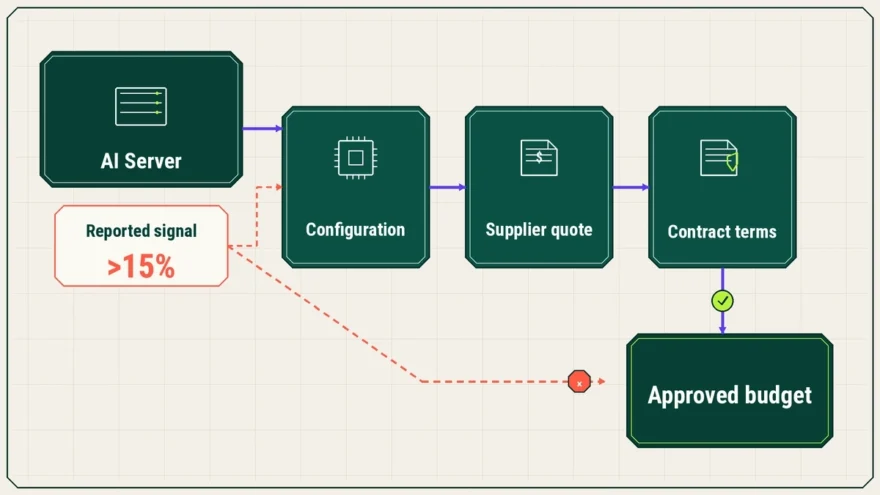
A supplier-risk signal should enter monitoring before it changes an order. Finance Circuit’s Vistry supplier-credit monitoring example separates reported insurer action from a supplier response that changes terms or order acceptance. The report belongs in a watch or exception record; confirmed commercial terms or an approved sourcing decision should trigger the versioned PO change.
Capture receipt and service status without turning the PO tool into a warehouse system
PO automation needs enough receipt information to show the open balance and support matching, but it need not own warehouse execution or service certification. It can consume the authoritative receipt or milestone record. Keep acknowledgement and receipt separate: acceptance of an order does not prove delivery, and a receipt may still enter a quality or service dispute.
Produce a match-ready handoff
Two-way matching compares invoice price information with the PO. Three-way matching also compares invoiced quantity with receipt quantity. Microsoft’s invoice matching documentation also shows that tolerances can apply to unit price, price totals and charges. Matching is therefore not one switch. It is a set of policies applied to the current PO, receipt and invoice data. Selecting the software that applies those policies is covered separately in the Finance Circuit guide to evaluating invoice matching products.
The PO handoff should expose the effective version, original and remaining quantities and values, receipts, cancellations, charges, currency, tax basis where relevant, matching policy, tolerance source and active holds. Detailed invoice capture, approval and posting belong in the invoice automation control map.
Close the order under an explicit rule
Do not close an order merely because a date passed or one invoice posted. Define closure by order type, preserve any residual quantity or value and record why it no longer represents an expected commitment. On project-based work that residual is also committed cost against a project budget, so clearing it silently removes a real obligation from the project forecast.
Supplier acknowledgement and change control are the control hinge
The gap between dispatch and receipt needs its own control. The buyer has issued a commitment, but the supplier may not accept the requested quantity, price or date. A useful system converts that uncertainty into controlled states. The money moves before any of them resolve, which is why how a commitment consumes an approved project budget is a separate control question on project work.
| Response state | Required system treatment | Buyer decision |
|---|---|---|
| No response | Keep the order in an awaiting-response queue with due date, reminders and escalation. | Decide whether fulfilment may proceed and who follows up. |
| Accepted | Record the accepted version and supplier response evidence. | Release downstream planning or receiving activity under policy. |
| Accepted with changes | Create a proposed change set without overwriting the buyer’s issued version. | Accept, reject or negotiate the changes; reapprove and resend where required. |
| Partially accepted | Preserve line or schedule decisions and calculate the unresolved balance. | Approve the supported split, substitute, cancellation or new order. |
| Rejected | Hold fulfilment, retain the reason and route the order to the buyer or requester. | Cancel, amend, re-source or issue a replacement order. |
| Invalid or duplicate response | Quarantine the message without changing the order state. | Resolve identity, version or interface errors before reprocessing. |
The Oracle supplier-response example provides a useful acceptance test: proposed supplier changes are submitted as a change order, and the buying organisation approves or rejects them. The buyer’s system should never silently convert a supplier proposal into the effective PO.
Design exceptions as controlled states, not email work
Every failed gate should create one reason code, one current owner, required clearing evidence, state-entry time and the next escalation point. Reassignment should not reset age or remove the original cause.
| Exception | Primary owner | Evidence needed to clear |
|---|---|---|
| Supplier or master-data validation failure | Supplier-master owner | Approved supplier status, corrected identifier or documented exception. |
| Approval or authority failure | Requester, approver or policy owner | Correct route, sufficient authority and required support. |
| Dispatch rejection | Procurement operations or integration owner | Endpoint or recipient correction and accepted resend result. |
| Supplier response variance | Buyer or contract owner | Accepted commercial decision, revised order and approval evidence. |
| Missing or disputed receipt | Receiver, service owner or contract owner | Receipt, rejection, dispute, cancellation or corrected order. |
| Match variance | Buyer, receiver or AP according to cause | Corrected PO, receipt, invoice, credit or approved tolerance outcome. |
| Interface or reconciliation failure | Finance systems or application owner | Error detail, corrected payload, safe retry and accepted control total. |
Reporting should separate exception volume, age, value and cause. A low number of open items can still be material if they represent large commitments, production-critical deliveries or repeated control bypasses. Overrides need a named actor, reason, scope, expiry and follow-up review.
Integrations and system-of-record design
A PO product rarely owns every object. Intake may own request approval, the enterprise resource planning system may own supplier and accounting records, contract software may own terms, operations may own receipts and AP may own matching. Assign one authoritative system to each object and pass stable identifiers between them.
The finance systems integration map explains the wider interface-control model. For a PO implementation, test these requirements directly:
- Stable identifiers: requisition, contract, supplier, PO, version, line, schedule, receipt and invoice references survive every handoff.
- Field ownership: each mapped field has one authoritative source, an effective date and an approved override path.
- Sequence control: an older acknowledgement or change cannot overwrite a newer PO version.
- Idempotent retries: resending after a timeout does not create a second order, receipt or response.
- Accepted-versus-rejected reconciliation: interface runs reconcile submitted counts and values to accepted records plus reason-coded rejections.
- Error persistence: a failure remains visible through correction and reprocessing instead of disappearing from the operational history.
- Business completeness monitoring: dashboards identify orders stuck between approved, dispatched, acknowledged, received and closed states.
Ask which data is synchronous, event-driven or batch, and what happens when one system is unavailable. A live demo should include a timeout, duplicate event, out-of-sequence response and rejected field value. A green “connected” badge is not evidence that the business population reconciles.
Audit trail and control evidence
An audit trail should reconstruct what the buyer authorised, what the supplier received and responded to, what changed and which version downstream systems used. The change-control examples above illustrate why history must preserve earlier states rather than only current values.
For a sampled order, the export should contain:
- the approved source request, contract or catalogue reference and their versions;
- the PO creator, creation time, initial values and validation results;
- the approval route, actors, actions, authority basis, comments and timestamps;
- the released document or payload, version, dispatch channel, recipient and delivery result;
- the supplier response payload, identity, response state, line or schedule detail and time;
- every change with before-and-after values, reason, requester, reapproval and retransmission result;
- receipt, service-entry, cancellation and dispute records linked to the correct order lines;
- matching policy, tolerance source, variance, hold and any override;
- interface submission, acceptance, rejection, retry and reconciliation records; and
- closure status, residual commitment and closure reason.
Access controls and retention periods depend on company policy and jurisdiction. The evaluation requirement is functional: can an authorised reviewer export a complete, understandable history without relying on the memory of the buyer or system administrator?
How to evaluate purchase order automation software
Convert each requirement into a scenario, expected state transition and evidence output. Do not award a requirement because the vendor says the product “supports approvals” or “integrates with the ERP.” The buyer should observe the configured result using representative data.
| Requirement | Question to ask | Evidence to request | Fail signal |
|---|---|---|---|
| PO creation and validation | Can the system create from approved demand without rekeying and block invalid master data? | Field lineage, validation log and duplicate-conversion test. | Drafts are created with missing or untraceable source values. |
| Approval and release | Are approval, release and external confirmation separate states? | Workflow rule, approval history and release hold example. | One status hides who approved what and whether it was sent. |
| Dispatch | Can routing vary by supplier and expose delivery failure? | Channel configuration, message ID, delivery result and resend history. | The system records “sent” without endpoint acceptance evidence. |
| Supplier acknowledgement | Can suppliers accept, reject, partially accept or propose changes against a version? | Portal or message response, overdue queue and line-level example. | A single acknowledgement flag loses the commercial response. |
| Change control | Does every released-order change create a version and apply the correct reapproval rule? | Version comparison, rule result, approval and replacement dispatch. | Users can overwrite an issued order without visible history. |
| Matching readiness | Does AP receive the effective PO, receipts, tolerances, holds and remaining balance? | Two-way and three-way test cases, variance detail and superseded-version test. | Matching reads stale terms or an incomplete receipt population. |
| Exception management | Does every failed gate create a reason, owner, due point and resolution record? | Queue ageing, reassignment history, escalation and override report. | Failures become generic tasks or disappear after retry. |
| Integration control | Can the product reconcile accepted and rejected transactions and retry safely? | Run totals, rejection file, duplicate-event test and recovery log. | Technical success is reported without business-level reconciliation. |
| Audit and administration | Can a reviewer reconstruct the order, rule versions, actors and supplier responses? | Sample audit export, access-role matrix and configuration-change history. | The product shows only the current values or administrator screenshots. |
Run scripted demonstration tests
- Convert one approved requisition into a PO, then attempt to convert the same source a second time.
- Use a disabled supplier or expired contract reference and show that the draft cannot progress.
- Route an order just below and just above an approval threshold, then change the legal entity or currency.
- Send the PO through a valid channel and a deliberately invalid endpoint; compare the recorded states.
- Return a supplier response that accepts one line, changes a delivery date and rejects another line.
- Change the price after supplier acceptance and show the new version, reapproval, resend and response history.
- Enter an invoice against a superseded PO version and a receipt below the invoiced quantity; inspect the match exception.
- Replay an interface event after a simulated timeout and prove that no duplicate record is created.
- Export the complete history for the order and reconcile every state to its source evidence.
Test configuration and operating ownership
Capability depends on configuration, data and ownership. Before approval, identify who will maintain approval rules, supplier channels, acknowledgement due dates, change triggers, matching tolerances, retention, access roles and interface monitoring. Ask how configuration moves between environments, who can change it and whether those changes are logged.
Implementation scope should state which suppliers, order types, legal entities, currencies, languages, tax fields, receipt processes and ERP interfaces are included. Vendor demonstrations and documentation establish company-stated capability. Contract acceptance should depend on the configured scenarios and evidence outputs the buyer has tested.
Pilot the workflow before wider rollout
Begin with a bounded population: one legal entity, a stable group of PO-backed suppliers, defined order types and known receipt rules. Preserve the baseline and denominator before automation changes the queue.
- Map current PO states, manual handoffs, exception reasons, systems and owners.
- Measure creation errors, approval age, dispatch failures, response coverage, change volume, receipt lag, match exceptions and interface rejections.
- Configure the eight state gates and the evidence required to clear each one.
- Run representative normal, changed, rejected and failed-interface cases with targeted human review.
- Reconcile the pilot population by count and value, then review every override and missing evidence item.
- Expand only after the rules and support model work for the tested population.
Track stage-level measures: creation first-pass rate, approval age, dispatch acceptance, response coverage and cycle, changed-order rate, receipt lag, match exceptions, interface rejections, open-order age and evidence completeness. Use the organisation’s own baseline and risk limits, not an unsupported universal benchmark.
Frequently asked questions
What is purchase order automation?
Purchase order automation uses software to create, validate, approve, release, dispatch, track, change and close purchase orders while retaining the authority, supplier response and evidence for each state. A finance-control implementation also passes the effective order and receipt data to invoice matching.
Is purchase order automation the same as purchase requisition software?
No. Requisition software manages an internal request and its approval. Purchase order automation begins when authorised demand is ready to become an order and controls the buyer-to-supplier PO lifecycle. One product may provide both capabilities, but the objects and control gates remain distinct.
Does purchase order automation include invoice matching?
It should provide the effective PO version, receipt references, open balance, tolerances and holds required for matching. Invoice capture, approval, posting and payment usually remain downstream AP functions. Software suites may combine them, but the acceptance tests should keep each stage and owner visible.
What should a supplier acknowledgement record?
Record the supplier identity, PO number and version, response time, document and line or schedule decisions, proposed price, quantity or delivery changes, comments and the buyer action required. A sent-email flag does not establish that the supplier accepted the order.