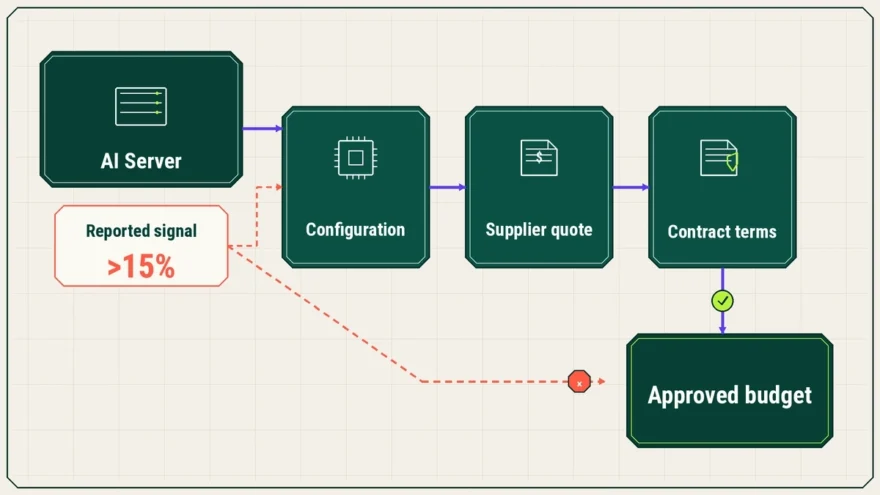
The U.S. Treasury’s Office of Investment Security says its Strategic Vendor Program is an implemented initiative and that it is organizing events, roundtables and company visits to connect businesses that have cleared Committee on Foreign Investment in the United States review with U.S.-based suppliers. A Reuters report from an August 10 company visit said the program nevertheless remains in pilot phase and that detailed guidance on how vendors will be identified has not been issued.
For procurement teams at eligible foreign-invested businesses, the changed state is access to an active government sourcing channel, not certified production capacity. Treasury has not published a supplier-qualification scorecard, capacity-acceptance test or scaling standard. A supplier surfaced through the program should therefore enter the sourcing pipeline as a candidate. Counting its output before technical approval, executable throughput, dependency mapping and scale evidence are complete can understate continuity risk and distort inventory, tooling, supplier-development and production plans.
What changed and what it means
Premature capacity recognition can understate continuity risk and distort inventory, tooling, supplier-development and production plans.
- Decision affected
- Decide when a domestic supplier surfaced through the Strategic Vendor Program has enough evidence to enter approved sourcing capacity.
- Evidence in brief
- Treasury describes the initiative as implemented and in active outreach; Reuters reports that it remains in pilot phase without detailed vendor-identification guidance.
- What remains unresolved
- Treasury has not published vendor-curation, supplier-qualification, capacity-validation or formal-designation criteria.
- Next verification
- Keep candidate capacity outside the approved sourcing baseline until technical, quality, dependency, throughput and scaling evidence is complete.
Key takeaways
- Treasury describes the Strategic Vendor Program as implemented and active, while current reporting says it remains a pilot without detailed vendor-identification guidance.
- The program is aimed at parties whose transactions have cleared CFIUS review, not procurement teams generally.
- A government-surfaced supplier is a sourcing lead, not evidence that its products, processes or output have passed buyer qualification.
- Procurement should recognize only demonstrated, approved and uncommitted output in the base sourcing plan; planned expansion belongs in a milestone-linked scenario.
What Treasury has implemented, and what remains pilot
Treasury’s public page says the program is intended to raise awareness of the relevant domestic vendor base for parties that have cleared CFIUS review. Its stated objectives include building domestic supply chains, helping smaller businesses learn about capital-access programs and working with economic-development partners to expand manufacturing capabilities. The page also says the Office of Investment Security is engaging stakeholders through events, roundtables and visits.
The prior state was an early pilot seeking market input. DLA Piper’s June 3 account of the pilot said Treasury was asking where companies had difficulty finding or engaging U.S. suppliers and where supplier capacity or capital constraints could impede growth. It also said participation was voluntary and would not affect current or future CFIUS submissions.
Taken together, the sources support a narrow status: the initiative has moved into active outreach, but its operating design remains in pilot. Public guidance does not yet explain how vendors will be identified or curated, whether participation creates a formal designation, or what evidence would establish that a supplier can meet a buyer’s requirements. Procurement should not fill those gaps with an internal assumption that Treasury has qualified the supplier.
Treat a program connection as a lead, not supplier approval
The first control is to separate lead provenance from supplier status. Record that the candidate was identified through the Strategic Vendor Program, but keep that field outside the approval decision. The qualification record should still identify:
- Legal and operating scope: the contracting entity, facility, ownership chain, production location and exact item or service offered.
- Technical fit: the specification, drawing, process, tooling and test method the supplier must satisfy.
- Quality evidence: required certifications, sample or first-article results, non-conformance handling and traceability.
- Commercial readiness: price basis, lead time, minimum order, allocation rights, warranty, termination and change-control terms.
- Risk and onboarding checks: sanctions, cybersecurity, financial condition, insurance, business continuity and supplier-master controls appropriate to the purchase.
These are Finance Circuit procurement tests, not Treasury program requirements. The distinction matters because a supplier may be relevant to the program’s domestic-supply objective while still being unsuitable for a particular item, facility, quality standard or delivery window.
Test executable production capacity, not nameplate capacity
Capacity should be measured at the constrained process and in accepted output, not in a supplier’s headline equipment rating. Ask for recent production records covering the item or a technically comparable process, including scheduled hours, changeovers, downtime, yield, scrap, rework and delivery performance. Then deduct capacity already committed to other customers and any output that depends on unapproved tooling, labour, materials or subcontractors.
The evidence gate below prevents a proposed source from entering the base plan too early.
| Candidate state | Minimum evidence | Sourcing-plan treatment |
|---|---|---|
| Introduced | Named legal entity, facility, item scope and program contact | Record as a lead; count zero base capacity |
| Qualification underway | Specifications, quality records, samples, compliance checks and commercial proposal | Keep outside the base plan |
| Production qualified | Accepted trial run, approved process, executable lead time and current net uncommitted output | Count only the quantity and date approved by the buyer |
| Scale plan funded | Approved capital, equipment orders, staffing, upstream commitments and dated commissioning milestones | Keep in a milestone-linked scenario until installation and qualification are complete |
| Sustained scaled output | Repeated accepted production at the agreed yield, lead time and delivery level | Recognize demonstrated net capacity and refresh it on a set cadence |
Map dependency risks before calling capacity domestic
A U.S. production address does not establish a self-contained domestic supply chain. The supplier may rely on a foreign sole-source material, specialist tooling, imported machine spares, offshore heat treatment, a single logistics route or a small group of trained operators. Any one of those dependencies can cap output below the supplier’s stated capacity.
Map each constraint to the tier that owns it, the current source, replacement lead time, inventory cover, qualification time and failure effect. Require evidence for any claimed substitute, including whether the substitute has been technically approved and whether its own capacity is available. The sourcing record should show which dependencies are domestic, which remain foreign, and which have no qualified alternative.
This is also where procurement should test concentration. A candidate may add a second legal supplier while leaving the same upstream producer, toolmaker, port, utility or subcontractor as the common point of failure. Count the risk reduction only after the dependency chain has changed, not when a second purchase order is created.
Require scaling evidence before booking future output
Treasury’s program objectives include helping relevant companies expand and raising awareness of capital-access options. That support may improve a supplier’s ability to grow, but an available program, loan or investor introduction does not prove that expansion is funded, installed or qualified.
Separate the scale claim into five states: planned, funded, installed, qualified and sustained. For each state, retain dated evidence such as approved capital, financing conditions, equipment purchase orders, site and permit readiness, hiring and training, upstream supply commitments, commissioning results and the buyer’s acceptance record. Link every future quantity to the milestone that releases it.
Do not carry the supplier’s full target output into the base plan while those milestones remain open. Use a separate scenario for the proposed quantity and start date, and remove or delay it when evidence slips. This keeps sourcing, inventory and production assumptions aligned with the same operating record rather than with a presentation or government introduction.
Build one capacity-recognition record
Procurement should keep one version-controlled record for the supplier, facility, item and constrained process. It should state the evidence date, qualification status, demonstrated good output, committed customer load, dependency limits, scale milestones, approved sourcing quantity, effective date, owner and expiry or review date.
Quality should approve the product and process. Operations should validate the bottleneck and ramp assumptions. Procurement should confirm allocation, commercial terms and continuity obligations. Finance should test whether tooling, supplier-development spending, deposits or working-capital assumptions match the approved stage. No one function should convert proposed capacity into a planning fact by itself.
The approval can be staged. A buyer may release a limited quantity after an accepted trial while keeping the scale case outside the baseline. What matters is that the quantity in the sourcing plan never exceeds the output supported by the latest accepted evidence.
A separate recognition test applies when stock is funded before use: GM’s Procura inventory-assurance tests show why financing does not by itself prove that parts are usable, controlled or releasable.
What procurement should watch next
The next material program update would be detailed guidance on vendor identification or curation, a formal participation or designation process, disclosure of how shared information will be handled, or evidence that named suppliers received support and reached operating milestones. None of those outcomes is established by the current public record.
Until Treasury publishes more, procurement should treat the active pilot as a new route for finding possible U.S. suppliers. It should not treat participation, contact with an agency or access to development support as a capacity certificate. The base sourcing plan should change only when buyer-controlled qualification and production evidence support a specific quantity, facility and date.