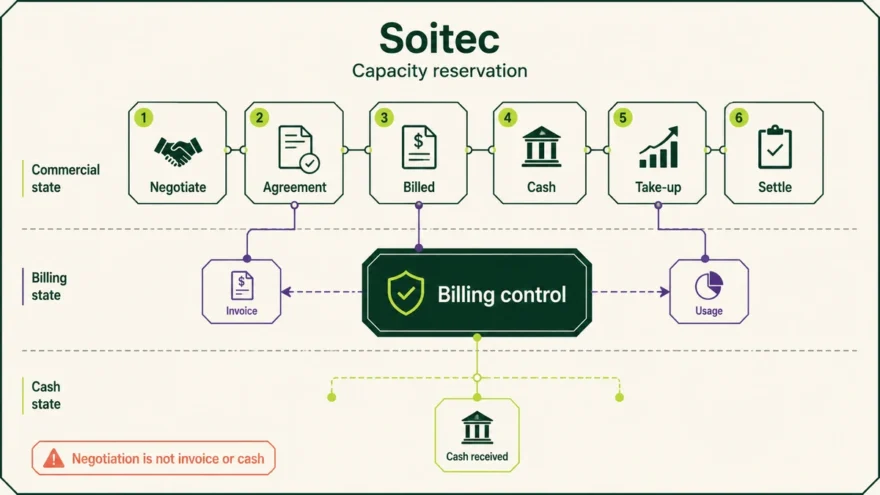
Enterprise billing software is not simply invoicing software that handles more customers. It is the operating layer that converts approved commercial terms, usage or fulfilment evidence, customer and legal-entity data, tax inputs and pricing rules into invoices, credits, payment status and finance-system records. The evaluation therefore has to follow the whole transaction, not stop when a sample PDF looks correct.
A platform can handle a standard subscription and still fail when an amendment is backdated, usage arrives late, a parent pays for subsidiaries, tax is corrected, or a finalized invoice must be credited without breaking receivables and revenue records. The useful question is which product can execute the enterprise’s real scenarios, explain every amount and preserve controlled handoffs. Disputed and aged balances then pass to accounts receivable collections software.
Quick answer
Weak billing lineage moves pricing, usage, tax, credit and accounting exceptions into disputes, manual journals and delayed close work.
Decision: Approve a shortlist and implementation only after each platform passes representative contract, amendment, global-operation, integration and close-acceptance tests.
Key takeaways
- Use the dated product map to choose an architecture class; the named platforms are examples, not a ranking.
- Evaluate billing archetypes and exception paths with representative contracts, not yes-or-no feature responses.
- Require effective-dated lineage from contract, usage and price versions through invoices, credits, receivables and accounting outputs.
- Test CPQ, tax, payment, collections and revenue-recognition boundaries because a product label does not establish system ownership.
- Make migration, reconciliation, access, change control and exception ownership part of product acceptance.
What enterprise billing software must control
Enterprise billing software is a configurable system for calculating and issuing complex customer charges across recurring, usage-based, one-time and contract-driven models while maintaining the data and statuses needed by accounts receivable, payments, collections, tax, revenue accounting and the general ledger. Vendor definitions commonly include invoicing, payments, collections, tax, revenue recognition, global currencies and enterprise integrations; Zuora’s enterprise-billing category definition is one company-stated example of that broad scope.
That breadth creates a boundary problem. The platform may own charge calculation and invoice lifecycle while another system owns the signed contract, tax determination, payment execution, open receivable, revenue schedule or posted journal. A candidate should therefore identify three distinct outputs for each scenario:
- Commercial calculation: the quantity, rate, tier, discount, minimum, credit and effective-dated rule that produced the charge.
- Customer document: the legal seller, bill-to party, invoice number, date, currency, tax, payment terms, line detail and delivery status.
- Finance record: the receivable, credit, cash status, revenue input, accounting dimensions, posting batch and reconciliation evidence.
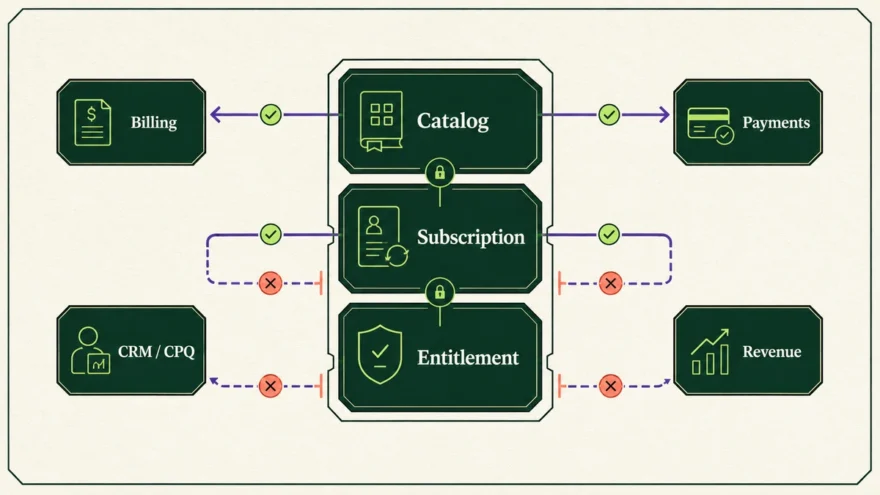
The system boundary should be decided at the object and lifecycle-state level. A suite can contain several of these functions, and a specialist can own one calculation domain, but neither arrangement removes the need for one authoritative owner and a traceable handoff. The finance technology stack boundary model provides the wider architecture test.
Enterprise billing platform map as of 18 August 2026
This neutral map groups products by the center of gravity documented in official vendor material. It is not a ranking or an exhaustive directory, and the segments overlap. Use it to decide which architecture class deserves testing, then apply the same transaction pack and evidence requirements to every candidate.
| Primary segment | Platform | Documented center of gravity | Finance boundary to verify |
|---|---|---|---|
| Subscription and recurring billing | Zuora Billing | One-time, recurring, usage-based and hybrid charges, plus account hierarchies and integrations. | Which modules own tax, payments, collections, revenue and ERP posting. |
| Chargebee Billing | Customer subscriptions built from plans, add-ons, charges, discounts and invoices. | Business-entity routing, contract changes and downstream accounting ownership. | |
| Maxio Advanced Billing | Recurring, usage and multi-attribute rated pricing with payment-gateway collection. | Entity, tax, revenue, collections and ledger scope. | |
| Stripe Billing | Subscriptions, recurring payments, custom pricing, usage tracking and invoicing. | Tax, revenue schedules, collection cases and ERP posting. | |
| Usage-based or API-native billing | Orb | Events, metrics, plans, subscriptions, invoices, credits and collection functions. | Late-event corrections, issued invoices and payment or ERP ownership. |
| Metronome | Usage events, billable metrics, rate cards, contracts and invoice generation. | Legal-entity, tax, collection, revenue and ledger integrations. | |
| Stigg | Product catalog, meters, entitlements, subscriptions, credits and usage pricing. | Entitlement-only and external-billing modes require an explicit invoice owner. | |
| Broader ERP-connected enterprise billing | BillingPlatform | Metadata-driven SOAP and REST interfaces for rating, billing and finance-system connections. | Whether AR, general-ledger and revenue modules are authoritative. |
| NetSuite SuiteBilling | Subscriptions, price books, usage rating, change orders and billing accounts in NetSuite. | Physical-goods limits, revenue integration and multi-entity configuration. | |
| ZoneBilling for NetSuite | Usage, subscription and project billing, amendments and Salesforce-to-NetSuite flows. | Company-stated connector scope versus tested close and reconciliation evidence. |
Where billing ends and adjacent systems begin
Suite names can combine several functions, but selection still requires one owner for each object and lifecycle state. The following boundaries use product-specific documentation as evidence of the handoff pattern, not as a universal architecture.
| Adjacent system | Typical ownership boundary | Acceptance evidence |
|---|---|---|
| Configure, price, quote (CPQ) | CPQ owns the approved quote and commercial terms; billing receives the accepted order or subscription. Chargebee’s quote-conversion documentation shows one product-specific handoff. | Quote version, approvals, conversion ID and field-by-field carryover. |
| Tax engine and electronic invoicing | The tax service owns determination, commit or cancel status and jurisdiction rules; billing supplies entity, customer, product and location data. | Tax-engine request and response evidence, exemptions, document ID and correction path. |
| Payments | The payment service owns authorization, capture, failure, refund and settlement states; billing owns the invoice and amount due. | Payment-attempt history, invoice mapping, fees, payout and bank reconciliation. |
| Collections | Billing may own reminders and retries; a collections system can own delinquency strategies, promises, disputes and activities. | Collections case-state evidence, status sync, named owner and hold or release rules. |
| Revenue recognition | Revenue systems apply accounting policy, allocation and schedule logic; billing supplies contracts, service or usage evidence, invoices and credits. | Policy-controlled recognition evidence, accepted and rejected records, schedules and journals. |
Recent Finance Circuit reporting shows the control consequences without turning the map into an endorsement. The usage-to-settlement control file follows usage, rating and promotions into invoices, payments and settlement. The usage-to-payout system-of-record analysis separates customer credits and invoices from provider liabilities and payouts. The customer-prepayment control file keeps commitments, billing documents, cash, deferred revenue and earned revenue in distinct states.
Build the evaluation around billing archetypes, not feature lists
Start by grouping the enterprise’s contracts into billing archetypes. A single customer can use more than one: a recurring platform fee, usage overages, a one-time implementation milestone and a prepaid credit pool may all appear in the same commercial relationship. Each archetype has a different source event and correction risk.
| Archetype | Primary billing input | Calculation test |
|---|---|---|
| Recurring | Subscription, quantity, billing period and price phase | Renewal, proration, ramp, add-on, cancellation and mixed frequency |
| Usage-based | Accepted meter or operational event | Aggregation, tiering, threshold, minimum, dimension and rounding |
| Contract or milestone | Approved milestone, delivery, time, cost or schedule | Fixed amount, time and materials, unit rate, milestone and retention |
| Hybrid | Combination of subscription, usage, minimums and credits | Order of operations across base fee, commitment, overage, discount and credit |
Each archetype carries a different correction risk, so the evidence retained must match the way the charge was built.
| Archetype | Correction risk | Minimum retained evidence |
|---|---|---|
| Recurring | Wrong effective date or stale subscription phase | Contract and subscription version, period, price, proration basis and invoice link |
| Usage-based | Late, duplicate, missing or corrected events | Source event ID, timestamp, customer, metric, quantity, version and adjustment reference |
| Contract or milestone | Change order, hold, partial acceptance or backdated rate | Contract line, approval, fulfilment evidence, effective date and billing-plan version |
| Hybrid | Double charging, incorrect carryover or credit consumption | Calculation sequence, component lineage, credit ledger and consolidated invoice trace |
For every archetype, add the exception path before scoring products. A feature is not demonstrated until the vendor shows what happens after a late event, rejected tax response, expired card, contract amendment, account transfer, duplicate API call or closed accounting period.
Test recurring, usage-based and contract billing
Recurring and ramped subscriptions
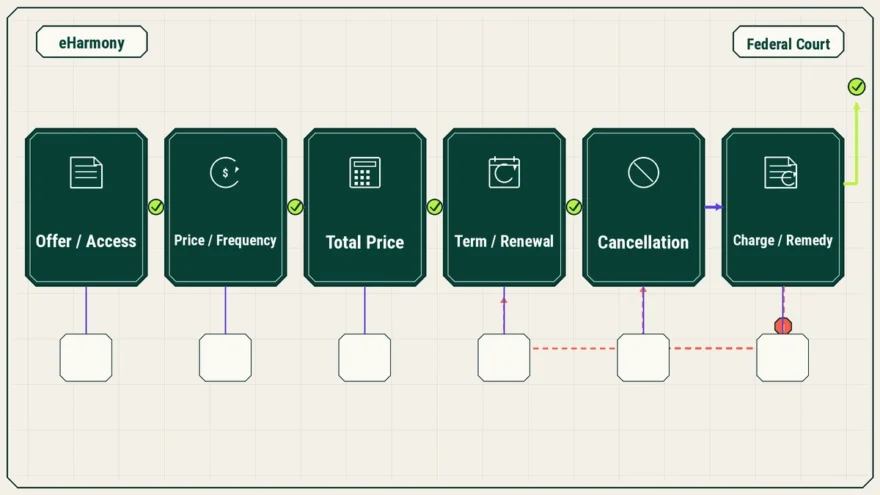
Test recurring billing with a promotional phase, scheduled price increase, midterm add-on, quantity change, renewal uplift and effective-dated cancellation. Require the source version, proration method, invoice-line construction and downstream adjustment. Each of those is a change to the subscription record before it is a billing input, so where the subscription record should be authoritative is settled first. The offer-to-charge control lessons from the eHarmony ruling add a precondition: displayed plan, total price, renewal term and cancellation state must agree with the subscription record before charge release.
Official subscription-schedule documentation illustrates why phase logic matters: schedules can define future changes, upgrades, downgrades and backdated starts. That establishes a capability pattern, not universal behaviour. The proof of concept must show how the candidate handles the enterprise’s day-count convention, time zone, partial period, mixed frequency, price approval and renewal rule.
Usage-based and event-driven charges
Usage billing begins before rating. The enterprise first needs to know which operational event is billable, who owns it, how it is identified, and when it becomes accepted. The event record should carry a stable ID, customer and product identifiers, event time, quantity, unit or dimension, source, ingestion status and any replacement reference.
Run four event tests: an exact duplicate, an event received after cut-off, a replacement event and a partly rejected batch. Require the rated result, affected invoice or credit, customer explanation and audit trail. Orb’s backfill and event-amendment guidance shows that correction support can depend on the period, credit model and invoice state.
Contract, milestone and hybrid terms
Contract billing can be driven by time and materials, unit rates, fixed schedules, delivery evidence, percentage completion or approved milestones. The system should keep the signed commercial terms, billing plan and fulfilment evidence separate while linking them to the invoice calculation. Where percentage completion drives the billing, the separate question of how progress is measured on the revenue side belongs to the project records rather than the billing platform.
An Oracle milestone-billing example bills predetermined amounts when milestones are completed while recognizing revenue by a different method. The example reinforces an important selection boundary: billing timing and revenue timing can diverge. A billing platform must preserve the inputs and outputs needed by the accounting policy, but a product label does not determine the accounting conclusion.
Use a hybrid scenario with a monthly fee, annual minimum, tiered overage, prepaid credits and year-end true-up. Require the calculation order, credit expiry or carryover, consumption priority, negative-usage treatment and presentation on the invoice and accounting export.
Test amendments, backdating, credits and rebills
Backdating is not a single feature. It is a coordinated change to commercial effective dates, billing periods, historical quantities, tax, invoice state, customer balance, accounting date and possibly a closed period. The test should begin with a specific timeline.
Create a contract effective 1 January, finalize the January invoice on 31 January, approve an amendment on 12 February effective 15 January, then correct usage on 18 February. Require the old and new contract versions, recalculation delta, customer-document path, tax, payment or refund effect, receivables entry, revenue handoff and journal outcome.
Oracle’s documentation on contract bill-rate amendments shows one system marking transactions on or after an amendment’s effective date for adjustment processing. The important evaluation point is not to assume every product works that way. It is to make the effective-date rule and adjustment population visible and testable.
| State | Expected correction path | Evidence to inspect | Failure signal |
|---|---|---|---|
| Draft invoice | Recalculate or regenerate under the approved version | Before-and-after calculation, approval and draft history | Original inputs disappear or the change has no approver |
| Finalized and unpaid | Controlled revision, credit and rebill, or allowed adjustment | Original invoice, linked correction, customer notice and open-item update | The finalized document is silently overwritten |
| Paid | Credit note linked to refund, customer credit or approved external settlement | Credit reason, payment reference, balance movement and accounting entry | Cash refund and account credit can both remain active |
| Closed period | Current-period correction or controlled reopen under policy | Accounting date, period status, approval and reconciliation impact | The billing system posts into a closed period without an exception |
Stripe’s credit-note lifecycle is one documented model: a credit note reduces a finalized invoice and, for a paid invoice, can lead to a refund, future customer credit or an externally handled credit. The candidate’s proof should cover the equivalent economic outcomes and prevent duplicate relief.
Test legal entities, currencies, tax and customer hierarchies
Legal-entity and currency boundaries
Multi-entity support should be tested as legal and accounting separation, not as a reporting filter. For each seller, identify the invoice issuer, numbering sequence, tax registration, bank or payment account, base currency, accounts-receivable book, chart-of-accounts mapping, document template, close calendar and data-access boundary.
Product configuration can mix inherited and entity-specific settings. Chargebee’s multi-business-entity routing documentation, for example, describes site-level payment-gateway configuration with entity-level routing overrides. A buyer should map every setting that is global, inherited, optional or isolated and then test whether a change for one entity affects another.
Keep transaction, functional, settlement and reporting currency distinct. Test the exchange-rate source and date for invoices, tax, revenue inputs, payments and reporting, plus rounding and later credits. Chargebee RevRec’s multi-currency boundary leaves non-revenue foreign-exchange effects to the accounting system. Every candidate should state that ownership explicitly.
Tax and electronic-invoicing ownership
Tax testing should begin with data ownership: legal seller, customer location evidence, ship-to or service location, product or tax code, exemption certificate, registration scope, tax-inclusive or exclusive price, tax date, currency and document status. Then test calculation, commit, cancellation, credit, refund, tax-only adjustment and override approval.
Avalara’s tax correction workflow distinguishes the original invoice date used for refund tax calculation from the current refund document date and includes credit memos, tax-only adjustments and controlled overrides. The enterprise should require equivalent evidence regardless of which tax engine is selected.
Electronic-invoicing rules vary by jurisdiction and can change. Separate tax calculation from legal-document generation, government clearance or reporting, delivery, acknowledgement, archive and correction. Confirm the provider and legal entity for each step, then obtain specialist review.
Customer, payer and service hierarchies
A corporate relationship may contain sold-to, bill-to, payer, service, usage and statement accounts that do not share one hierarchy. Oracle Billing and Revenue Management documentation on account and bill-unit hierarchies shows that organizational parent-child relationships can differ from the units that actually pay charges.
Test a parent that pays some child accounts while other children pay themselves. Add separate purchase-order requirements, credit limits, invoice currencies, tax treatment, consolidated statements, shared discounts and a mid-period transfer between payers. The system should preserve historical payer responsibility, open items and document delivery rather than rewriting prior invoices under the new hierarchy.
Verify revenue-recognition, payments, collections and ledger handoffs
Revenue-recognition handoff
Billing and revenue recognition share contract and transaction data, but they answer different questions. The IFRS Foundation’s IFRS 15 contract-revenue principle ties recognition to the transfer of promised goods or services and the consideration expected in exchange. Invoice timing by itself does not establish that conclusion.
The accounting handoff should carry stable contract and line identifiers, version and modification date, service period, billing event, invoice and credit references, price inputs, allocation attributes where needed, fulfilment or usage evidence, currency, legal entity and posting status. Finance must identify rejected records and replay them without duplicate schedules or journals. The accounting-policy owner remains responsible for ASC 606 or IFRS 15 conclusions.
Payments and collections
Separate invoice status from payment authorization, capture, receipt, settlement and cash application. The proof of concept should include automatic card collection, bank transfer, partial payment, multiple payments, failed payment, retry, payment-method update, refund, chargeback, unapplied cash and payment received for the wrong customer. The last two scenarios carry most of the downstream risk, and unapplied cash and exception disposition explains why unidentified, unapplied and on-account balances need separate owners and ageing.
Automated recovery is only one part of collections. Stripe documents automatic payment retries, but an enterprise still needs rules for customer segment, amount, dispute, promise to pay, service hold, escalation, write-off and reactivation. Each payment and collection status must return to the open receivable with a named exception owner.
Receivables and general-ledger reconciliation
Every billing batch or interface should provide accepted and rejected record counts, totals by entity and currency, invoice and credit amounts, tax, accounting date, posting batch and journal reference. A technically successful API response is not enough if the receivables subledger or ledger is incomplete.
Oracle describes its Receivables-to-General-Ledger reconciliation report as the primary tool for that product’s receivables-to-ledger comparison. The broader requirement applies across architectures: finance needs a repeatable subledger-to-ledger reconciliation and an ageing process for differences. The order-to-cash handoff map shows how billing, receivables, collections, cash application and close evidence connect.
Evaluate APIs, integrations, security and operating controls
Score integrations from an object map, not a connector count. For each customer, contract, subscription, usage, price, invoice, credit, payment, tax, receivable and journal object, record authority, cross-system key, trigger, timing, acknowledgement, retry, reconciliation and exception owner. The finance systems integration controls provide the fuller design.
Demonstrate duplicate, delayed, out-of-order, partly accepted and replayed messages. Stripe’s idempotent-request guidance and duplicate webhook-event guidance illustrate controls that must be verified in the candidate’s APIs and the enterprise integration layer.
| Control area | Evidence to inspect | Test to perform |
|---|---|---|
| Access and segregation | Role matrix, single sign-on, multi-factor authentication, privileged access and periodic review export | Attempt conflicting price, invoice, credit, refund and journal actions with separated roles |
| Configuration change | Version history, approver, effective date, deployment record and rollback path | Change a rate, tax mapping and invoice rule in a non-production environment, then promote it |
| Invoice finalization | Approval state, immutable document ID, delivery record and correction linkage | Finalize, deliver, credit and rebill without overwriting the original |
| Interface completeness | Counts, amounts, accepted and rejected statuses, retry log and reconciliation report | Interrupt a batch, replay it and prove no invoice or posting is missing or duplicated |
| Security and resilience | Current assurance report, subprocessor list, encryption statement, backup evidence, recovery objectives and incident process | Review scope, exceptions and customer responsibilities with security and risk owners |
Do not treat a certification logo as proof that the configured billing process is controlled. Assurance scope, complementary customer controls, excluded services and report period matter. The enterprise must also own user administration, integration credentials, configuration approvals, monitoring and evidence retention.
Measure implementation and migration complexity
Implementation effort is determined by the gap between the target operating model and the candidate’s standard data model, configuration, integrations and control evidence. Ask each vendor to estimate and separately price five workstreams:
- Commercial model: catalog, pricing, contract versions, billing schedules, usage metrics, credits and customer hierarchy.
- Finance design: entities, currencies, tax, invoice formats, receivables, revenue inputs, account mapping, close and reporting.
- Integration: CRM, contract, product, usage, ERP, tax, payment, collections, data platform and identity services.
- Migration: customers, contracts, subscriptions, open invoices, credits, payment tokens, usage history, tax evidence and opening balances.
- Operating model: roles, approvals, exception queues, support, release governance, reconciliation, training and first-close ownership.
Separate platform fees from charges for events, invoices, APIs, payments, tax, electronic invoicing, environments, storage and support. Add partner and internal labour, custom code, data cleansing, parallel run, audit support, later changes and exit costs. Negotiated price, staffing and delivery time remain not disclosed until a vendor provides a scoped proposal.
Migration acceptance should fix the population and cut-off, preserve source identifiers, reconcile opening balances, identify in-flight invoices and payments, and run old and new calculations in parallel. Set tolerances by record count, quantity, currency, rated amount, tax, invoice total, credit balance, open receivable and journal. Every difference needs an owner, age, disposition and approval.
Run a proof of concept and set approval criteria
A useful proof of concept is a controlled transaction test, not a guided product tour. Give every shortlisted vendor the same anonymized scenario pack, expected result format and evidence requirements. Do not allow a vendor to replace a difficult scenario with a simpler demonstration.
| Requirement | Test transaction | Expected result |
|---|---|---|
| Recurring ramp | Three price phases, quantity change and renewal uplift | Correct periods, prorations and future schedule |
| Usage correction | Duplicate, late and replacement events across cut-off | One accepted quantity and controlled delta |
| Backdated amendment | Prior-period rate change after invoice finalization | Effective-dated recalculation and allowed correction path |
| Global operation | Two sellers, three currencies, tax exemption and parent payer | Correct entity, document, currency, tax and payer |
| Credit and payment | Paid invoice, partial credit, refund and remaining customer credit | One economic outcome with matched cash and balance |
| Revenue and ledger | Milestone invoice with a different revenue pattern | Complete accounting input and balanced posting handoff |
| Interface failure | Timeout, partial batch, duplicate webhook and replay | No lost or duplicated finance event |
| Migration | Opening contracts, invoices, credits and in-flight usage | Reproducible opening position and parallel-run match |
Record the evidence, failure signal and accountable owner for each test in the same run.
| Requirement | Retained evidence | Failure signal | Owner |
|---|---|---|---|
| Recurring ramp | Contract version, calculation trace and invoice lines | Manual rate repair or unclear phase precedence | Billing operations |
| Usage correction | Event log, rejection, backfill and invoice or credit link | Duplicate charge or missing historical correction | Product operations and billing |
| Backdated amendment | Old and new versions, approval, credit or rebill and accounting date | Finalized invoice overwritten or closed period bypassed | Commercial operations and controllership |
| Global operation | Entity configuration, tax response, hierarchy and posting | Cross-entity data leakage or wrong legal seller | Billing, tax and regional finance |
| Credit and payment | Credit note, payment reference, refund and customer ledger | Duplicate relief or unexplained open balance | AR and payments |
| Revenue and ledger | Contract line, service period, invoice, schedule input and journal ID | Invoice date drives revenue without policy-controlled inputs | Revenue accounting and controller |
| Interface failure | Idempotency key, statuses, retry log and reconciliation | Success status without business acceptance | Finance systems |
| Migration | Population, control totals, differences, approvals and rollback | Unreconciled spreadsheet adjustments | Program lead and controllership |
Make some criteria pass or fail rather than weighted preferences. A candidate should not proceed when it cannot reproduce an invoice line from source evidence and an approved rule version, preserve finalized documents, isolate legal entities, govern late and duplicate usage, return accepted and rejected interface totals, or retain an auditable configuration history.