This guide covers automation inside a company’s corporate treasury function. It does not cover a bank’s own balance-sheet treasury or asset-liability management, rank treasury management systems (TMSs), or compare liquidity management software.
Corporate treasury automation is often treated as a software purchase. The harder work is deciding how money, data and evidence change state across banks, enterprise resource planning (ERP) systems, treasury applications and the general ledger. A fast interface does not help when treasury cannot tell whether a balance is current, a payment settled, or a hedge has the accounting record required by policy.
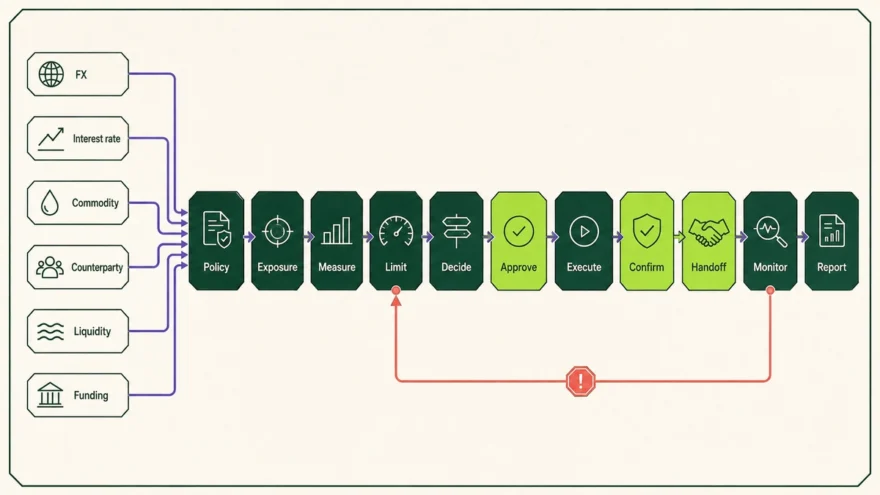
The useful design unit is the sequence of collection, calculation, recommendation, approval, release, external execution, accounting, reconciliation and exception resolution. Each stage needs a technical route, an authoritative system or evidence source, and a human owner.
Quick answer
Poorly bounded automation can move stale data or duplicate instructions, weaken approval evidence, and conceal liquidity, accounting or reconciliation breaks.
Decision: Choose which corporate treasury stages to automate, which approvals and exceptions need retained authority, and which system should own each stage.
Key takeaways
- Automation layers move data and instructions; treasury and finance systems own defined records; people retain policy, approval and exception authority.
- Bank data, payment status, settlement, accounting and reconciliation are separate evidence states even when one platform displays them together.
- Automate repeatable state changes, but keep judgment, overrides and irreversible authority explicit.
- Establish data completeness, identifiers and exception handling before adding rules that move money or execute financial trades.
Corporate treasury automation: scope, layers and ownership
Treasury automation is the controlled use of software, connectivity and workflow rules to collect financial data, calculate treasury positions, route decisions, issue approved instructions, record accounting results and resolve exceptions. The Association for Financial Professionals describes TMS scope as extending across cash, payments, foreign exchange (FX), debt, investments, accounting interfaces, bank access and reporting. Its technology-in-treasury overview also distinguishes bank portals, specialist applications, dedicated TMS platforms and ERP treasury capabilities.
Those categories describe tools, not ownership. Start with three separate questions:
| Decision layer | Typical components | What it should own | What it cannot establish alone |
|---|---|---|---|
| Automation and connectivity | APIs, SWIFT, host-to-host links, file transfer, integration platforms, schedulers and workflow rules | Transport, transformation, validation, routing, retries and technical status | Business authority, accounting treatment, usable liquidity or settlement |
| Treasury and finance systems | TMS, ERP treasury modules, payment hubs, cash platforms and specialist debt, investment or FX applications | Defined internal records, calculations and workflow states | Bank statements, counterparty confirmations or posted ledger entries |
| Human control ownership | Corporate treasurer, delegated approver, controller, accounting specialist, system owner and exception resolver | Policy, assumptions, limits, authority, overrides, exceptions and sign-off | Technical receipt, settlement or posting without authoritative evidence |
One product may contain several components, but accountability remains separate. An integration service may deliver a bank statement, a TMS may calculate the internal position, the statement remains external evidence, and the ERP ledger owns the posted journal. Finance Circuit’s finance technology stack reference architecture applies the wider rule: one authoritative owner per object and lifecycle state.
Map every treasury workflow through the same stages before comparing software:
| Stage | Automation role | Authoritative system or evidence |
|---|---|---|
| Collect | Import bank, ERP, market, trade and reference data; normalize and check totals. | Received source record retained without silently rewriting its meaning. |
| Calculate | Build positions, forecasts, exposures, interest schedules, valuations and proposed journals. | Named TMS, ERP or specialist record with versioned inputs. |
| Recommend | Propose transfers, funding, investments, hedges or exception dispositions. | Proposal record that remains distinct from approval and execution. |
| Approve | Route work by amount, entity, account, instrument or risk threshold. | Workflow record with an immutable approval trail. |
| Release | Create and transmit a permitted payment, transfer or trade. | One designated releasing system for each instruction type and channel. |
| Execute and settle externally | Receive acknowledgements, confirmations and settlement messages. | Bank, infrastructure or counterparty evidence. |
| Account | Generate proposed entries, apply mappings and send journals. | General ledger for the posted accounting state. |
| Reconcile | Match bank, treasury and ledger records under approved rules. | Reconciliation record linking both sides and the match decision. |
| Resolve exceptions | Create cases, route by cause and age, and block false completion. | Owned exception queue with current state and retained evidence. |
Each stage above still needs a named human control owner and a defined evidence minimum.
| Stage | Human control ownership | Minimum evidence |
|---|---|---|
| Collect | Approve sources, account perimeter, cut-offs and fallback methods. | Source ID, timestamp, sequence or total, account coverage and load status. |
| Calculate | Approve formulas, assumptions, tolerances and model changes. | Input lineage, rule version, calculation time and reproducible output. |
| Recommend | Accept, amend or reject under policy. | Decision basis, limit checks, alternatives and reviewer identity. |
| Approve | Exercise delegated authority and maintain approval rules. | Approver, role check, timestamp, approved version and any conditions. |
| Release | Approve release rules, emergency procedures and permitted routes. | Stable instruction ID, release event, channel and payload version. |
| Execute and settle externally | Investigate uncertain, rejected or out-of-policy outcomes. | External ID, acceptance or rejection, confirmation and settlement status. |
| Account | Own accounting policy, mappings, posting rules and review. | Journal ID, source transaction, posting status and approver where required. |
| Reconcile | Approve tolerances, review ambiguous matches and sign off completion. | Match rule, items compared, differences, reviewer and closure evidence. |
| Resolve exceptions | Assign resolver, deadline, escalation and permitted corrective action. | Reason code, owner, actions, attachments and final disposition. |
Automate bank data and the daily cash cycle
Bank data, cash position and liquidity
Bank-data automation should begin with coverage and evidence, not a dashboard. Inventory each bank, entity, account, currency and reporting channel. For every flow, record delivery time, message or file type, balance semantics, detail, cut-off and fallback.
SWIFT’s corporate ISO 20022 guidance identifies payment initiation and status messages such as pain.001 and pain.002 separately from cash-reporting messages such as camt.052, camt.053 and camt.054. Its CGI message working groups likewise separate payment and bank-reporting functions. A statement is not a payment acknowledgement, and a transaction notification is not automatically a complete prior-day statement.
The automation layer should check file or message identity, sequence, duplicate receipt, expected-account coverage, opening-to-closing balance logic, currency, record counts and value totals before data enters a consolidated position. Missing or late accounts should create visible exceptions. The corporate treasury bank-connectivity guide goes deeper on choosing APIs, SWIFT, host-to-host or a mixed route for each balance, statement, payment and acknowledgement flow.
A cash-position system can combine reported balances, known flows, pending transfers, restricted cash and approved adjustments. It should show the source and age of each component. The treasurer still judges usable cash, restrictions, minimum balances and movements across policy thresholds.
Do not mix observed balances with forecast items without labels. A cash position is a point-in-time view. A forecast is a model of future cash. Both may appear on one screen, but each amount should remain traceable to a bank record, ERP document or documented assumption.
Forecasting, reconciliation and daily exceptions
Automate forecast inputs, roll-forwards, currency translation, variance calculations and version retention. Keep assumptions, one-time items, scenario selection and challenge under named ownership. No model can repair missing entities, inconsistent cut-offs or ownerless inputs.
For a short-horizon operating forecast, opening cash should tie to the agreed bank-data cut-off and cash perimeter. Finance Circuit’s controlled 13-week cash-flow forecast process covers source timing, assumptions, versions, variance review and sign-off in more detail.
Automated matching is suitable when keys, tolerances and permitted one-to-many or many-to-one patterns are defined. Exact matches can close without manual handling. Ambiguous matches, stale open items, unexplained bank charges, rejected payments and transactions without an expected ledger entry should enter an exception queue.
The queue needs value and age, not only item count. A small number of high-value or old exceptions may matter more than a large volume of routine timing differences. Evidence requirements should remain consistent across manual and automated work, as set out in Finance Circuit’s account-reconciliation control standard.
Automate payments, liquidity, debt and investments
Payments, sweeps and intercompany funding
Payment automation can assemble validated instructions from approved sources, apply account and beneficiary controls, route approvals, transmit files or messages, receive status updates and feed settlement evidence into reconciliation. It should not collapse approved, sent, received, accepted, rejected, settled and reconciled into one completed flag.
Each status answers a different question. An accepted instruction may not have settled, a settled transaction may not have posted, and a timeout may conceal bank receipt. The finance systems integration state map explains why receipt, acceptance, posting, settlement and reconciliation need separate controls.
Retry logic is especially sensitive when money moves. Microsoft’s retry-pattern guidance warns that repeating a non-idempotent operation can execute it more than once when the first request succeeded but its response was lost. Use a stable instruction identifier, check the external status before resubmission and route uncertain outcomes to investigation instead of repeating them blindly.
Rules can propose or execute sweeps and transfers against approved targets, structures, cut-offs and entity funding rules. Straight-through execution fits repetitive movements inside a fixed perimeter. New accounts, currencies, limit breaches, missing sources or changed tax or legal assumptions should stop the rule.
Intercompany funding creates both cash and accounting states. The payment instruction, intercompany position, interest calculation, settlement and journal should share identifiers. A bank-confirmed transfer is not proof that the intercompany accounting is complete.
Debt and investment workflows
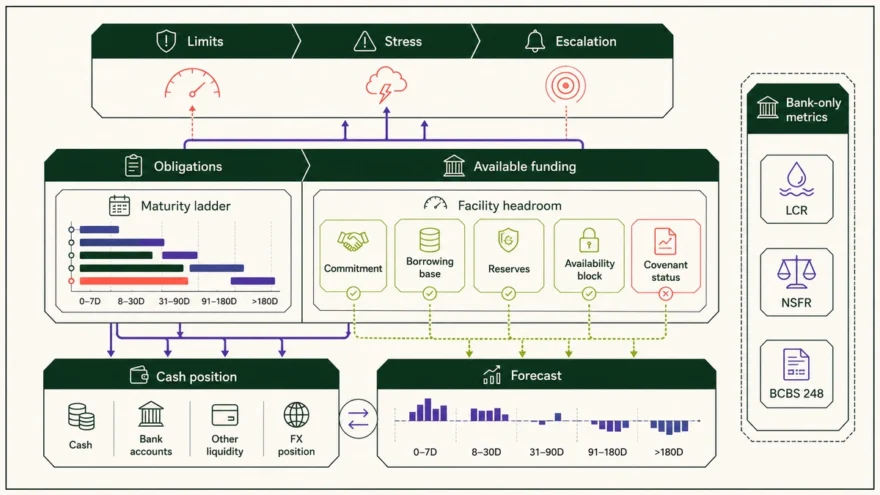
Automate debt schedules, interest calculations from approved terms, payment alerts, maturity ladders, covenant inputs and proposed instructions. Retain authority for financing choices, amendments, waivers, refinancing and contract interpretation. Link each amount to the facility, rate source, reset period and approval.
Covenant automation can identify the source period, definition and adjustment policy used, then flag a potential breach or missing input. It should not convert an incomplete calculation into a compliance conclusion.
A live Finance Circuit treasury-news example shows why debt automation needs explicit stages. The Alphabet Australian-dollar bond mandate analysis separates mandate, launch, pricing, allocation, settlement, fees, currency treatment and usable cash. The example is historical and transaction-specific, but the control lesson is durable: a proposed or priced borrowing is not settled liquidity.
For corporate liquidity investments, software can apply approved instrument, tenor, counterparty, concentration and maturity rules; build proposals; route trade approval; collect confirmations; and update the cash forecast. A person with delegated authority should approve trades and policy exceptions. This is an operating-control design, not an investment recommendation.
Investment accounting should remain linked to the executed instrument, settlement, accrued income, valuation source and maturity. A trade ticket and a journal are different records even when one system creates both.
Automate FX, hedges and treasury accounting
Exposure capture, netting and hedge execution
FX automation can collect exposures from receivables, payables, purchase commitments, forecast cash flows and balance-sheet positions; translate them using approved market data; group them by entity, currency and horizon; and apply documented netting rules. Treasury should be able to trace a net exposure back to its components and identify excluded, late or disputed inputs. Which exposures enter that collection at all, and the netting and limit rules applied to them, are set upstream in the treasury risk framework those rules implement. Collection is only half the requirement, so specify what the collecting system must hand to the system that executes before the design is fixed.
The system may compare the exposure with policy limits and produce a hedge proposal. The proposal is not an approved hedge. Treasury retains judgment over forecast confidence, natural offsets, timing, instrument choice, tenor and counterparty allocation. Whether the resulting designation and effectiveness test can be evidenced is a separate hedge accounting software question.
Design the hedge workflow as linked states:
- Record the exposure and its source.
- Apply approved netting and policy tests.
- Create a proposal with instrument, amount, tenor and rationale.
- Obtain the required approval before execution.
- Transmit or enter the trade and capture the counterparty confirmation.
- Match economics, dates and identifiers between the internal trade and confirmation.
- Send approved data to valuation, cash forecasting and accounting, while unresolved breaks remain open.
Accounting designation and documentation should remain a separate controlled state. FASB’s summary of Accounting Standards Update 2017-12 states that the amendments were intended to align hedge accounting more closely with an organization’s risk-management activities. That does not permit execution software to infer that every economic hedge qualifies for a particular accounting treatment. Policy ownership and technical accounting review remain necessary.
Valuation, accounting and reconciliation
Automate market-data ingestion, valuation runs, accrual calculations and proposed journals only after finance has approved the source hierarchy, valuation method, calendars, account mapping and posting rules. Record the data version and calculation time. When a rate or curve is missing, the process should identify the fallback used or stop rather than substitute an unknown value.
The treasury system may own trade economics and valuation detail. The bank or counterparty may provide confirmation and settlement evidence. The general ledger owns the posted accounting state. The automation layer connects these records, but it should not make one system appear authoritative for all three.
Reconciliation should identify differences in amount, currency, date, account, counterparty, instrument, journal or status and route each cause to the correct owner. A valuation break belongs with the valuation owner, a missing confirmation with treasury operations, a rejected journal with accounting, and an unexplained bank settlement with the relevant bank or transaction owner.
Build control ownership and exception handling into the design
Automation shifts work from routine entry to rule ownership, monitoring and exception resolution. An exception process is part of the operating model, not a fallback added after deployment.
Authority, access and evidence
NIST defines separation of duty as preventing one user from having enough privileges to misuse a system alone and notes that the control can be enforced through conflicting roles or at access time. In treasury, apply that principle across beneficiary or counterparty maintenance, payment or trade preparation, approval, release, accounting-rule maintenance and reconciliation sign-off.
System roles should reflect the company’s authority matrix. Review emergency access, service accounts and integration credentials as well as named users. A workflow that requires two approvals can still fail its control objective if one administrator can change roles, limits and beneficiary data without independent review.
Human control ownership must remain visible. Name who approves the rule, which threshold permits straight-through execution, who reviews overrides and who accepts final evidence. A system log proves an event occurred; it does not prove current-policy authorization.
Retries, duplicates and exception ownership
Every instruction needs a stable identifier across source, approval, transmission, acknowledgement, settlement and accounting. Design for timeouts after success, partial acceptance, duplicates, delayed statuses and out-of-order events. Define which events may be retried and which require an external check or investigation.
At minimum, each exception should record:
- the affected account, instruction, trade, journal or reconciliation item;
- the failed stage, reason code and last confirmed internal and external states;
- amount, currency, materiality and age;
- current owner, escalation deadline and permitted corrective actions;
- evidence attached, actions taken, final disposition and reviewer.
Dashboards should distinguish missing evidence from negative evidence. No rejection received is not the same as accepted, and no unmatched item found is not the same as proving that all expected accounts were loaded.
Closure should require evidence appropriate to the failed stage. A corrected payment file needs new approval and correlation to the rejected version. A journal repair needs the accepted posting ID. A stale bank feed needs restored account coverage and reconciliation, not only a closed incident ticket.
Choose the right treasury system architecture
Software selection should follow the stage and ownership map. The AFP treasury management system guide includes implementation, training, licensing, maintenance, transaction services and security in the cost decision. Product capability does not determine data or control ownership.
| Category | Use when | Ownership boundary to test | Documented examples |
|---|---|---|---|
| Bank portals and bank cash-management services | The company needs bank-specific reporting, approvals or execution and has a limited banking perimeter. | Multi-bank consolidation, consistent status evidence, ERP integration and cross-bank controls. | Evaluate each bank and flow rather than assume one portal covers the operating model. |
| ERP-native cash and treasury capabilities | The ERP is intended to own accounting, master data and much of the transaction lifecycle. | Depth of bank connectivity, position management, dealing, risk, hedge and specialist treasury controls. | SAP S/4HANA Cloud for treasury and risk management states support for FX, investments, borrowings, cash forecasting, payments and accounting. Oracle Fusion Cloud Financial Management states that cash, payments and accounting sit on a common finance foundation. |
| Dedicated treasury management system | Treasury needs multi-bank cash, payments, debt, investments, FX, risk and accounting in one specialist operating platform. | Implementation scope, data ownership, ERP handoffs, control configuration and total cost. | FIS states that Integrity covers cash positioning, forecasting, payments, FX, debt, investments and accounting. ION makes comparable company-stated claims for Reval. |
| Connectivity or payment hub | Multiple source systems need one controlled route to banks and consistent status handling. | Where payment approval occurs, how identifiers persist and which system owns settlement and reconciliation. | Assess bank reach, message support, security, signing, acknowledgements and fallback by flow. |
| Specialist cash, forecasting, risk or data application | A focused problem needs deeper capability or a different deployment path than the existing ERP or TMS provides. | Duplicate positions, conflicting forecasts, extra master data and unclear handoffs. | Trovata’s cash and treasury platform states that it uses normalized bank data across cash visibility, forecasting, payments and accounting workflows. |
| Integration, workflow and treasury-data layer | Existing systems remain authoritative but need orchestration, validation, monitoring and exception routing. | Custom-code ownership, idempotency, observability, security and long-term maintenance. | Confirm whether the layer should calculate, route or only transport; technical convenience does not grant business authority. |
This is not a TMS ranking. It also does not replace a dedicated liquidity management software comparison, which should assess cash-visibility coverage, forecast methods, scenario capability, liquidity actions, bank connectivity and implementation fit for that narrower buying decision. Nor does it set the limits that govern funding concentration, facility headroom and stress results, which a liquidity risk limit framework specifies separately.
The examples are company-stated capabilities, not verified customer outcomes. Confirm edition, geography, modules, bank coverage, connectivity, implementation scope, security and contract. Test the company’s own messages, accounts, approvals, exceptions and accounting outputs rather than a clean demonstration dataset.
Implement treasury automation in controlled waves
Deployment order should follow control dependency, not the order in which product modules are demonstrated. A practical sequence is:
- Wave 0: define ownership and control. Document the current and intended owner for every data object and status. Approve the account perimeter, legal entities, currencies, source hierarchy, cut-offs, authority matrix, limits, tolerances, accounting rules, evidence requirements and exception routes. Establish identifiers that persist across systems.
- Wave 1: establish bank data, positions and reconciliation. Connect priority accounts, prove completeness, expose source timestamps and build the daily position. Reconcile imported transactions and make missing accounts or late files visible. Do not add automatic money movement until the team trusts the input perimeter and can explain material breaks.
- Wave 2: add forecasts and decision support. Connect forecast drivers, retain versions and compare forecast with actual cash by source, entity, currency and horizon. Automate variance preparation while keeping assumption ownership and scenario approval visible.
- Wave 3: control payment and liquidity execution. Implement preparation, approval, transmission, status handling and settlement reconciliation. Then add rules-based sweeps or transfers within approved limits. Test duplicate prevention, timeout after success, partial rejection, cut-off failure, unavailable bank channels and emergency fallback.
- Wave 4: connect debt, investments, FX, hedges and accounting. Add specialist workflows after data, identity, approvals and exceptions work across the core cash cycle. Test each lifecycle from source exposure or contract through approval, execution, confirmation, valuation, journal and reconciliation. Obtain accounting or legal review where policy or contract interpretation is required.
Measure control coverage rather than activity alone. Useful candidates include expected-account coverage, age of the last successful bank message, cash-position adjustments, unmatched value and age, payment-status completeness, duplicate attempts blocked, forecast bias and variance, overrides by reason, unposted treasury journals and open exceptions past deadline. These are design measures, not universal benchmarks. Define the denominator, source and owner for each one.
Treasury automation approval checklist
- Is the scope explicitly corporate treasury, with bank treasury, TMS rankings and liquidity-software comparison excluded?
- Does each automation layer have a technical owner and a defined operating purpose?
- Does every object and lifecycle state have one authoritative system or external evidence source?
- Is a human control owner named for policy, assumptions, approvals, overrides and exceptions?
- Are banks, entities, accounts, currencies, cut-offs and fallback sources documented?
- Can users distinguish calculated, recommended, approved, transmitted, accepted, settled, posted and reconciled states?
- Are approval limits, separation of duties, service accounts and emergency access enforced and reviewed?
- Are retries safe, externally checked or routed to investigation?
- Do payment, debt, investment, FX and hedge records remain linked to settlement and accounting evidence?
- Do exceptions carry value, age, reason, owner, deadline, corrective action and closure evidence?
- Has the proof of concept used real account coverage, messages, failure cases and accounting outputs?
- Will implementation begin with bank-data completeness and reconciliation before automated movement of funds or trades?